
Futsal · Level 1: Beginner · Sub-level 1.3
Players, Substitutions and the Bench
10 tests · 100 facts · updated 15 October 2026 · markdown
This sub-level teaches who is on the court and who is off it — five players a side, one of them the goalkeeper, counted in the five and not extra, with a match abandoned if a team drops below three; rolling substitutions made on the fly through a team's own five-metre zone, unlimited in number, with the player coming on waiting until the one going off has left; the improper-substitution caution and the indirect free kick that follows; an outfield player changing places with the goalkeeper only during a stoppage with the officials told, the goalkeeper's freedom to play anywhere, and the flying goalkeeper as a tactic rather than a Law; the bench and the technical area, who may sit there and who answers for their conduct; playing short after a send-off, two minutes of playing time with an early return if the fuller team scores; how a substitution is completed with the bib; injured players and where they come back on; extra persons on the court; the team list and the captain's armband; and the substitutes who warm up and wait on the bench.
Each test below is ten questions on Insporta. The list under a test is what the questions check: one fact per question, with the source it was written from. Read it before the test, or come back from a wrong answer.
Test 1The five on court and the minimumTake a test
A team has at most five players on the court, and one of them must be the goalkeeper; every other position is a tactical choice.
Source: FIFA Futsal Laws of the Game 2025/26, Law 3.1 · recall
Three on the court is the floor for both sides; drop below it and the game cannot begin or go on.
Source: FIFA Futsal Laws of the Game 2025/26, Law 3.1 · recall
Once a team has fewer than three players, whether through send-offs or injury, the match is abandoned.
Source: FIFA Futsal Laws of the Game 2025/26, Law 3.1 · applied
Only players and substitutes named on the official team list before the match may take part; anyone else is an outside agent.
Source: FIFA Futsal Laws of the Game 2025/26, Law 3.2 · applied
The cap of five names a total headcount, not five outfielders plus a keeper, so whoever is guarding the goal uses up one of the five places.
Source: FIFA Futsal Laws of the Game 2025/26, Law 3.1 · recall
If a team has too many players on the court, play is stopped, the extra person leaves and is cautioned, and play restarts with an indirect free kick to the opponents.
Source: FIFA Futsal Laws of the Game 2025/26, Law 3.9 · applied
Nine named substitutes is the ceiling for official competition; other matches may use more if the teams agree beforehand and the referee is informed.
Source: FIFA Futsal Laws of the Game 2025/26, Law 3.2 · applied
Only a set number of team officials, named beforehand, may sit in the technical area with the substitutes; the number is fixed by the competition rules.
Source: FIFA Futsal Laws of the Game 2025/26, Law 3.3 · recall
Any of the team's players may take over in goal; the new goalkeeper must wear colours that set him apart from the others and the officials.
Source: FIFA Futsal Laws of the Game 2025/26, Law 3.4 · applied
Only the goalkeeper may handle the ball, and only inside his own penalty area; outside it he is treated like any other player.
Source: FIFA Futsal Laws of the Game 2025/26, Law 3.1 · recall
Test 2Rolling substitutionsTake a test
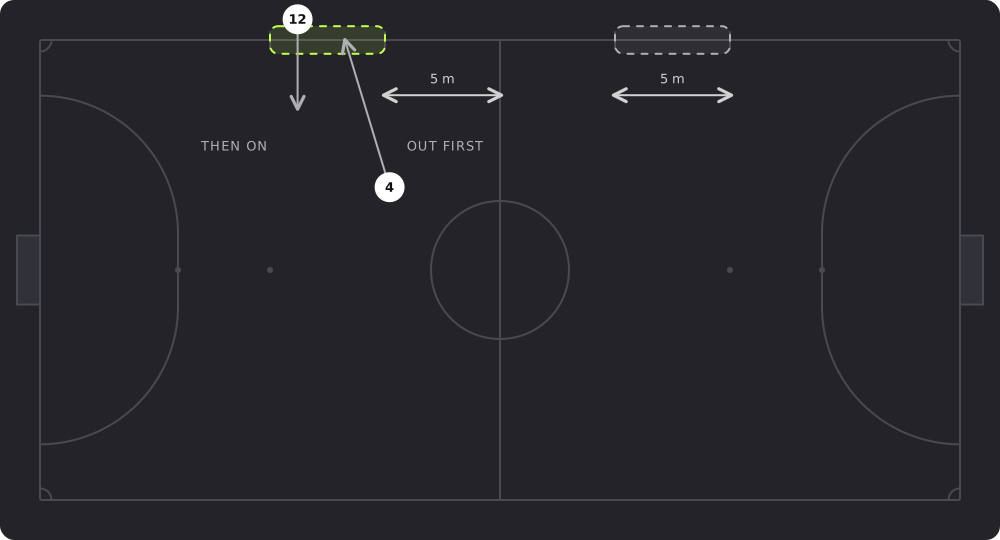
Futsal uses rolling substitutions: any number of them, made while the ball is in or out of play, and a player who has been substituted may come back on.
Source: FIFA Futsal Laws of the Game 2025/26, Law 3.3 · recall
There is no rule tying the two players to one exact point; both may cross anywhere within the zone's five-metre width.
Source: FIFA Futsal Laws of the Game 2025/26, Law 3.3 · recall
The substitute may only enter after the player being replaced has completely left the court, and he must enter through the substitution zone.
Source: FIFA Futsal Laws of the Game 2025/26, Law 3.3 · applied
Substitutions may be made whether the ball is in play or out of play; the restriction is on where players enter and leave, not on the moment.
Source: FIFA Futsal Laws of the Game 2025/26, Law 3.3 · applied
A player who has been substituted may come back onto the court later as a substitute himself; there is no rule keeping him off for the rest of the match.
Source: FIFA Futsal Laws of the Game 2025/26, Law 3.3 · applied
Rolling substitutions do not interrupt play; a change can be made as a restart is being taken, as long as players use the substitution zone.
Source: FIFA Futsal Laws of the Game 2025/26, Law 3.3 · applied
The incoming player waits until the outgoing player has left, so the team is never briefly six on the court during the change.
Source: FIFA Futsal Laws of the Game 2025/26, Law 3.3 · recall
Entering before the other player has left is an improper substitution: play is stopped, the player is cautioned, and the restart is an indirect free kick to the opponents.
Source: FIFA Futsal Laws of the Game 2025/26, Law 3.9 · applied
Both players in a change must use the team's own substitution zone; leaving over the touch line elsewhere is an infringement, cautioned like any improper substitution.
Source: FIFA Futsal Laws of the Game 2025/26, Law 3.9 · applied
Play restarts with an indirect free kick to the opposing team from where the ball was when play stopped; if that is inside the penalty area, it is taken from the six-metre line.
Source: FIFA Futsal Laws of the Game 2025/26, Law 3.9 · recall
Test 3Changing the goalkeeper and the flying goalkeeperTake a test
Any player may change places with the goalkeeper, but only when play is stopped and only after the referee has been informed.
Source: FIFA Futsal Laws of the Game 2025/26, Law 3.4 · recall
A goalkeeper change made during play, or without the referee knowing, is an infringement; the Law requires both a stoppage and prior notice.
Source: FIFA Futsal Laws of the Game 2025/26, Law 3.4 · applied
Swapping the goalkeeper for an outfield player lets a team attack five against four; the goalkeeper plays as a normal outfielder and keeps no handling rights away from his area.
Source: General futsal · recall
The flying goalkeeper is a tactic, not a Law of its own; it relies on the ordinary rules for changing the goalkeeper and making substitutions.
Source: General futsal · applied
With the goalkeeper committed upfield, a turnover leaves the net empty; the opposition can score from distance before he recovers, which is the price of the extra attacker.
Source: General futsal · applied
A player taking over in goal must wear colours distinguishing him from the outfield players, the opponents and the officials, just like any goalkeeper.
Source: FIFA Futsal Laws of the Game 2025/26, Law 3.4 · recall
The goalkeeper is not confined to any zone; he may move and play the ball anywhere, and often does so as a spare man in attack.
Source: FIFA Futsal Laws of the Game 2025/26, Law 3 · applied
A goalkeeper who controls the ball in his own half may not keep it for more than four seconds whether he uses hands or feet; exceeding that is an indirect free kick to the opponents.
Source: FIFA Futsal Laws of the Game 2025/26, Law 12 · applied
There is nothing in the Laws against scoring from long range in open play; a clearance that beats the unguarded net is a legitimate goal.
Source: FIFA Futsal Laws of the Game 2025/26, Law 10 · applied
When the change is noticed with the ball already out of play, the players are corrected and play resumes with the restart appropriate to why it stopped; a caution may still be given.
Source: FIFA Futsal Laws of the Game 2025/26, Law 3.9 · recall
Test 4The bench and team officialsTake a test
Substitutes and the named team officials occupy the bench in the technical area on their team's side of the court, behind the touch line.
Source: FIFA Futsal Laws of the Game 2025/26, Law 1.4 · recall
The senior team official present, normally the head coach, is responsible for the behaviour of everyone in the technical area.
Source: FIFA Futsal Laws of the Game 2025/26, Law 3.3 · recall
Team officials may give instructions but must remain within the bounds of the technical area; one who will not stay inside it can be warned and then dismissed.
Source: FIFA Futsal Laws of the Game 2025/26, Law 3.3 · applied
A team official guilty of misconduct is shown a yellow or red card; if the offender cannot be identified, the senior official in the technical area receives it.
Source: FIFA Futsal Laws of the Game 2025/26, Law 12 · applied
The Laws leave the maximum number of substitutes and officials on the bench to the competition rules, which vary by tournament.
Source: FIFA Futsal Laws of the Game 2025/26, Law 3.3 · recall
Substitutes and substituted players are subject to the same cautions and send-offs as players on the court; misconduct on the bench is punished in the same way.
Source: FIFA Futsal Laws of the Game 2025/26, Law 12 · applied
An official sent from the technical area takes no further part and is not replaced; the team continues with the officials it has left.
Source: FIFA Futsal Laws of the Game 2025/26, Law 3.3 · applied
A team official is any non-player named on the team list, such as a coach, fitness or medical staff; they occupy the technical area but take no part in play.
Source: FIFA Futsal Laws of the Game 2025/26, Law 3 · recall
Two staff standing and coaching at once breaks the rule of a single standing instructor on each bench; the rest stay seated.
Source: FIFA Futsal Laws of the Game 2025/26, Law 3.3 · applied
Extra time is a continuation of the match; substitutes and officials remain available under the same conditions, though no timeout may be taken.
Source: FIFA Futsal Laws of the Game 2025/26, Law 7 · recall
Test 5Playing short after a send-offTake a test
After a send-off the team is reduced by one for two minutes of playing time, timed by the timekeeper, before a substitute may take the sent-off player's place.
Source: FIFA Futsal Laws of the Game 2025/26, Law 3.8 · recall
If the team with more players scores while the other is short, the short-handed team may immediately restore its numbers; the remaining reduction time is cancelled.
Source: FIFA Futsal Laws of the Game 2025/26, Law 3.8 · applied
The reduction ends early only when the team with more players scores; a goal by the short-handed team leaves the two minutes running.
Source: FIFA Futsal Laws of the Game 2025/26, Law 3.8 · applied
The timekeeper counts the two minutes in playing time, stopping the count whenever the match clock stops, so it is not two minutes on the wall.
Source: FIFA Futsal Laws of the Game 2025/26, Law 3.8 · recall
A dismissal before the whistle for kick-off simply costs the team that player; one of the named substitutes steps straight into his spot, so five still line up.
Source: FIFA Futsal Laws of the Game 2025/26, Law 3.7 · applied
A player who is sent off must leave the vicinity of the court and the technical area; he does not sit on the bench.
Source: FIFA Futsal Laws of the Game 2025/26, Law 12 · recall
Each send-off brings its own two-minute reduction, timed separately, so the team is two players short until the first reduction ends or the opponents score against it.
Source: FIFA Futsal Laws of the Game 2025/26, Law 3.8 · applied
While a team is short by two, a goal by the fuller team lets one player return; a further goal lets the next return, one for each concession.
Source: FIFA Futsal Laws of the Game 2025/26, Law 3.8 · applied
If the two minutes have not run out when the period ends, the remainder is served at the start of the next period; the reduction is not cancelled by half-time.
Source: FIFA Futsal Laws of the Game 2025/26, Law 3.8 · recall
A team must have at least three players on the court; a send-off that would reduce it below three ends the match.
Source: FIFA Futsal Laws of the Game 2025/26, Law 3.1 · applied
Test 6Completing a substitutionTake a test
The player being substituted leaves through his team's substitution zone without needing either referee's permission.
Source: FIFA Futsal Laws of the Game 2025/26, Law 3.4 · recall
The referees do not need to authorise the substitute; he enters through his own zone once the player being replaced has left.
Source: FIFA Futsal Laws of the Game 2025/26, Law 3.4 · recall
The substitute hands his bib to the player being replaced, who now becomes a substitute himself.
Source: FIFA Futsal Laws of the Game 2025/26, Law 3.4 · recall
If the player being replaced had to leave elsewhere for a reason allowed by the Laws, the substitute hands the bib to the third referee.
Source: FIFA Futsal Laws of the Game 2025/26, Law 3.4 · applied
A substitution is completed when the substitute fully enters the court through his own zone after handing over his bib. From then he is a player and 7 is a substitute.
Source: FIFA Futsal Laws of the Game 2025/26, Law 3.4 · applied
A substitute who has not completed the substitution cannot restart play with a kick-in, free kick, corner kick, penalty kick or goal clearance, or receive a dropped ball.
Source: FIFA Futsal Laws of the Game 2025/26, Law 3.4 · applied
Permission to go ahead with a substitution may be refused in some cases, for example if the substitute's equipment is not in order.
Source: FIFA Futsal Laws of the Game 2025/26, Law 3.4 · recall
The substitute becomes a player and the player replaced becomes a substitute, free to take further part in the match.
Source: FIFA Futsal Laws of the Game 2025/26, Law 3.4 · recall
The player being replaced leaves through the zone, the substitute hands him the bib, and the change is complete when the substitute is fully on the court.
Source: FIFA Futsal Laws of the Game 2025/26, Law 3.4 · applied
A substitute becomes a player when he completes his entry, and turns back into a substitute when he is himself replaced; he may go on again later.
Source: FIFA Futsal Laws of the Game 2025/26, Law 3.4 · applied
Test 7Injured playersTake a test
If a player is seriously injured the referees stop play and make sure he is removed from the court.
Source: FIFA Futsal Laws of the Game 2025/26, Law 5.3 · recall
An injured player, the goalkeeper included, may not be treated on the court, apart from a few listed exceptions.
Source: FIFA Futsal Laws of the Game 2025/26, Law 5.3 · recall
A treated player re-enters from his own team's substitution zone, and a team's zone is in the half it defends. White defend the right, so their zone is C; A is grey's zone and B the timekeeper's table.
Source: FIFA Futsal Laws of the Game 2025/26, Law 5.3 · applied
An injured player may return only after the match has restarted, and he comes back on through his team's substitution zone.
Source: FIFA Futsal Laws of the Game 2025/26, Law 5.3 · recall
A collision between players of the same team is one of the exceptions to the rule that an injured player must leave.
Source: FIFA Futsal Laws of the Game 2025/26, Law 5.3 · applied
A bleeding player must leave the court and may return only on a referee's signal, once the bleeding has stopped and there is no blood on his kit.
Source: FIFA Futsal Laws of the Game 2025/26, Law 5.3 · applied
When play has been stopped for an injury that was not the result of an offence, it restarts with a dropped ball.
Source: FIFA Futsal Laws of the Game 2025/26, Law 5.3 · recall
If a player is only slightly injured, the referees let play continue until the ball is out of play.
Source: FIFA Futsal Laws of the Game 2025/26, Law 5.3 · applied
Play is stopped for a serious injury, the player is taken off for treatment, and he may come back only after play has restarted, through his team's zone.
Source: FIFA Futsal Laws of the Game 2025/26, Law 5.3 · applied
An injured player who will take the penalty kick is one of the exceptions: he may be assessed on the court and stay to take it.
Source: FIFA Futsal Laws of the Game 2025/26, Law 5.3 · applied
Test 8Extra persons on the courtTake a test
The coach and other officials named on the team list are team officials; anyone not named as a player, substitute or official is an outside agent.
Source: FIFA Futsal Laws of the Game 2025/26, Laws 3.9 and 3.10 · recall
The referees stop play only if there is interference; otherwise they have the person removed when play next stops and take disciplinary action.
Source: FIFA Futsal Laws of the Game 2025/26, Laws 3.9 and 3.10 · applied
Interference by a team official, substitute or sent-off player is punished with a direct free kick, and a foul is added to that team's count.
Source: FIFA Futsal Laws of the Game 2025/26, Laws 3.9 and 3.10 · applied
If the ball is going into the goal and the interference does not prevent a defender from playing it, the goal is awarded, unless the interference was by the attacking team.
Source: FIFA Futsal Laws of the Game 2025/26, Laws 3.9 and 3.10 · applied
Once play has restarted after a goal, the goal cannot be disallowed; the referees remove any extra person still on the court and report the incident.
Source: FIFA Futsal Laws of the Game 2025/26, Laws 3.9 and 3.10 · applied
A goal is disallowed if an extra person from the scoring team interfered; the restart is a direct free kick from where he was, or a penalty kick in the penalty area.
Source: FIFA Futsal Laws of the Game 2025/26, Laws 3.9 and 3.10 · applied
An extra ball that does not interfere is removed at the earliest chance while play continues; if it interferes, play stops for a dropped ball.
Source: FIFA Futsal Laws of the Game 2025/26, Law 2.5 · applied
Interference by a substitute is punished like a direct-free-kick foul. It happened inside grey's penalty area, so white get a penalty kick.
Source: FIFA Futsal Laws of the Game 2025/26, Laws 3.9 and 3.10 · applied
Interference by an outside agent stops play, the person is removed, and play restarts with a dropped ball.
Source: FIFA Futsal Laws of the Game 2025/26, Laws 3.9 and 3.10 · applied
An outside agent who diverts the ball into the goal has interfered, so the goal is disallowed if seen before the restart, and play resumes with a dropped ball.
Source: FIFA Futsal Laws of the Game 2025/26, Laws 3.9 and 3.10 · applied
Test 9The team list and the captainTake a test
In all matches the names of the players and substitutes must be given to the referees before the start; anyone not named then may not take part.
Source: FIFA Futsal Laws of the Game 2025/26, Law 3.3 · recall
Names are given to the referees whether the players are present or not.
Source: FIFA Futsal Laws of the Game 2025/26, Law 3.3 · applied
Each team must have a captain, identified by an armband.
Source: FIFA Futsal Laws of the Game 2025/26, Law 3.12 · recall
A player sent off before the team list is submitted cannot be named on it as anything.
Source: FIFA Futsal Laws of the Game 2025/26, Law 3.8 · applied
A named substitute who is sent off, before or after kick-off, may not be replaced.
Source: FIFA Futsal Laws of the Game 2025/26, Law 3.8 · applied
At most nine substitutes may be used in an official competition, and the competition rules state how many may be named.
Source: FIFA Futsal Laws of the Game 2025/26, Law 3.2 · recall
If the teams do not agree a maximum and inform the referees before the match, no more than ten substitutes are allowed.
Source: FIFA Futsal Laws of the Game 2025/26, Law 3.2 · applied
The captain wears the armband issued by the competition organiser or a single-coloured one, which may carry a 'C'. B's band is split into two colours.
Source: FIFA Futsal Laws of the Game 2025/26, Law 4.2 · applied
The list goes to the referees before kick-off; a player named on it who arrives late may still take part.
Source: FIFA Futsal Laws of the Game 2025/26, Laws 3.1 and 3.3 · applied
Three on the court is the minimum and five the maximum; nine substitutes may be used in an official competition, and ten in a friendly where no other number was agreed.
Source: FIFA Futsal Laws of the Game 2025/26, Laws 3.1 and 3.2 · recall
Test 10Substitutes and returning playersTake a test
All substitutes are subject to the authority and jurisdiction of the referees, whether they are called on to play or not.
Source: FIFA Futsal Laws of the Game 2025/26, Law 3.4 · recall
Substitutes can be cautioned and sent off just as players on the court can.
Source: FIFA Futsal Laws of the Game 2025/26, Law 12.3 · recall
A named substitute who is sent off cannot be replaced, but the team on the court is not reduced.
Source: FIFA Futsal Laws of the Game 2025/26, Law 3.8 · applied
During a timeout the substitutes must stay off the court.
Source: FIFA Futsal Laws of the Game 2025/26, Law 7.3 · applied
If a substitute touches the ball while it is in play but clearly leaving the court, without meaning to interfere unfairly, the restart is an indirect free kick and there is no sanction.
Source: FIFA Futsal Laws of the Game 2025/26, Law 9.2 · applied
A player who crosses a boundary line as part of a playing movement commits no offence.
Source: FIFA Futsal Laws of the Game 2025/26, Law 3.11 · applied
After the two-minute reduction the substitute may enter with the authorisation of the timekeeper or the third referee.
Source: FIFA Futsal Laws of the Game 2025/26, Law 3.8 · recall
At most five substitutes per team may warm up at the same time. Six are warming up, so one must stop.
Source: FIFA Futsal Laws of the Game 2025/26, Law 3.5 · applied
The team serves a two-minute numerical reduction, and only then may a substitute come on, unless a goal ends it sooner.
Source: FIFA Futsal Laws of the Game 2025/26, Law 3.8 · applied
Improper re-entry is cautioned; when the player interferes, the restart is a direct free kick from where it happened and a foul is counted.
Source: FIFA Futsal Laws of the Game 2025/26, Law 3.11 · applied
Sources
FIFA Futsal Laws of the Game 2025/26 (approved by the Bureau of the FIFA Council, effective 5 September 2025) for every rule; the FIFA Futsal Coaching Manual (2025), chapter 2, and general futsal history for the sport's origins and governance. Both FIFA publications are free to download but not open-licensed, so questions are authored in original wording from these sources, never reproduced. A specific clause reference sits in each question's source field, never in the stem.
- FIFA Futsal Laws of the Game 2025/26, Law 3.315
- FIFA Futsal Laws of the Game 2025/26, Law 3.415
- FIFA Futsal Laws of the Game 2025/26, Law 3.812
- FIFA Futsal Laws of the Game 2025/26, Law 5.310
- FIFA Futsal Laws of the Game 2025/26, Laws 3.9 and 3.109
- FIFA Futsal Laws of the Game 2025/26, Law 3.16
- FIFA Futsal Laws of the Game 2025/26, Law 3.95
- FIFA Futsal Laws of the Game 2025/26, Law 3.24
- FIFA Futsal Laws of the Game 2025/26, Law 124
- General futsal3
- FIFA Futsal Laws of the Game 2025/26, Law 32
- FIFA Futsal Laws of the Game 2025/26, Law 3.112
- FIFA Futsal Laws of the Game 2025/26, Law 101
- FIFA Futsal Laws of the Game 2025/26, Law 1.41
- FIFA Futsal Laws of the Game 2025/26, Law 71
- FIFA Futsal Laws of the Game 2025/26, Law 3.71
- FIFA Futsal Laws of the Game 2025/26, Law 2.51
- FIFA Futsal Laws of the Game 2025/26, Law 3.121
- FIFA Futsal Laws of the Game 2025/26, Law 4.21
- FIFA Futsal Laws of the Game 2025/26, Laws 3.1 and 3.31
- FIFA Futsal Laws of the Game 2025/26, Laws 3.1 and 3.21
- FIFA Futsal Laws of the Game 2025/26, Law 12.31
- FIFA Futsal Laws of the Game 2025/26, Law 7.31
- FIFA Futsal Laws of the Game 2025/26, Law 9.21
- FIFA Futsal Laws of the Game 2025/26, Law 3.51