
Futsal · Level 1: Beginner · Sub-level 1.2
The Court and the Kit
10 tests · 100 facts · updated 15 October 2026 · markdown
This sub-level teaches where futsal is played and what with — a flat, hard, normally indoor court from twenty-five to forty-two metres long, marked with eight-centimetre lines, a halfway line and a centre circle of three metres; the penalty area built from two six-metre quarter-circles joined by a straight line rather than drawn as a rectangle, the penalty mark at six metres and the second penalty mark at ten; goals three metres wide and two high, centred and anchored, and a five-metre substitution zone in front of each bench with the stretch by the timekeeper's table kept clear; the size-4 ball tested for a low, controlled bounce of fifty to sixty-five centimetres from two metres; the playing surface and the hall around it, advertising boards and the ceiling; the compulsory kit, with shin guards under the socks, colours, bibs, numbers, protective equipment and a goalkeeper dressed to stand out; a goal that is moved or knocked over; and the technical area and the warm-up zone behind it.
Each test below is ten questions on Insporta. The list under a test is what the questions check: one fact per question, with the source it was written from. Read it before the test, or come back from a wrong answer.
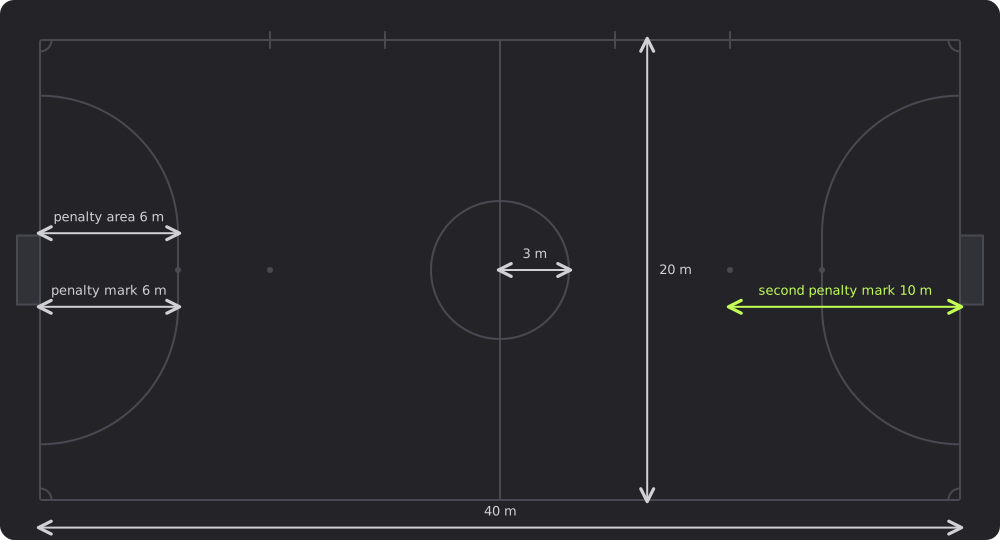
Test 1Lines and dimensionsTake a test
The touch line must be longer than the goal line; for an ordinary match it measures 25 to 42 metres, and only 38 to 42 for international play.
Source: FIFA Futsal Laws of the Game 2025/26, Law 1.2 · recall
All the court markings are eight centimetres wide, and the goalposts and crossbar are made the same eight centimetres so the frame lines up with the goal line.
Source: FIFA Futsal Laws of the Game 2025/26, Law 1.2 · recall
The centre circle has a three-metre radius; at a kick-off the opponents of the kicking team must stand outside it until the ball is in play.
Source: FIFA Futsal Laws of the Game 2025/26, Law 1.2 · applied
A short mark is drawn just outside the court, at right angles to the end line and 5 m from each corner arc, so the officials can see whether the defenders have retreated far enough.
Source: FIFA Futsal Laws of the Game 2025/26, Law 1.2 · applied
If the ball hits the ceiling, play restarts with a kick-in to the opponents of the team that touched it last, taken on the touch line nearest to where it hit.
Source: FIFA Futsal Laws of the Game 2025/26, Law 9 · applied
Both benches sit behind the same touch line on the same side of the court, with the substitution zones in front of them and a clear space in front of the timekeeper's table.
Source: FIFA Futsal Laws of the Game 2025/26, Law 1.4 · recall
The strip in front of the timekeeper's table, five metres either side of the halfway line, carries no substitution zone, so players change away from the officials.
Source: FIFA Futsal Laws of the Game 2025/26, Law 1.3 · applied
The centre mark is at the middle of the halfway line, inside the centre circle, and the ball is placed on it for every kick-off.
Source: FIFA Futsal Laws of the Game 2025/26, Law 1.2 · recall
The goal line of a futsal court measures 16 to 25 metres for an ordinary match, so a hall only 15 metres wide is too narrow whatever its length.
Source: FIFA Futsal Laws of the Game 2025/26, Law 1.2 · applied
A regulation futsal court is normally 40 metres long by 20 wide, the same footprint as a team-handball court; the permitted ranges are wider than that.
Source: FIFA Futsal Laws of the Game 2025/26, Law 1.2 · recall
Test 2The penalty area and the marksTake a test
Each quarter-circle has a six-metre radius measured from the outside of a goalpost; the tops of the two arcs are joined by a straight line 3.16 m long, parallel to the goal line.
Source: FIFA Futsal Laws of the Game 2025/26, Law 1.2 · recall
The arcs are struck with a six-metre radius from the base of each goalpost; ten metres is the second penalty mark and 9.15 metres is a football measurement.
Source: FIFA Futsal Laws of the Game 2025/26, Law 1.2 · recall
The penalty mark is six metres from the midpoint of the goal line; the ten-metre mark further out is the separate second penalty mark used for accumulated fouls.
Source: FIFA Futsal Laws of the Game 2025/26, Law 1.2 · recall
The second penalty mark sits ten metres from the goal line and is where a direct free kick is taken from once a team has committed its sixth accumulated foul in a period.
Source: FIFA Futsal Laws of the Game 2025/26, Law 1.2 · recall
The corner arc is a quarter-circle of 25-centimetre radius, and the ball must be placed inside it for a corner kick.
Source: FIFA Futsal Laws of the Game 2025/26, Law 1.2 · recall
Each substitution zone is bounded by two lines that cross the touch line, and players entering or leaving must do so between them.
Source: FIFA Futsal Laws of the Game 2025/26, Law 1.3 · applied
The substitution zone is five metres wide, marked on the touch line directly in front of each team's bench.
Source: FIFA Futsal Laws of the Game 2025/26, Law 1.3 · recall
The six-metre penalty mark is for a penalty kick; the ten-metre mark comes into use once a team reaches six accumulated fouls in the period.
Source: FIFA Futsal Laws of the Game 2025/26, Law 1.2 · applied
A five-metre reference mark on each side of the second penalty mark shows whether players other than the kicker and goalkeeper have kept their distance at a sixth-foul free kick.
Source: FIFA Futsal Laws of the Game 2025/26, Law 1.2 · recall
A futsal court has a 25-centimetre corner arc but no corner flags, since it is played indoors; the ball is placed within the arc for a corner kick.
Source: FIFA Futsal Laws of the Game 2025/26, Law 1.2 · recall
Test 3The goals and the substitution zonesTake a test
The distance between the posts is three metres and the lower edge of the crossbar is two metres above the ground.
Source: FIFA Futsal Laws of the Game 2025/26, Law 1.8 · recall
The posts and bar are eight centimetres wide, matching the goal line, so the front of the frame lines up exactly with the line the whole ball must cross.
Source: FIFA Futsal Laws of the Game 2025/26, Law 1.8 · recall
Goals may be portable, but they must be secured so there is no danger of them overturning during play.
Source: FIFA Futsal Laws of the Game 2025/26, Law 1.8 · applied
Players leaving and joining must both use their own team's substitution zone, the marked five-metre stretch of touch line in front of their bench.
Source: FIFA Futsal Laws of the Game 2025/26, Law 3.3 · recall
The substitution zones stop five metres short of the halfway line on each side, leaving the stretch in front of the timekeeper's table clear.
Source: FIFA Futsal Laws of the Game 2025/26, Law 1.3 · applied
The goal is centred on the goal line with a post an equal distance from each corner, so both halves of the court match.
Source: FIFA Futsal Laws of the Game 2025/26, Law 1.8 · applied
The technical area is the space around the bench from which a set number of officials may direct the team; the substitution zone is the separate gap in the touch line used for changes.
Source: FIFA Futsal Laws of the Game 2025/26, Law 1.4 · recall
Nets are attached to the posts, bar and the ground behind, and held up by supports so the goalkeeper has room to move.
Source: FIFA Futsal Laws of the Game 2025/26, Law 1.8 · applied
Futsal has no goal area; the goalkeeper may throw a goal clearance from any point inside the penalty area.
Source: FIFA Futsal Laws of the Game 2025/26, Law 16 · applied
A futsal court must be rectangular with the touch lines longer than the goal lines, so a square is not a legal court whatever its size.
Source: FIFA Futsal Laws of the Game 2025/26, Law 1.2 · applied
Test 4The ballTake a test
Adult futsal uses a size 4 ball, one size down from the size 5 used in adult football.
Source: FIFA Futsal Laws of the Game 2025/26, Law 2.1 · recall
A futsal ball measures 62 to 64 centimetres around, a little smaller than a football's 68 to 70.
Source: FIFA Futsal Laws of the Game 2025/26, Law 2.1 · recall
At kick-off the ball weighs 400 to 440 grams; it is checked beforehand and can be changed if it falls outside the range.
Source: FIFA Futsal Laws of the Game 2025/26, Law 2.1 · recall
Dropped from two metres, a futsal ball must rebound to between 50 and 65 centimetres on the first bounce; this deliberately low bounce keeps the game on the floor.
Source: FIFA Futsal Laws of the Game 2025/26, Law 2.1 · recall
The reduced bounce stops the ball flying up off a hard floor, so futsal is played with quick passing and tight control rather than in the air.
Source: FIFA Futsal Laws of the Game 2025/26, Law 2.1 · applied
If the ball becomes defective while in play and no restart is due, play is stopped and resumed with a dropped ball where it was when it failed.
Source: FIFA Futsal Laws of the Game 2025/26, Law 2.2 · applied
Only a ball meeting the Law and approved by the referee may be used, and it is not changed during the match without the referee's permission.
Source: FIFA Futsal Laws of the Game 2025/26, Law 2.1 · applied
A futsal ball is inflated to between 0.6 and 0.9 atmospheres at sea level.
Source: FIFA Futsal Laws of the Game 2025/26, Law 2.1 · recall
A multi-ball setup lets play resume the instant the ball leaves the court, which matters because the clock is stopped and everyone wants it moving again.
Source: General futsal · applied
The ball must be spherical and made of leather or other suitable material; synthetics are allowed as long as it meets the size, weight and bounce limits.
Source: FIFA Futsal Laws of the Game 2025/26, Law 2.1 · recall
Test 5The players' equipmentTake a test
The compulsory kit is a shirt with sleeves, shorts, socks, shin guards and footwear; anything else a player wears must not be dangerous.
Source: FIFA Futsal Laws of the Game 2025/26, Law 4.1 · recall
Shin guards must be entirely covered by the socks, made of a suitable material and give a reasonable degree of protection.
Source: FIFA Futsal Laws of the Game 2025/26, Law 4.1 · recall
A vest will not do: the Law asks for a shirt that has sleeves.
Source: FIFA Futsal Laws of the Game 2025/26, Law 4.1 · recall
Shin guards must be of a suitable material and size and covered by the socks; the players are responsible for their size and suitability.
Source: FIFA Futsal Laws of the Game 2025/26, Law 4.1 · applied
The goalkeeper wears colours that distinguish him from the other players, the two teams and the match officials.
Source: FIFA Futsal Laws of the Game 2025/26, Law 4.1 · recall
A goalkeeper is allowed to wear long trousers, while outfield players wear shorts.
Source: FIFA Futsal Laws of the Game 2025/26, Law 4.1 · recall
Players may not wear any jewellery; all such items must be removed, and taping them over is not accepted as a substitute.
Source: FIFA Futsal Laws of the Game 2025/26, Law 4.2 · applied
Each shirt carries a number on the back that is unique within the team, so players can be told apart on the team list and by the officials.
Source: FIFA Futsal Laws of the Game 2025/26, Law 4.1 · recall
A player whose equipment is faulty leaves the court to put it right, and returns only on the officials' signal, normally when the ball is next out of play.
Source: FIFA Futsal Laws of the Game 2025/26, Law 4.3 · applied
External tape or any material applied over the socks must be the same colour as the part of the sock it covers.
Source: FIFA Futsal Laws of the Game 2025/26, Law 4.1 · applied
Test 6The playing surface and the hallTake a test
The court must be flat, smooth and non-abrasive, and surfaces that are dangerous to players or officials are not allowed.
Source: FIFA Futsal Laws of the Game 2025/26, Law 1.1 · recall
The surface should preferably be made of wood.
Source: FIFA Futsal Laws of the Game 2025/26, Law 1.1 · recall
Artificial turf is permitted only in exceptional cases, for domestic competitions, and only if the competition rules say so.
Source: FIFA Futsal Laws of the Game 2025/26, Law 1.1 · applied
The court is marked with continuous lines, which must not be slippery; broken lines are not permitted.
Source: FIFA Futsal Laws of the Game 2025/26, Law 1.2 · recall
Other lines are allowed in a multipurpose hall provided they are a different colour and clearly distinguishable from the futsal lines.
Source: FIFA Futsal Laws of the Game 2025/26, Law 1.2 · applied
The lines must be clearly distinguishable from the colour of the court; no single colour is prescribed.
Source: FIFA Futsal Laws of the Game 2025/26, Law 1.2 · recall
Music and sound effects are allowed during the match as long as they do not drown out the referees' whistles or the timekeeper's signal, or hinder communication.
Source: FIFA Futsal Laws of the Game 2025/26, Law 1.15 · applied
Upright advertising is prohibited in the technical areas and substitution zones, which is where A stands. Elsewhere boards must be at least 1 m from the touch lines and clear of the goal nets, as B, C and D are.
Source: FIFA Futsal Laws of the Game 2025/26, Law 1.14 · applied
Striking the ceiling puts the ball out of play. Play stops, and the side that did not touch it last kicks it back in from the touch line, at the point level with where it struck.
Source: FIFA Futsal Laws of the Game 2025/26, Law 9.3 · applied
Unauthorised marks on the court are unsporting behaviour: play is stopped if no advantage applies, the player is cautioned and the opponents restart with an indirect free kick.
Source: FIFA Futsal Laws of the Game 2025/26, Law 1.2 · applied
Test 7Colours, bibs and numbersTake a test
Each side's kit has to be told apart from the other side's and from what the referees wear.
Source: FIFA Futsal Laws of the Game 2025/26, Law 4.3 · recall
If the two goalkeepers' shirts are the same colour and neither has another shirt to change into, the referees allow the match to be played.
Source: FIFA Futsal Laws of the Game 2025/26, Law 4.3 · applied
An undershirt must be a single colour matching the main colour of the shirt sleeve, or exactly replicate the sleeve's pattern.
Source: FIFA Futsal Laws of the Game 2025/26, Law 4.3 · recall
Undershorts and tights match the main colour of the shorts, or their lowest part, and team-mates must all wear the same colour.
Source: FIFA Futsal Laws of the Game 2025/26, Law 4.3 · recall
A bib is worn over the shirt to identify the substitutes.
Source: FIFA Futsal Laws of the Game 2025/26, Law 4.4 · recall
A bib must be a different colour from both teams' shirts and from the opponents' bibs. Only D's green clashes with none of blue, red or yellow.
Source: FIFA Futsal Laws of the Game 2025/26, Law 4.4 · applied
Numbering is set by the competition rules, normally from 1 to 15, with number 1 reserved for a goalkeeper.
Source: FIFA Futsal Laws of the Game 2025/26, Law 4.7 · recall
The Law points out that numbers above 15 cannot be shown clearly with the referees' hand signals.
Source: FIFA Futsal Laws of the Game 2025/26, Law 4.7 · applied
A player who leaves to correct his equipment has it checked by a match official and may re-enter only with a referee's permission.
Source: FIFA Futsal Laws of the Game 2025/26, Law 4.6 · applied
A head cover is worn on the head, the shirt on the upper body, the shorts at the hips and the socks over the lower leg.
Source: FIFA Futsal Laws of the Game 2025/26, Law 4.3 · recall
Test 8Protective and other equipmentTake a test
Non-dangerous protective equipment such as soft, lightweight padded knee and arm protectors is permitted; jewellery and dangerous items are not.
Source: FIFA Futsal Laws of the Game 2025/26, Law 4.4 · recall
Sports spectacles are listed among the permitted equipment.
Source: FIFA Futsal Laws of the Game 2025/26, Law 4.4 · recall
A head cover must not be attached to the shirt, must not be dangerous and must have no protruding parts.
Source: FIFA Futsal Laws of the Game 2025/26, Law 4.4 · recall
Protectors match the main colour of the shorts; where that is not possible, black or white may be used, and all such protectors must then be the same colour.
Source: FIFA Futsal Laws of the Game 2025/26, Law 4.4 · applied
Players, including substitutes and sent-off players, may not wear or use any electronic or communication equipment, except approved tracking systems.
Source: FIFA Futsal Laws of the Game 2025/26, Law 4.4 · applied
Team officials may use small, mobile, handheld devices such as tablets or phones for player welfare or tactical reasons.
Source: FIFA Futsal Laws of the Game 2025/26, Law 4.4 · applied
A player who refuses to comply, or puts the item back on, must be cautioned.
Source: FIFA Futsal Laws of the Game 2025/26, Law 4.1 · applied
A head cover must be black or the shirt's main colour, and team-mates must wear the same colour. A, B and D wear black; C's red cover is neither black nor blue. B's white knee protectors are allowed.
Source: FIFA Futsal Laws of the Game 2025/26, Law 4.4 · applied
A player wearing a dangerous item is ordered to remove it, and if he is unable or unwilling he must leave the court at the next stoppage.
Source: FIFA Futsal Laws of the Game 2025/26, Law 4.1 · applied
Lost footwear must be replaced no later than the next time the ball is out of play; a goal he scores before that is still awarded.
Source: FIFA Futsal Laws of the Game 2025/26, Law 4.2 · applied
Test 9When the goal movesTake a test
A goal has moved when at least one of its posts is no longer touching the end line in its normal position.
Source: FIFA Futsal Laws of the Game 2025/26, Law 1.10 · recall
Goals must not be fixed to the floor, but they need a stabilising system, such as weight at the back, so they cannot overturn.
Source: FIFA Futsal Laws of the Game 2025/26, Law 1.9 · recall
If a defender moves his own goal by accident and the ball neither enters nor touches it, play is stopped and restarted with a dropped ball.
Source: FIFA Futsal Laws of the Game 2025/26, Law 1.10 · applied
The goal is allowed because the ball passed over the line between where the posts should be, and the defender is cautioned for moving it deliberately.
Source: FIFA Futsal Laws of the Game 2025/26, Law 1.10 · applied
A goal is never allowed when an attacker has moved the goal; if it was accidental, play restarts with a dropped ball.
Source: FIFA Futsal Laws of the Game 2025/26, Law 1.10 · applied
If the crossbar cannot be repaired the match is abandoned; a rope may not be used to replace it.
Source: FIFA Futsal Laws of the Game 2025/26, Law 1.9 · applied
Additional marks under the posts help the referees make sure a moved goal is returned to its correct position.
Source: FIFA Futsal Laws of the Game 2025/26, Law 1.10 · recall
When a defender moves his own goal, the referees judge whether the whole ball passed over the goal line between the normal position of the posts. It did, so the goal stands; as it was accidental, there is no caution.
Source: FIFA Futsal Laws of the Game 2025/26, Law 1.10 · applied
Deliberately moving your own goal when the ball neither enters nor touches it brings a caution and an indirect free kick to the opponents.
Source: FIFA Futsal Laws of the Game 2025/26, Law 1.10 · applied
Play stops until the crossbar is repaired or replaced, and the match then restarts with a dropped ball.
Source: FIFA Futsal Laws of the Game 2025/26, Law 1.9 · applied
Test 10The technical area and warming upTake a test
The technical area extends forward up to 75 cm from the touch line.
Source: FIFA Futsal Laws of the Game 2025/26, Law 1.8 · recall
The technical area should extend only 1 m on either side of the designated sitting area.
Source: FIFA Futsal Laws of the Game 2025/26, Law 1.8 · recall
Only one person at a time is authorised to stand and convey tactical instructions from the technical area.
Source: FIFA Futsal Laws of the Game 2025/26, Law 1.8 · recall
Substitutes and the fitness coach warm up in the zone provided behind the technical area.
Source: FIFA Futsal Laws of the Game 2025/26, Law 1.8 · recall
Without a warm-up zone they may warm up near the touch line, as long as they do not obstruct the players and referees and behave responsibly.
Source: FIFA Futsal Laws of the Game 2025/26, Law 1.8 · applied
Occupants stay inside the technical area except in special cases, such as a physiotherapist or doctor entering the court with a referee's permission.
Source: FIFA Futsal Laws of the Game 2025/26, Law 1.8 · applied
The occupants of the technical area are identified before the start of the match, in line with the competition rules.
Source: FIFA Futsal Laws of the Game 2025/26, Law 1.8 · recall
The warm-up zone lies behind the technical area (A). B is the bench inside the technical area, C the substitution zone on the touch line and D the timekeeper's table.
Source: FIFA Futsal Laws of the Game 2025/26, Law 1.8 · applied
Moving away from the court: first the touch line, then a 75 cm gap to the front of the technical area, the bench inside it, and the warm-up zone at the back.
Source: FIFA Futsal Laws of the Game 2025/26, Law 1.8 · recall
A team official who behaves inappropriately through the use of electronic equipment is dismissed from the technical area.
Source: FIFA Futsal Laws of the Game 2025/26, Law 4.4 · applied
Sources
FIFA Futsal Laws of the Game 2025/26 (approved by the Bureau of the FIFA Council, effective 5 September 2025) for every rule; the FIFA Futsal Coaching Manual (2025), chapter 2, and general futsal history for the sport's origins and governance. Both FIFA publications are free to download but not open-licensed, so questions are authored in original wording from these sources, never reproduced. A specific clause reference sits in each question's source field, never in the stem.
- FIFA Futsal Laws of the Game 2025/26, Law 1.220
- FIFA Futsal Laws of the Game 2025/26, Law 1.814
- FIFA Futsal Laws of the Game 2025/26, Law 4.110
- FIFA Futsal Laws of the Game 2025/26, Law 4.410
- FIFA Futsal Laws of the Game 2025/26, Law 2.18
- FIFA Futsal Laws of the Game 2025/26, Law 1.107
- FIFA Futsal Laws of the Game 2025/26, Law 4.36
- FIFA Futsal Laws of the Game 2025/26, Law 1.34
- FIFA Futsal Laws of the Game 2025/26, Law 1.13
- FIFA Futsal Laws of the Game 2025/26, Law 1.93
- FIFA Futsal Laws of the Game 2025/26, Law 1.42
- FIFA Futsal Laws of the Game 2025/26, Law 4.22
- FIFA Futsal Laws of the Game 2025/26, Law 4.72
- FIFA Futsal Laws of the Game 2025/26, Law 91
- FIFA Futsal Laws of the Game 2025/26, Law 3.31
- FIFA Futsal Laws of the Game 2025/26, Law 161
- FIFA Futsal Laws of the Game 2025/26, Law 2.21
- General futsal1
- FIFA Futsal Laws of the Game 2025/26, Law 1.151
- FIFA Futsal Laws of the Game 2025/26, Law 1.141
- FIFA Futsal Laws of the Game 2025/26, Law 9.31
- FIFA Futsal Laws of the Game 2025/26, Law 4.61