
Futsal · Level 2: Elementary · Sub-level 2.2
Free Kicks and Accumulated Fouls
10 tests · 100 facts · updated 15 October 2026 · markdown
This sub-level teaches free-kick procedure in more depth than L1 1.5 touched it — the ball stationary, the four-second limit that turns an overdue direct free kick into an indirect one, and the 5 m distance for opponents; which challenges and handling produce a direct free kick and which produce an indirect one, and the disciplinary offences that sit alongside them; a team's first five accumulated fouls of a period, when a wall is allowed; and the sixth foul onward, when the wall disappears, the attacking team may choose between the second penalty mark and the spot of the foul, every other player must retreat to 5 m behind an imaginary line, the goalkeeper must stay in his own area at 5 m, and the identified kicker must shoot rather than pass; tests 6-10 add where a free kick is taken when the offence was off the court or in the penalty area; the kicker's touches and when the ball is in play; setting up the sixth-foul free kick, its offences and their outcomes; and the warnings and cautions around free kicks.
Each test below is ten questions on Insporta. The list under a test is what the questions check: one fact per question, with the source it was written from. Read it before the test, or come back from a wrong answer.
Test 1The Free Kick ItselfTake a test
For both direct and indirect free kicks, the ball must be stationary when the kick is taken.
Source: FIFA Futsal Laws of the Game 2025/26, Law 13.1 · recall
A free kick must be taken within four seconds of being positioned; exceeding that limit turns it into an indirect free kick for the opponents.
Source: FIFA Futsal Laws of the Game 2025/26, Law 13.2 · applied
On a free kick outside the penalty area, opponents must stay at least 5 m from the ball until it is in play.
Source: FIFA Futsal Laws of the Game 2025/26, Law 13.1 · recall
Every free kick outside the penalty area carries the same 5 m distance requirement for opponents, not only the sixth-foul kick.
Source: FIFA Futsal Laws of the Game 2025/26, Law 13.1 · applied
The four seconds run from the ball being positioned for the free kick, the same starting point as futsal's other four-second restarts.
Source: FIFA Futsal Laws of the Game 2025/26, Law 13.2 · recall
An indirect free kick needs a second touch, by another player, before a goal can count from it.
Source: FIFA Futsal Laws of the Game 2025/26, Law 13 (indirect restart principle) · applied
A direct free kick may be shot straight at goal and counts if it goes in, unlike an indirect free kick.
Source: FIFA Futsal Laws of the Game 2025/26, Law 13 (direct/indirect distinction) · recall
The 5 m distance and four-second limit apply to free kicks in general, direct and indirect alike.
Source: FIFA Futsal Laws of the Game 2025/26, Law 13.1–13.2 · applied
An ordinary free kick, unlike a sixth-foul award, is taken from the spot of the offence.
Source: FIFA Futsal Laws of the Game 2025/26, Law 13 (general placement) · recall
The choice between the second penalty mark and the spot of the foul is specific to a sixth-foul award, not to every free kick.
Source: FIFA Futsal Laws of the Game 2025/26, Law 13.4 · applied
Test 2Direct and Indirect Free Kick OffencesTake a test
Tripping sits among the direct free kick offences; delaying, dissent and persistent infringement are cautionable conduct instead.
Source: FIFA Futsal Laws of the Game 2025/26, Law 12.1 · recall
A challenge judged reckless is one of the offences producing a direct free kick, not merely a caution.
Source: FIFA Futsal Laws of the Game 2025/26, Law 12.1 · applied
Deliberate handball sits among the direct free kick offences, alongside tripping and pushing.
Source: FIFA Futsal Laws of the Game 2025/26, Law 12.1 · recall
Controlling the ball in his own half for more than four seconds is a goalkeeper offence producing an indirect, not a direct, free kick.
Source: FIFA Futsal Laws of the Game 2025/26, Law 12.2 · applied
Dangerous play involving no actual contact is an indirect free kick offence; striking, tripping and jumping at an opponent are all direct free kick offences.
Source: FIFA Futsal Laws of the Game 2025/26, Law 12.1–12.2 · recall
Impeding an opponent without contact is an indirect, not a direct, free kick offence.
Source: FIFA Futsal Laws of the Game 2025/26, Law 12.2 · applied
Pushing an opponent, when careless, reckless or with excessive force, is one of the direct free kick offences.
Source: FIFA Futsal Laws of the Game 2025/26, Law 12.1 · recall
Law 12's free kick offences all involve some careless, reckless or dangerous conduct; a clean challenge that wins the ball isn't one of them.
Source: FIFA Futsal Laws of the Game 2025/26, Law 12 (scope) · applied
Law 12 frames its direct free kick offences on a scale starting at careless, rising through reckless to excessive force.
Source: FIFA Futsal Laws of the Game 2025/26, Law 12.1 · recall
Law 12 penalises deliberately handling the ball; the offence turns on intent, not on mere contact.
Source: FIFA Futsal Laws of the Game 2025/26, Law 12.1 · applied
Test 3Fouls One to Five — The WallTake a test
For a team's first five accumulated fouls in a period, the defending side may form a wall to defend the free kick.
Source: FIFA Futsal Laws of the Game 2025/26, Law 13.3 · recall
A third foul in a period is still within the first five, so the ordinary free kick procedure applies, wall included.
Source: FIFA Futsal Laws of the Game 2025/26, Law 13.3 · applied
Accumulated fouls are counted per period, so the count starts again at zero in the second period; extra time is the exception, as it carries on the count from the second period.
Source: FIFA Futsal Laws of the Game 2025/26, Law 13.3 · recall
The accumulated-foul count resets at the start of each period, so five fouls in the first leave the team back at zero for the second.
Source: FIFA Futsal Laws of the Game 2025/26, Law 13.3 · applied
The sixth and later fouls of a period switch off the wall and bring a different, more restrictive procedure.
Source: FIFA Futsal Laws of the Game 2025/26, Law 13.3–13.4 · recall
A wall remains legal through a team's fifth foul in a period; only the sixth foul onward removes it.
Source: FIFA Futsal Laws of the Game 2025/26, Law 13.3 · applied
The wall is available for a team's first five accumulated fouls in a period; it disappears from the sixth foul onward.
Source: FIFA Futsal Laws of the Game 2025/26, Law 13.3 · recall
The fourth foul sits within the first five and still allows a wall; the seventh is past the sixth-foul threshold and does not.
Source: FIFA Futsal Laws of the Game 2025/26, Law 13.3–13.4 · applied
Extra time is not a fresh start for accumulated fouls: whatever a team had reached when the second period ended stays on its tally through both extra periods.
Source: FIFA Futsal Laws of the Game 2025/26, Law 13.3 · recall
The wall disappears starting with the sixth foul, so a team already on its fifth is exactly one foul away from losing it.
Source: FIFA Futsal Laws of the Game 2025/26, Law 13.3 · applied
Test 4The Sixth Foul — No WallTake a test
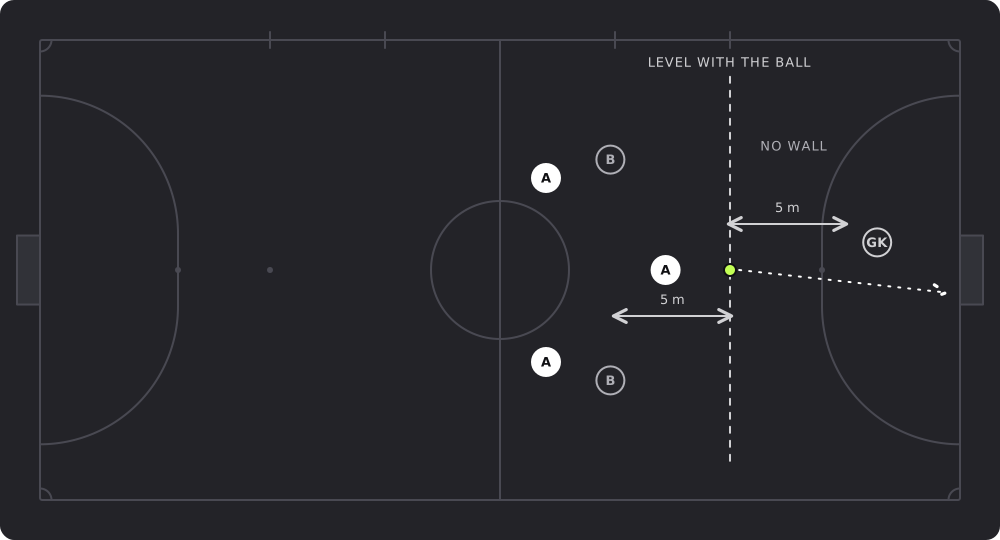
From the sixth team foul of a period onward, the defending team's players may not form a wall at all.
Source: FIFA Futsal Laws of the Game 2025/26, Law 13.4 · recall
When a sixth-foul offence happens in that zone, the attacking team chooses between the second penalty mark and the spot of the foul.
Source: FIFA Futsal Laws of the Game 2025/26, Law 13.4 · applied
Every player besides the kicker and the goalkeeper must stay behind an imaginary line, level with the ball and parallel to the goal line, at least 5 m away.
Source: FIFA Futsal Laws of the Game 2025/26, Law 13.4 · recall
The 5 m distance for a sixth-foul free kick applies to every player besides the kicker and the goalkeeper, not just to the one who fouled.
Source: FIFA Futsal Laws of the Game 2025/26, Law 13.4 · applied
The defending goalkeeper must be at least 5 m from the ball until it is kicked and must not distract the kicker; the Laws do not confine him to the goal line or the penalty area.
Source: FIFA Futsal Laws of the Game 2025/26, Law 13.4 · recall
The goalkeeper must be at least 5 m from the ball until it is kicked, wherever in his area he chooses to stand; a mark 5 m from the 10 m mark shows the line he may not cross.
Source: FIFA Futsal Laws of the Game 2025/26, Law 13.4 · applied
The Law requires the kicker for a sixth-foul free kick to be a specific, properly identified player, not an open choice on the spot.
Source: FIFA Futsal Laws of the Game 2025/26, Law 13.4 · recall
The identified kicker of a sixth-foul free kick must attempt to score with a direct shot, not lay the ball off.
Source: FIFA Futsal Laws of the Game 2025/26, Law 13.4 · applied
A stationary ball, the 5 m distance and the four-second limit apply to free kicks generally; the wall ban is specific to the sixth foul and beyond.
Source: FIFA Futsal Laws of the Game 2025/26, Law 13 · recall
That choice of spot is specific to a sixth foul committed in the defending team's own half, outside the penalty area, between the imaginary 10 m line and the goal line.
Source: FIFA Futsal Laws of the Game 2025/26, Law 13.4 · recall
Test 5Putting It TogetherTake a test
The fourth foul is within the first five, so a wall is allowed; the choice between the mark and the foul spot belongs only to the sixth foul onward.
Source: FIFA Futsal Laws of the Game 2025/26, Law 13.3–13.4 · applied
A prompt, direct shot at goal within four seconds satisfies both the general time limit on any free kick and the sixth-foul kick's specific direct-shot requirement.
Source: FIFA Futsal Laws of the Game 2025/26, Law 13 · applied
A stationary ball is required for every free kick; a wall, the choice of spot, and the specific identified-kicker rule are all sixth-foul-specific or absent from it.
Source: FIFA Futsal Laws of the Game 2025/26, Law 13 (synthesis) · recall
A direct free kick offence committed by the defending team inside its own penalty area is a penalty kick, whatever that team's foul count for the period.
Source: FIFA Futsal Laws of the Game 2025/26, Laws 12–14 (general principle) · applied
At a sixth-foul free kick, even the goalkeeper must stay at least 5 m from the ball; only the kicker himself stands closer.
Source: FIFA Futsal Laws of the Game 2025/26, Law 13.4 · recall
The sixth foul removes the wall, tightens where every other player must stand, and can move the restart to the second penalty mark — real procedural change, not stricter phrasing of the same rule.
Source: FIFA Futsal Laws of the Game 2025/26, Law 13.3–13.4 · applied
Of the four listed elements, the wall is the only one that reaching the sixth foul switches off; the four-second limit, the 5 m distance and the stationary ball all still apply.
Source: FIFA Futsal Laws of the Game 2025/26, Law 13 · recall
Because the accumulated-foul count resets at the start of each period, there is nothing from an earlier period left over to carry toward the next one's threshold.
Source: FIFA Futsal Laws of the Game 2025/26, Law 13.3 · applied
Removing the wall and tightening positioning from the sixth foul onward raises the cost of persistent fouling, so a team can't foul tactically once it has already used up its first five.
Source: FIFA Futsal Laws of the Game 2025/26, Law 13 (purpose) · recall
Outside his own penalty area a goalkeeper has no special handling privilege, so deliberate handball there is an ordinary direct free kick offence.
Source: FIFA Futsal Laws of the Game 2025/26, Law 12.1 (goalkeeper outside the area) · applied
Test 6Free kicks away from the usual spotTake a test
An indirect free kick for entering, re-entering or leaving the court without permission is taken where the ball was when play stopped; if that was inside the penalty area, it moves to the nearest point of the penalty-area line.
Source: FIFA Futsal Laws of the Game 2025/26, Law 13.2 · applied
When a player commits an offence off the court, play restarts with a free kick from the point on the boundary line nearest to where the offence occurred.
Source: FIFA Futsal Laws of the Game 2025/26, Law 13.2 · applied
The free kick is taken from the nearest point on the boundary line. It becomes a penalty kick only when that point lies on the part of the end line belonging to the offender's penalty area, which is not the case here.
Source: FIFA Futsal Laws of the Game 2025/26, Law 13.2 · applied
A free kick not taken within four seconds gives the opponents an indirect free kick; when the delaying team was inside its own penalty area, it is taken from the nearest point of the penalty-area line.
Source: FIFA Futsal Laws of the Game 2025/26, Law 13.3 · applied
A kicker who touches the ball again before another player does gives away an indirect free kick, but if the second touch is a handball offence it is a direct free kick.
Source: FIFA Futsal Laws of the Game 2025/26, Law 13.3 · applied
A kicker's handball after his free kick is normally a direct free kick, or a penalty inside his own area, but when the kicker is the goalkeeper it is an indirect free kick.
Source: FIFA Futsal Laws of the Game 2025/26, Law 13.3 · applied
Picture a line running from the offence towards the halfway line, parallel to the touch line: where it meets the edge of the area is the spot.
Source: FIFA Futsal Laws of the Game 2025/26, Law 13.2 · recall
The nearest point of the boundary lies on the part of the end line that belongs to grey's penalty area, and kicking is a direct-free-kick offence, so a penalty kick is awarded.
Source: FIFA Futsal Laws of the Game 2025/26, Law 13.2 · applied
The player's unauthorised exit is an indirect-free-kick offence; as the ball was out on the court when play stopped, the kick goes exactly there.
Source: FIFA Futsal Laws of the Game 2025/26, Law 13.2 · applied
If the kicker leaves and his substitute touches the ball before any other player has, it counts as the kicker's second touch: the opponents get an indirect free kick where the substitute touched it.
Source: FIFA Futsal Laws of the Game 2025/26, Law 13.3 · applied
Test 7The kicker and the ballTake a test
A free kick can be taken by lifting the ball with a foot or with both feet simultaneously.
Source: FIFA Futsal Laws of the Game 2025/26, Law 13.2 · recall
At every free kick the ball is in play when it is kicked and clearly moves.
Source: FIFA Futsal Laws of the Game 2025/26, Law 13.2 · recall
The four-second count must be shown clearly by one of the referees when a direct or indirect free kick is taken.
Source: FIFA Futsal Laws of the Game 2025/26, Law 13.1 · recall
Opponents who had no time to leave may stay, but one who touches or challenges for the ball before it is in play has the free kick retaken.
Source: FIFA Futsal Laws of the Game 2025/26, Law 13.3 · applied
If an opponent is closer than the required distance when a free kick is taken, the kick is retaken unless the advantage can be applied.
Source: FIFA Futsal Laws of the Game 2025/26, Law 13.3 · applied
Inside its own area the kicking team does not have to clear the area first: a clear movement of the kicked ball is enough to bring it into play.
Source: FIFA Futsal Laws of the Game 2025/26, Law 13.2 · applied
The ball is in play once it is kicked and clearly moves; it need not travel any set distance.
Source: FIFA Futsal Laws of the Game 2025/26, Law 13.2 · applied
A player correctly taking a free kick who deliberately kicks the ball at an opponent in order to play it again, but not carelessly, recklessly or with excessive force, is allowed to play on.
Source: FIFA Futsal Laws of the Game 2025/26, Law 13.2 · applied
The ball must be stationary; it is in play once kicked and clearly moving, and the kicker must not touch it again until it has touched another player.
Source: FIFA Futsal Laws of the Game 2025/26, Law 13.2 · applied
The kicker may not touch the ball twice in a row, but a defender in the wall is another player; once the ball has touched him, the kicker may play it again.
Source: FIFA Futsal Laws of the Game 2025/26, Law 13.2 · applied
Test 8The sixth-foul kick: setting it upTake a test
The ball must be stationary with part of it touching or overhanging the centre of the 10 m mark, or at the place of the offence when the kicker may choose that.
Source: FIFA Futsal Laws of the Game 2025/26, Law 13.5 · recall
Among the conditions of the procedure, the goalposts, crossbar and goal net must not be moving.
Source: FIFA Futsal Laws of the Game 2025/26, Law 13.5 · recall
The goalkeeper must be at least 5 m from the ball and must not unfairly distract the kicker, for example by delaying the kick or touching the goalposts, crossbar or net.
Source: FIFA Futsal Laws of the Game 2025/26, Law 13.5 · recall
Back-heeling is permitted provided the ball moves towards the opponents' goal and it is an attempt to score directly.
Source: FIFA Futsal Laws of the Game 2025/26, Law 13.5 · recall
The ball is in play when it is kicked and clearly moves towards the opponents' goal.
Source: FIFA Futsal Laws of the Game 2025/26, Law 13.5 · recall
Standing off the court to rush in later is not an option: everyone apart from the kicker and the goalkeeper has to be on the court when the kick is taken.
Source: FIFA Futsal Laws of the Game 2025/26, Law 13.5 · applied
At a restart a player's position is judged by the position of the feet or any part of the body touching the court.
Source: FIFA Futsal Laws of the Game 2025/26, Law 13.5 · recall
Under the 2025/26 Laws the defending goalkeeper only has to be at least 5 m from the ball until it has been kicked; he need not stand on his line or inside his area.
Source: FIFA Futsal Laws of the Game 2025/26, Law 13.5 · applied
After the referee's signal the kicker must shoot towards goal; once the ball clearly moves towards goal it is in play and the other players may come in.
Source: FIFA Futsal Laws of the Game 2025/26, Law 13.5 · applied
A sixth-foul offence between the end line and the imaginary line 10 m out, outside the penalty area, lets the kicker choose the 10 m mark or the spot of the foul; the players then take up their positions.
Source: FIFA Futsal Laws of the Game 2025/26, Law 13.5 · applied
Test 9The sixth-foul kick: offences and outcomesTake a test
If the defending goalkeeper commits an offence and the ball enters the goal, the goal is awarded.
Source: FIFA Futsal Laws of the Game 2025/26, Law 13.5 · applied
An attacking team-mate is penalised for encroaching only if it clearly affected the goalkeeper or he then plays the ball or challenges for it and scores or creates a chance.
Source: FIFA Futsal Laws of the Game 2025/26, Law 13.5 · applied
If a team-mate of the identified kicker takes the kick, play is restarted with an indirect free kick to the defending team whether or not a goal is scored, and the player who took it is cautioned.
Source: FIFA Futsal Laws of the Game 2025/26, Law 13.5 · applied
Feinting during the run-up is permitted, but feinting after completing it is illegal: the kicker is cautioned and the defending team gets an indirect free kick.
Source: FIFA Futsal Laws of the Game 2025/26, Law 13.5 · applied
If the defending goalkeeper and the kicker offend at the same time, the kicker is cautioned and play restarts with an indirect free kick to the defending team.
Source: FIFA Futsal Laws of the Game 2025/26, Law 13.5 · applied
An early run by a defender cannot cancel a goal his own team concedes; with the ball in the net, the goal stands.
Source: FIFA Futsal Laws of the Game 2025/26, Law 13.5 · applied
The kick is retaken if an outside agent touches the ball, unless the ball is going into the goal and the interference stops no defender playing it; then the goal counts, unless the interference came from the attacking team.
Source: FIFA Futsal Laws of the Game 2025/26, Law 13.5 · applied
The goalkeeper was closer than 5 m, an offence. When the ball misses the goal, the kick is retaken only if his offence clearly affected the kicker.
Source: FIFA Futsal Laws of the Game 2025/26, Law 13.5 · applied
If the ball rebounds into the court from the goalkeeper, crossbar or posts and is then touched by an outside agent, the referees stop play and restart with a dropped ball where it was touched.
Source: FIFA Futsal Laws of the Game 2025/26, Law 13.5 · applied
A save after the goalkeeper's offence means a retake; the goalkeeper is warned for his first such offence in the match and cautioned for any later one, before the kick is taken again.
Source: FIFA Futsal Laws of the Game 2025/26, Law 13.5 · applied
Test 10Warnings and cautions at free kicksTake a test
Failing to respect the required distance when play restarts with a free kick is a cautionable offence.
Source: FIFA Futsal Laws of the Game 2025/26, Law 12.3 · applied
A team-mate of the goalkeeper penalised for encroachment is warned for the first offence in the game and cautioned for any later one; the kick is retaken.
Source: FIFA Futsal Laws of the Game 2025/26, Law 13.5 · applied
After a first warning, any further encroachment by the same player in the game is punished with a caution.
Source: FIFA Futsal Laws of the Game 2025/26, Law 13.5 · applied
When players of both teams offend, the kick is retaken and the offenders are warned for the first offence, unless one commits a more serious offence such as illegal feinting.
Source: FIFA Futsal Laws of the Game 2025/26, Law 13.5 · applied
Of the two simultaneous offenders only the kicker sees a yellow card; the goalkeeper escapes a card here.
Source: FIFA Futsal Laws of the Game 2025/26, Law 13.5 · recall
If an attacking player is less than 1 m from a wall of two or more defenders when the kick is taken, the defending team gets an indirect free kick.
Source: FIFA Futsal Laws of the Game 2025/26, Law 13.3 · applied
If the kicker's team-mate offends before the ball is in play and it enters the goal, the kick is retaken.
Source: FIFA Futsal Laws of the Game 2025/26, Law 13.5 · applied
An opponent who obstructs the kicker from moving towards the ball at a sixth-foul free kick must be cautioned, even if he was respecting the 5 m distance.
Source: FIFA Futsal Laws of the Game 2025/26, Law 13.5 · applied
When players of both teams offend but one commits a more serious offence such as illegal feinting, the opponents get an indirect free kick and that offender is cautioned without a warning.
Source: FIFA Futsal Laws of the Game 2025/26, Law 13.5 · applied
Encroachment with no impact goes unpunished; the first penalised offence brings a warning, a later one a caution, and a second caution in the match means a sending-off.
Source: FIFA Futsal Laws of the Game 2025/26, Law 13.5 · applied
Sources
FIFA Futsal Laws of the Game 2025/26 (approved by the Bureau of the FIFA Council, effective 5 September 2025) for every rule. Free to download but not open-licensed, so questions are authored in original wording, never reproduced. A specific clause reference sits in each question's source field, never in the stem.
- FIFA Futsal Laws of the Game 2025/26, Law 13.528
- FIFA Futsal Laws of the Game 2025/26, Law 13.316
- FIFA Futsal Laws of the Game 2025/26, Law 13.215
- FIFA Futsal Laws of the Game 2025/26, Law 13.411
- FIFA Futsal Laws of the Game 2025/26, Law 12.16
- FIFA Futsal Laws of the Game 2025/26, Law 13.14
- FIFA Futsal Laws of the Game 2025/26, Law 13.3–13.44
- FIFA Futsal Laws of the Game 2025/26, Law 133
- FIFA Futsal Laws of the Game 2025/26, Law 12.22
- FIFA Futsal Laws of the Game 2025/26, Law 13 (indirect restart principle)1
- FIFA Futsal Laws of the Game 2025/26, Law 13 (direct/indirect distinction)1
- FIFA Futsal Laws of the Game 2025/26, Law 13.1–13.21
- FIFA Futsal Laws of the Game 2025/26, Law 13 (general placement)1
- FIFA Futsal Laws of the Game 2025/26, Law 12.1–12.21
- FIFA Futsal Laws of the Game 2025/26, Law 12 (scope)1
- FIFA Futsal Laws of the Game 2025/26, Law 13 (synthesis)1
- FIFA Futsal Laws of the Game 2025/26, Laws 12–14 (general principle)1
- FIFA Futsal Laws of the Game 2025/26, Law 13 (purpose)1
- FIFA Futsal Laws of the Game 2025/26, Law 12.1 (goalkeeper outside the area)1
- FIFA Futsal Laws of the Game 2025/26, Law 12.31