
Futsal · Level 2: Elementary · Sub-level 2.3
The Penalty Kick and the Kick-In
10 tests · 100 facts · updated 15 October 2026 · markdown
This sub-level teaches the penalty kick's procedure — the ball on the mark, the goalkeeper fixed to his line until it's kicked, every other player outside the area, behind the mark, 5 m back — and what follows a goalkeeper's encroachment against an attacker's, a simultaneous infringement, and a burst ball; the kick-in's own procedure — one foot on the touchline, the ball stationary within 25 cm of the exit point, the four-second limit, the opponents' 5 m, that it can never score directly, and what a second touch by the kicker, foot or hand, actually costs the team; tests 6-10 add the goalkeeper and the kicker at a penalty kick, encroachment and its impact test, the kick-in's offences, and when and where a kick-in is taken, the ceiling included.
Each test below is ten questions on Insporta. The list under a test is what the questions check: one fact per question, with the source it was written from. Read it before the test, or come back from a wrong answer.
Test 1The Penalty Kick — ProcedureTake a test
A penalty kick is taken with the ball placed on the penalty mark.
Source: FIFA Futsal Laws of the Game 2025/26, Law 14.1 · recall
The goalkeeper must remain on his goal line, facing the kicker and between the posts, until the ball is kicked.
Source: FIFA Futsal Laws of the Game 2025/26, Law 14.1 · recall
Every player other than the kicker and the goalkeeper must be on the court, outside the penalty area, behind the penalty mark, and at least 5 m from it.
Source: FIFA Futsal Laws of the Game 2025/26, Law 14.1 · applied
The ball is in play once it is kicked and moves forward.
Source: FIFA Futsal Laws of the Game 2025/26, Law 14.2 · recall
Law 14 describes the penalty kick as the ball being kicked forward, not simply touched in any direction.
Source: FIFA Futsal Laws of the Game 2025/26, Law 14.2 · applied
The Law's positioning requirements apply up to the moment the kick is taken; once it's struck, play is live and those players may react freely.
Source: FIFA Futsal Laws of the Game 2025/26, Law 14 · applied
A player must be both behind the penalty mark and at least 5 m from it; satisfying only the distance isn't enough on its own.
Source: FIFA Futsal Laws of the Game 2025/26, Law 14.1 · applied
Unlike the sixth-foul free kick, an ordinary penalty kick carries no requirement that a specific player be identified beforehand.
Source: FIFA Futsal Laws of the Game 2025/26, Law 14 (contrast with Law 13.4) · recall
A penalty kick is taken against a defending side with a goalkeeper positioned on the line; the kick can't proceed with nobody occupying that role.
Source: FIFA Futsal Laws of the Game 2025/26, Law 14 (general principle) · applied
The 5 m figure is the minimum gap the Law sets for anyone not taking or facing the kick.
Source: FIFA Futsal Laws of the Game 2025/26, Law 14.1 · recall
Test 2Penalty Kick — Encroachment and RetakesTake a test
If the goalkeeper encroaches and no goal results, the penalty kick is retaken.
Source: FIFA Futsal Laws of the Game 2025/26, Law 14.3 · recall
A goalkeeper's early move doesn't undo a goal that was scored anyway.
Source: FIFA Futsal Laws of the Game 2025/26, Law 14.3 · applied
An attacker's encroachment that clearly affects the goalkeeper leads to a retake even when the kick scores; a goalkeeper's early move, by contrast, never cancels a goal.
Source: FIFA Futsal Laws of the Game 2025/26, Law 14.3 · recall
If an attacker's encroachment clearly affected the goalkeeper and the kick does not produce a goal, play restarts with an indirect free kick to the defending team, not a retake.
Source: FIFA Futsal Laws of the Game 2025/26, Law 14.3 · applied
The two forms of encroachment are treated differently once the kick misses: goalkeeper encroachment brings a retake, attacker encroachment brings an indirect free kick to the defenders.
Source: FIFA Futsal Laws of the Game 2025/26, Law 14.3 · recall
If both teams infringe simultaneously on a penalty kick, it is retaken.
Source: FIFA Futsal Laws of the Game 2025/26, Law 14.4 · applied
A penalty kick is retaken if the ball bursts or becomes defective during it.
Source: FIFA Futsal Laws of the Game 2025/26, Law 14.4 · recall
Once a penalty kick rebounds off the goalkeeper, a post or the crossbar and then touches an outside agent such as a ball boy, the referees stop play and restart with a dropped ball, positioned as Law 8 directs.
Source: FIFA Futsal Laws of the Game 2025/26, Law 14.5 · applied
A scored penalty following attacker encroachment is retaken; the same scenario following goalkeeper encroachment instead stands as a goal.
Source: FIFA Futsal Laws of the Game 2025/26, Law 14.3 · recall
The consequence of encroachment varies with who caused it and whether the kick resulted in a goal; there's no single automatic outcome.
Source: FIFA Futsal Laws of the Game 2025/26, Law 14.3 (synthesis) · applied
Test 3The Kick-In — ProcedureTake a test
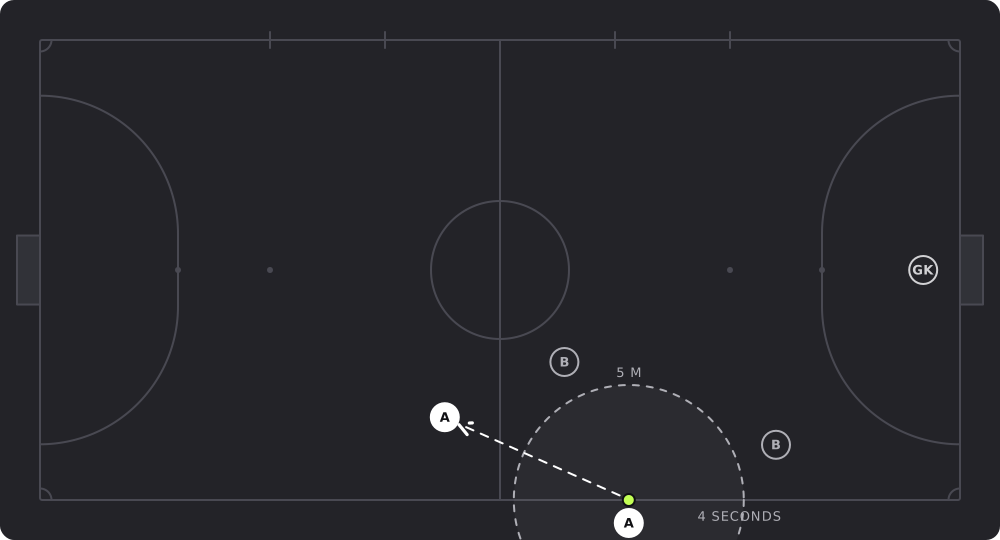
The 2025/26 Law fixes the ball, stationary on the touchline where it left the pitch, and says that only the kicker may be off the pitch; the old one-foot-on-the-line rule is gone.
Source: FIFA Futsal Laws of the Game 2025/26, Law 15.2 · recall
The ball must be stationary before a kick-in is taken, the same requirement as an ordinary free kick.
Source: FIFA Futsal Laws of the Game 2025/26, Law 15.2 · recall
The ball may be placed at the point where it left the court, or on the ground outside it, at a distance no greater than 25 cm from that point.
Source: FIFA Futsal Laws of the Game 2025/26, Law 15.2 · applied
A kick-in, like futsal's other restarts, must be delivered within four seconds of being ready to take it.
Source: FIFA Futsal Laws of the Game 2025/26, Law 15.3 · recall
Opponents must stay at least 5 m from the spot on the touchline where a kick-in is taken.
Source: FIFA Futsal Laws of the Game 2025/26, Law 15.3 · applied
Futsal's kick-in, not a throw-in, is what restarts play from the touchline, and it carries its own 5 m distance requirement for opponents.
Source: FIFA Futsal Laws of the Game 2025/26, Law 15.1 & 15.3 · recall
A kick-in taken with one foot on the touchline and the ball within 25 cm of the exit point satisfies both of the Law's positioning requirements.
Source: FIFA Futsal Laws of the Game 2025/26, Law 15.2 · applied
A kick-in is awarded to the opponents of the player who last touched the ball before it crossed the touchline.
Source: FIFA Futsal Laws of the Game 2025/26, Law 15.1 · recall
The kick-in goes to the opponents of whoever last touched the ball, here the defender, so the attacking side takes it.
Source: FIFA Futsal Laws of the Game 2025/26, Law 15.1 · applied
The ball must be stationary, and it must sit on the touch line at the point where it left the court; together these are the kick-in's two placement requirements.
Source: FIFA Futsal Laws of the Game 2025/26, Law 15.2 (synthesis) · recall
Test 4The Kick-In — No Direct Goal and the Second TouchTake a test
A goal may not be scored directly from a kick-in.
Source: FIFA Futsal Laws of the Game 2025/26, Law 15.4 · recall
A kick-in cannot produce a goal directly, regardless of how clean the strike was.
Source: FIFA Futsal Laws of the Game 2025/26, Law 15.4 · applied
If the kicker touches the ball again, other than with his hands, before another player touches it, an indirect free kick is awarded to the opponents.
Source: FIFA Futsal Laws of the Game 2025/26, Law 15.5 · recall
Deliberately handling the ball after a kick-in, before another player touches it, brings a direct free kick and counts toward the kicking team's accumulated fouls.
Source: FIFA Futsal Laws of the Game 2025/26, Law 15.5 · applied
A second touch with the foot is only an indirect free kick, while deliberately handling the ball afterward is a direct free kick that also counts as an accumulated foul.
Source: FIFA Futsal Laws of the Game 2025/26, Law 15.5 · recall
The second-touch restriction applies only until another player touches the ball; once an opponent, or a team-mate, has touched it, the kicker is free to play it again.
Source: FIFA Futsal Laws of the Game 2025/26, Law 15.5 · applied
Like an indirect free kick, a kick-in cannot produce a goal directly; a corner kick is different, since a goal scored straight from a corner does count.
Source: FIFA Futsal Laws of the Game 2025/26, Law 15.4 & Law 13 (synthesis) · recall
Because deliberately handling the ball after a kick-in counts as an accumulated foul, it adds to the team's running total exactly like any other foul that period.
Source: FIFA Futsal Laws of the Game 2025/26, Law 15.5 & 13.3 (synthesis) · applied
The extra sanction is tied specifically to the hand, not to touching the ball again as such.
Source: FIFA Futsal Laws of the Game 2025/26, Law 15.5 · recall
The restriction on the kicker touching the ball again only applies until another player touches it; after that, the kicker may play it like anyone else.
Source: FIFA Futsal Laws of the Game 2025/26, Law 15.5 (synthesis) · applied
Test 5Putting It TogetherTake a test
A stationary ball is required before both a penalty kick and a kick-in are taken, the same as any other restart.
Source: FIFA Futsal Laws of the Game 2025/26, Laws 14 and 15 · applied
A kick-in cannot produce a direct goal; a penalty kick, by its nature, is a direct attempt at goal.
Source: FIFA Futsal Laws of the Game 2025/26, Law 14 & Law 15.4 (synthesis) · recall
Both the penalty kick and the kick-in require opponents to stay at least 5 m away, the same distance as an ordinary free kick.
Source: FIFA Futsal Laws of the Game 2025/26, Law 14.1 & 15.3 (synthesis) · applied
The kick-in must be delivered within four seconds of being ready, unlike a penalty kick, which carries no such time limit.
Source: FIFA Futsal Laws of the Game 2025/26, Law 15.3 (contrast with Law 14) · recall
The kick-in's specific infringement is the kicker touching the ball again before another player does, a different concept from a penalty kick's encroachment by a positioned player.
Source: FIFA Futsal Laws of the Game 2025/26, Law 14.3 & Law 15.5 (synthesis) · applied
A penalty kick specifically requires every player besides the kicker and goalkeeper to be outside the penalty area and behind the mark; a kick-in's rule is only about the 5 m distance for opponents.
Source: FIFA Futsal Laws of the Game 2025/26, Law 14.1 & 15.3 (synthesis) · recall
An indirect free kick to the defenders is specifically what follows an attacker's encroachment on a penalty; an ordinary kick-in that doesn't produce a goal has no such special restart, since a kick-in was never going to score directly anyway.
Source: FIFA Futsal Laws of the Game 2025/26, Law 14.3 & Law 15 (synthesis) · applied
A kick-in goes to the opponents of whoever last touched the ball before it crossed the touchline; a penalty kick, by contrast, follows a foul inside the penalty area, not a question of last touch.
Source: FIFA Futsal Laws of the Game 2025/26, Law 14 & Law 15.1 (synthesis) · recall
A penalty kick's ball must be placed exactly on the penalty mark, with no tolerance; the 25 cm allowance is specific to a kick-in's placement.
Source: FIFA Futsal Laws of the Game 2025/26, Law 14.1 & 15.2 (synthesis) · applied
Both sets of rules exist to give the kicker room to take the restart without immediate interference, whether that means a 5 m gap at a kick-in or the fuller positioning rules around a penalty.
Source: FIFA Futsal Laws of the Game 2025/26, Laws 14 and 15 · recall
Test 6Penalty kick: the goalkeeperTake a test
He must look towards the kicker while he waits on his line; turning his back or standing side-on is not allowed.
Source: FIFA Futsal Laws of the Game 2025/26, Law 14.1 · recall
Pulling at the net or swinging on the bar is named in the Law as unfair distraction of the penalty taker.
Source: FIFA Futsal Laws of the Game 2025/26, Law 14.1 · recall
Having used up his warning earlier in the match, the goalkeeper now gets a yellow card, and the penalty is taken again.
Source: FIFA Futsal Laws of the Game 2025/26, Law 14.2 · applied
When the goalkeeper offends and the ball enters the goal, the goal is awarded; a warning or caution follows only when his offence leads to a retake.
Source: FIFA Futsal Laws of the Game 2025/26, Law 14.2 · applied
The Law requires him to stay on the goal line, facing the kicker and between the posts; it does not require him to stand still on it.
Source: FIFA Futsal Laws of the Game 2025/26, Law 14.1 · recall
A shot off the post is normally the end of it, but because the keeper's early move clearly unsettled the kicker, the penalty is taken again.
Source: FIFA Futsal Laws of the Game 2025/26, Law 14.2 · applied
When the ball is kicked, the goalkeeper must have at least part of one foot touching, in line with or behind the goal line.
Source: FIFA Futsal Laws of the Game 2025/26, Law 14.1 · applied
He is on the goal line, but beside the goal rather than inside the frame; the Law wants him between the posts until the kick.
Source: FIFA Futsal Laws of the Game 2025/26, Law 14.1 · applied
His first illegal move of the match costs him only a warning, but the saved kick is taken again.
Source: FIFA Futsal Laws of the Game 2025/26, Law 14.2 · applied
The penalty taker must be clearly identified before the kick; the referee signals once all players are in position, and the goalkeeper must stay on his line until the ball has been kicked.
Source: FIFA Futsal Laws of the Game 2025/26, Law 14.1 · applied
Test 7Penalty kick: the kickerTake a test
Feinting in the run-up is permitted; only feinting to kick after the run-up has been completed is an offence.
Source: FIFA Futsal Laws of the Game 2025/26, Law 14.2 · recall
Stopping at the end of the run-up to dummy the goalkeeper is the illegal kind of feint; the goal is cancelled, the taker is booked and the defenders restart.
Source: FIFA Futsal Laws of the Game 2025/26, Law 14.2 · applied
The post does not count as another player, so this is the kicker's second touch; made with the hand, it is punished as a handball.
Source: FIFA Futsal Laws of the Game 2025/26, Law 14.2 · applied
After the players have taken positions in accordance with the Law, one of the referees signals for the penalty kick to be taken.
Source: FIFA Futsal Laws of the Game 2025/26, Law 14.1 · recall
Illegal feinting after the run-up is cautioned without a warning, and a second caution in the same match means a sending-off.
Source: FIFA Futsal Laws of the Game 2025/26, Law 14.2 · applied
The goalkeeper is a player too, so his save frees the kicker to have another go, and the goal stands.
Source: FIFA Futsal Laws of the Game 2025/26, Law 14.1 · applied
A small but visible forward roll is all a penalty kick needs to be live.
Source: FIFA Futsal Laws of the Game 2025/26, Law 14.1 · applied
The kicker must kick the ball forwards, but back-heeling is permitted provided the ball moves forwards, as it does here.
Source: FIFA Futsal Laws of the Game 2025/26, Law 14.1 · applied
Unlike a free kick from the sixth accumulated foul, a penalty kick need not be a shot: once the ball has been kicked forwards and is in play, a team-mate may run in and play it.
Source: FIFA Futsal Laws of the Game 2025/26, Law 14.1 · applied
Once signalled, the penalty kick must be taken; if it is not, one of the referees may take disciplinary action before signalling again for the kick to be taken.
Source: FIFA Futsal Laws of the Game 2025/26, Law 14.2 · applied
Test 8Penalty kick: encroachmentTake a test
Running in early without bothering the goalkeeper and without touching the ball changes nothing; the penalty goal counts.
Source: FIFA Futsal Laws of the Game 2025/26, Law 14.2 · applied
An encroaching team-mate who plays the ball and scores is penalised; as the kick itself did not go in, play restarts with an indirect free kick to the defending team.
Source: FIFA Futsal Laws of the Game 2025/26, Law 14.2 · applied
The defender's early step had no effect on the kicker and he never reached the ball, so the goalkeeper's save simply stands.
Source: FIFA Futsal Laws of the Game 2025/26, Law 14.2 · applied
An encroaching defender who plays the ball and so prevents a chance is penalised: the ball did not go in, so the kick is retaken and he is warned for a first offence.
Source: FIFA Futsal Laws of the Game 2025/26, Law 14.2 · applied
When players of both teams offend with an impact, the kick is retaken and the offenders are warned, whether or not the ball went in.
Source: FIFA Futsal Laws of the Game 2025/26, Law 14.2 · applied
Encroachment is penalised only when it has an impact; with no impact on either side, a goal from the kick stands.
Source: FIFA Futsal Laws of the Game 2025/26, Law 14.2 · applied
A player who enters early is penalised only if it clearly affected the kicker or goalkeeper, or if he then plays the ball and it changes the outcome.
Source: FIFA Futsal Laws of the Game 2025/26, Law 14.2 · recall
Number 7 was inside the area too early, but a team-mate of the kicker is penalised only if his encroachment clearly affected the goalkeeper or he played the ball; neither happened.
Source: FIFA Futsal Laws of the Game 2025/26, Law 14.2 · applied
Blocking the goalkeeper's view is an encroachment with an impact; since white did not score, grey get the restart.
Source: FIFA Futsal Laws of the Game 2025/26, Law 14.2 · applied
A defender's encroachment that affects the kicker leads to a retake when the ball does not go in; after a first warning, any further such offence by the same player is cautioned.
Source: FIFA Futsal Laws of the Game 2025/26, Law 14.2 · applied
Test 9The kick-in: offencesTake a test
An opponent who unfairly distracts or impedes the kicker at a kick-in is cautioned for unsporting behaviour, whatever his distance.
Source: FIFA Futsal Laws of the Game 2025/26, Law 15 · applied
Any offence at a kick-in other than those listed separately, a moving ball included, gives the kick-in to the opposing team.
Source: FIFA Futsal Laws of the Game 2025/26, Law 15 · applied
The ball must be stationary on the touch line at the point where it left the court; any other offence at a kick-in gives it to the opponents.
Source: FIFA Futsal Laws of the Game 2025/26, Law 15 · applied
The kick-in taker's deliberate handling before anyone else has played the ball is punished as a handball, so the opponents take the stronger of the two free kicks.
Source: FIFA Futsal Laws of the Game 2025/26, Law 15 · applied
The 2025/26 Law sets the ball's position, stationary on the touch line, and says only the kicker may be off the court; it places no requirement on the kicker's feet.
Source: FIFA Futsal Laws of the Game 2025/26, Law 15 · recall
The ball must be put into play within four seconds of the team being ready to do so, or of the referee signalling that it is ready.
Source: FIFA Futsal Laws of the Game 2025/26, Law 15 · recall
A team-mate off the court at a kick-in gives the kick-in to the opponents, and he is cautioned if he was trying to deceive an opponent or gain a position.
Source: FIFA Futsal Laws of the Game 2025/26, Law 15 · applied
Because the kick-in taker was grey's own goalkeeper and he handled inside his area, the Law treats it more mildly: no penalty, only an indirect free kick.
Source: FIFA Futsal Laws of the Game 2025/26, Law 15 · applied
A kick-in must be taken within four seconds of the team being ready; if it is not, the kick-in is awarded to the opposing team.
Source: FIFA Futsal Laws of the Game 2025/26, Law 15 · applied
Swapping the kick-in taker for a substitute does not reset anything: the newcomer's first touch still counts as the taker's second.
Source: FIFA Futsal Laws of the Game 2025/26, Law 15 · applied
Test 10The kick-in: when and whereTake a test
A kick-in is awarded when the whole of the ball passes over the touch line, on the floor or in the air.
Source: FIFA Futsal Laws of the Game 2025/26, Law 15 · recall
All opponents must stand at least 5 m from the point on the touch line where the kick-in is to be taken.
Source: FIFA Futsal Laws of the Game 2025/26, Law 15 · recall
No distance or touch by a team-mate is needed; a kick-in is live as soon as the kicked ball visibly moves.
Source: FIFA Futsal Laws of the Game 2025/26, Law 15 · recall
A goal cannot be scored directly from a kick-in, but once another player, the goalkeeper included, has touched the ball, a goal can count.
Source: FIFA Futsal Laws of the Game 2025/26, Law 15 · applied
Catching a team-mate's kick-in in his own area counts as handling a ball kicked to him by his own side, which gives grey an indirect free kick.
Source: FIFA Futsal Laws of the Game 2025/26, Law 12 and Practical Guidelines · applied
A kick-in is given when the ball crosses the touch line or when it hits the ceiling while in play, to the opponents of the last player to touch it.
Source: FIFA Futsal Laws of the Game 2025/26, Law 15 · recall
The ball must be placed on the touch line at the point where it left the court.
Source: FIFA Futsal Laws of the Game 2025/26, Law 15 · applied
A goal cannot be scored directly from a kick-in: if the ball goes straight into the kicker's own goal, a corner kick is awarded to the opponents.
Source: FIFA Futsal Laws of the Game 2025/26, Law 15 · applied
Grey touched the ball last, so white take the kick-in: the ball stationary on the line where it went out, and in play once kicked and clearly moving, after which anyone may play it.
Source: FIFA Futsal Laws of the Game 2025/26, Law 15 · applied
A kick-in ball may not be moved at all from where it went out; attackers stay 1 m from a wall, opponents 3 m from the ball at a kick-off and 5 m from the point of a kick-in.
Source: FIFA Futsal Laws of the Game 2025/26, Law 15 · recall
Sources
FIFA Futsal Laws of the Game 2025/26 (approved by the Bureau of the FIFA Council, effective 5 September 2025) for every rule. Free to download but not open-licensed, so questions are authored in original wording, never reproduced. A specific clause reference sits in each question's source field, never in the stem.
- FIFA Futsal Laws of the Game 2025/26, Law 14.221
- FIFA Futsal Laws of the Game 2025/26, Law 1519
- FIFA Futsal Laws of the Game 2025/26, Law 14.116
- FIFA Futsal Laws of the Game 2025/26, Law 14.36
- FIFA Futsal Laws of the Game 2025/26, Law 15.55
- FIFA Futsal Laws of the Game 2025/26, Law 15.24
- FIFA Futsal Laws of the Game 2025/26, Law 14.42
- FIFA Futsal Laws of the Game 2025/26, Law 15.32
- FIFA Futsal Laws of the Game 2025/26, Law 15.12
- FIFA Futsal Laws of the Game 2025/26, Law 15.42
- FIFA Futsal Laws of the Game 2025/26, Laws 14 and 152
- FIFA Futsal Laws of the Game 2025/26, Law 14.1 & 15.3 (synthesis)2
- FIFA Futsal Laws of the Game 2025/26, Law 141
- FIFA Futsal Laws of the Game 2025/26, Law 14 (contrast with Law 13.4)1
- FIFA Futsal Laws of the Game 2025/26, Law 14 (general principle)1
- FIFA Futsal Laws of the Game 2025/26, Law 14.51
- FIFA Futsal Laws of the Game 2025/26, Law 14.3 (synthesis)1
- FIFA Futsal Laws of the Game 2025/26, Law 15.1 & 15.31
- FIFA Futsal Laws of the Game 2025/26, Law 15.2 (synthesis)1
- FIFA Futsal Laws of the Game 2025/26, Law 15.4 & Law 13 (synthesis)1
- FIFA Futsal Laws of the Game 2025/26, Law 15.5 & 13.3 (synthesis)1
- FIFA Futsal Laws of the Game 2025/26, Law 15.5 (synthesis)1
- FIFA Futsal Laws of the Game 2025/26, Law 14 & Law 15.4 (synthesis)1
- FIFA Futsal Laws of the Game 2025/26, Law 15.3 (contrast with Law 14)1
- FIFA Futsal Laws of the Game 2025/26, Law 14.3 & Law 15.5 (synthesis)1
- FIFA Futsal Laws of the Game 2025/26, Law 14.3 & Law 15 (synthesis)1
- FIFA Futsal Laws of the Game 2025/26, Law 14 & Law 15.1 (synthesis)1
- FIFA Futsal Laws of the Game 2025/26, Law 14.1 & 15.2 (synthesis)1
- FIFA Futsal Laws of the Game 2025/26, Law 12 and Practical Guidelines1