
Triathlon · Level 3: Pre-Intermediate · Sub-level 3.1
Race Strategy and Pacing
10 tests · 100 facts · updated 12 October 2026 · markdown
Racing rather than completing: effort distribution by distance, the swim start, bike tactics and the rules that govern them, reading the race as it happens, difficult conditions, and reviewing it honestly afterwards.
Each test below is ten questions on Insporta. The list under a test is what the questions check: one fact per question, with the source it was written from. Read it before the test, or come back from a wrong answer.
Test 1Pacing by Race DistanceTake a test
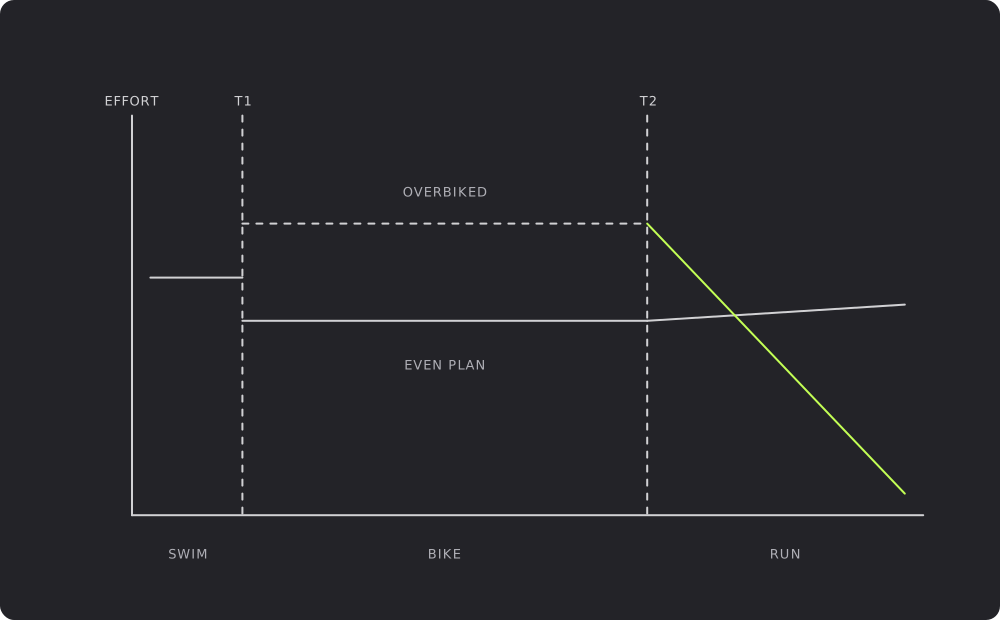
Duration brings constraints that a short race never encounters, so intensity must be traded against time. The longer the leg, the lower the percentage of threshold you can defend to the end.
Source: General endurance physiology and triathlon coaching reference
The penalty for overpacing a long race is non-linear, and it lands on the run where you are slowest and can least afford it. Erring slightly conservative is the cheaper mistake.
Source: General endurance physiology and triathlon coaching reference
Slightly negative splits are usually a symptom of good pacing rather than a strategy to engineer. The strong claims for big deliberate negative splits are not well supported.
Source: Endurance pacing research and triathlon coaching reference
Bike effort is chosen to serve the whole race, not the bike split. The longer the race, the further below threshold the bike has to sit.
Source: General triathlon coaching reference
Sprint racing rewards committing early because there is no long tail in which conservatism pays off. This is a frequent error among athletes used to longer racing rather than an established finding about all age-groupers.
Source: General triathlon coaching reference
The swim buys race position at a relatively low cost to the legs, which justifies an opening effort you would never use on the bike. That does not mean it is free.
Source: General triathlon coaching reference
The run is the leg that has to be paid for, so it is the leg the arithmetic starts from and the bike number is the output, not the input. A bike ceiling that the run cannot afford is not a target, it is a warning.
Source: General triathlon coaching reference
Racing another athlete's pacing plan is how you inherit their mistakes. Placings are settled at the finish line, not at 10 km on the bike.
Source: General triathlon coaching reference
Time is what you are minimising, and the slow section takes up more of it, so effort is worth marginally more there. This is a small adjustment around a steady baseline, not licence to attack the headwind.
Source: Cycling pacing research and triathlon coaching reference
A time target is a prediction made before the day's conditions were known, not an obligation. Racing the clock rather than your own limit reliably makes the deficit worse.
Source: General triathlon coaching reference
Test 2The Swim Start and First KilometresTake a test
The shortest line is also where every strong swimmer wants to be, so distance saved is paid for in contact and disrupted rhythm. Which side of that trade is right depends on your swim strength and composure.
Source: General triathlon coaching reference
Being overtaken repeatedly gives you turbulence, not a draft. Honest self-seeding puts you among athletes at your own pace, which is where a clean swim comes from.
Source: General triathlon coaching reference
The hard start is buying position and a draft, both of which pay back over the rest of the swim. It is a bought advantage, not free speed.
Source: General triathlon coaching reference
Staying boxed in means swimming in turbulence and taking contact for as long as it lasts, so a short decisive move is cheap by comparison. Pushing others is unsporting and can be penalised.
Source: World Triathlon competition rules / general triathlon coaching reference
Settling is an active decision made while you still have a choice. Waiting until the effort forces you to slow means the slowdown overshoots your target pace.
Source: General triathlon coaching reference
A draft is only worth having while it is taking you where you want to go. Off-line metres are pure loss and cannot be recovered later.
Source: General triathlon coaching reference
The direction of the effect is well established and the magnitude is not, which is why it is treated as a real but variable saving. Sitting slightly off the ideal position erodes most of it.
Source: Swimming drafting research and general triathlon coaching reference
Drafting benefit falls away quickly with distance, and a group swimming at or above your pace will keep extending the gap. Bridging early is far cheaper than bridging late.
Source: General triathlon coaching reference
A wrist device spends most of the stroke underwater, so open-water pace readings are noisy and often misleading. Effort and breathing are the signals you can actually trust mid-swim.
Source: General triathlon coaching reference
Getting the airway clear and restoring a long exhale settles the response; swimming harder deepens it. Signalling a safety craft is always the right call if it does not settle.
Source: World Triathlon safety guidance / general triathlon coaching reference
Test 3Non-Drafting Bike TacticsTake a test
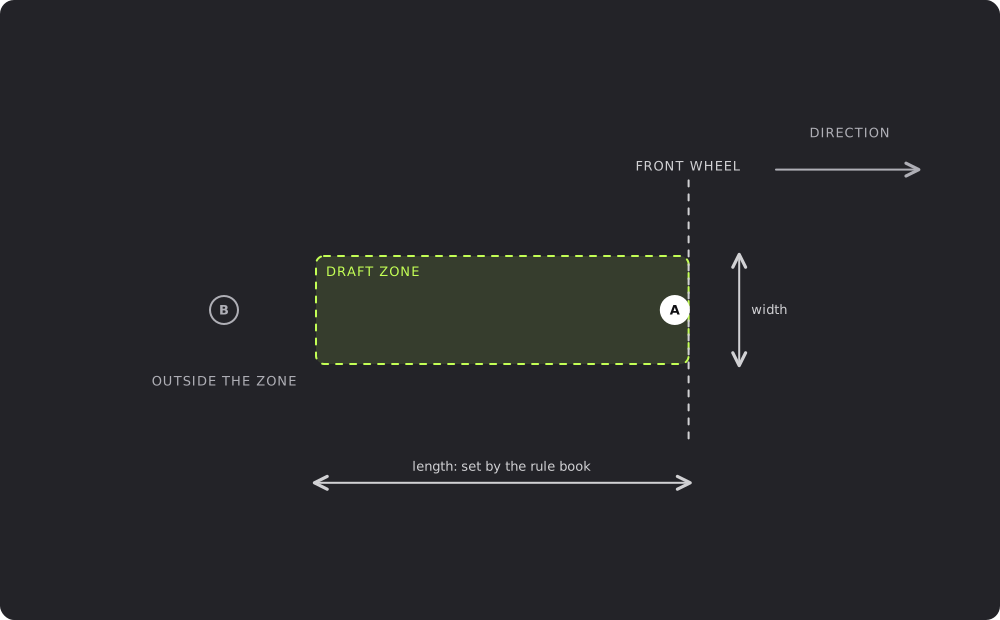
The zone is a rectangle referenced to the front wheel. Entering it is normally legal only as part of an overtake, with exceptions such as aid stations, turnarounds and transition approaches that vary by governing body and race distance.
Source: World Triathlon and IRONMAN competition rules
The principle is the same everywhere but the numbers are not, and racing to the wrong set is how experienced athletes collect penalties. The athlete guide is the authority for your race.
Source: World Triathlon and IRONMAN competition rules
The overtaken athlete has to exit the zone to the rear before repassing, which is exactly where many age-groupers pick up a drafting penalty. Riding alongside normally puts you inside the zone laterally, so that is drafting too.
Source: World Triathlon and IRONMAN competition rules
Blocking is a positional offence, independent of drafting, and it applies whenever you occupy the overtaking line without cause. Keeping to the correct side and moving out only to pass avoids it.
Source: World Triathlon and IRONMAN competition rules
An indecisive pass leaves you inside the zone for longer than the rules allow while gaining you nothing. Deciding early costs one short effort and removes the risk.
Source: World Triathlon and IRONMAN competition rules
The pass has to be completed inside a time limit, so a place where your speed advantage shrinks makes it expensive or unsafe. Wait for terrain where you can go past cleanly.
Source: World Triathlon and IRONMAN competition rules
Joining them or obstructing them puts your own race at risk of a penalty and gains nothing. Enforcement is the officials' job, not yours.
Source: World Triathlon and IRONMAN competition rules
The stand-down is a fixed loss, and overriding your pacing plan to recover it costs you far more on the run. An unserved penalty is normally upgraded to a disqualification.
Source: World Triathlon and IRONMAN competition rules
Pedalling still pays until you spin out or reach your handling limit, and the aero position matters most where speed is highest. Handling limits, not the power target, set the ceiling.
Source: General triathlon coaching reference
A crowded course is a common excuse and not an accepted one, so officials still judge each athlete individually. Referees may designate or neutralise specific sections, but that is their call, not yours.
Source: World Triathlon and IRONMAN competition rules
Test 4Draft-Legal RacingTake a test
Once drafting is legal, riding alone is a losing position and the tactics move to group dynamics. Time gaps open between packs, not between individuals.
Source: World Triathlon competition rules / general triathlon coaching reference
A few seconds in the water can become minutes on the road once packs organise. That leverage is why draft-legal specialists train the swim so heavily.
Source: World Triathlon competition rules / general triathlon coaching reference
Aero extensions put your hands away from the brakes and your body in an unstable position, which is unacceptable at close quarters. Draft-legal racing is ridden on road bikes.
Source: World Triathlon competition rules
A smooth rotation keeps the group's speed steady and spreads the cost, whereas accelerating at the front breaks up the very group you rely on. Surging is an attack, not a turn.
Source: General cycling and triathlon coaching reference
Pack co-operation is a tactical choice, not a rule, and each athlete rides for their own result. Sitting in is legitimate when your race is better served by saving the energy.
Source: World Triathlon competition rules / general triathlon coaching reference
The window to bridge is measured in the first minutes, while the group ahead is still disorganised. A single rider almost never closes on a rotating pack once it settles.
Source: General triathlon coaching reference
Riding alone between groups is the most expensive place in the race and it rarely ends well. Joining the chase costs you far less and preserves the run.
Source: General triathlon coaching reference
Looking further ahead gives you time to respond smoothly instead of reacting late with the brakes. An overlapped front wheel is knocked away the moment the rider ahead moves sideways, and you go down.
Source: General cycling safety and triathlon coaching reference
The accordion effect punishes the back of the pack repeatedly, and those repeated sprints are what drop tired riders. Position before a technical section is bought cheaply and saves a lot.
Source: General cycling and triathlon coaching reference
Energy saved by good positioning is spent on the run, which is why draft-legal races are often decided by running speed. How you rode determines how much of your run you still have.
Source: General triathlon coaching reference
Test 5The Run and the Final ThirdTake a test
The last third is where the bill for the swim, bike and early run arrives. Nothing new happens physiologically; the consequences of decisions already made simply become visible.
Source: General triathlon coaching and sports-science reference
The diagnostic pairing is high effort with low pace, and it appears early. Heavy legs off the bike and a slow opening kilometre are normal for everyone, and passing traffic tells you nothing in a wave or rolling start.
Source: General triathlon coaching and sports-science reference
Perceived effort climbs at a fixed pace as fatigue accumulates, so a rising RPE on its own is not a warning. Pairing it with what the pace is doing turns a feeling into usable evidence.
Source: General triathlon coaching and sports-science reference
The difference matters because the responses differ: a fade can often be managed with a small correction, while a blow-up needs an intervention such as walking, fuelling or cooling before anything else works.
Source: General triathlon coaching and sports-science reference
Early drift is the cheapest moment to intervene, and small corrections are the only ones you can pay for late in a race. A hard surge or an unplanned walk both cost more than the drift itself.
Source: General triathlon coaching and sports-science reference
Digestion and absorption take time you no longer have, so late calories mostly arrive after the finish. Evidence for a central mouth-rinse effect exists but the size of the benefit is debated.
Source: General triathlon coaching and sports-science reference
Ten seconds times six stations is about a minute, a price most athletes will happily pay to take on fluid cleanly. Quantifying the trade-off stops it being an argument about feel.
Source: General triathlon coaching and sports-science reference
With staggered starts your result comes from your own elapsed time, so the person you are duelling with may not be in your race at all. Race the clock and your plan unless you know the other athlete's start time.
Source: General triathlon coaching and sports-science reference
Responding to a pass from your ceiling turns one place into a possible collapse. Anyone still accelerating past you late may also be someone whose race started well after yours.
Source: General triathlon coaching and sports-science reference
Company can hold your rhythm together, but only while their pace and your plan agree. Drafting rules govern the bike leg, not the run, so running behind someone is not itself an offence.
Source: World Triathlon competition rules / general triathlon coaching reference
Test 6Reading the Race in ProgressTake a test
A finish time can only be checked after the finish, so it is useless as an in-race instrument. A plan built from verifiable quantities can be audited at any kilometre.
Source: General triathlon coaching and sports-science reference
The plan is the only one of the three made in ignorance of the actual day, so it is the first thing to revise. Effort and the watch are both measuring something real, just imperfectly.
Source: General triathlon coaching and sports-science reference
Instant pace is a derivative of a noisy position signal, so it is the least stable number on the watch. Averaged splits are far better evidence.
Source: General triathlon coaching and sports-science reference
A lost swim split is sunk cost, and the bike is the leg where trying to recover it is most expensive. Ride the effort you planned and let the split be what it is.
Source: General triathlon coaching and sports-science reference
Watts are one expression of an effort you already know from the inside, so the effort itself carries the plan when the meter does not. Naming the RPE band beforehand is what makes that switch instant rather than a guess.
Source: General triathlon coaching reference
Splits describe the past; decisions belong to the present. Athletes who read a slow split as an order to run faster are the ones who arrive at the last third with nothing left.
Source: General triathlon coaching and sports-science reference
Even effort produces uneven splits on an uneven course, so an even-time half only works on an even course. Split targets have to be shaped to the profile before the race.
Source: General triathlon coaching and sports-science reference
Cardiac drift is the expected response to heat and accumulated duration at a steady workload. Heart rate remains worth watching, but as a secondary signal rather than the intensity anchor.
Source: General triathlon coaching and sports-science reference
Falling fuel availability usually announces itself through rising effort, hunger and mood before it wrecks the pace. Recovering from it mid-race is slow, which is why the fuelling plan runs from the first hour.
Source: General triathlon coaching and sports-science reference
Chasing a dead target is the most common way an off-plan race becomes a DNF or a walk. Swapping the goal keeps the remaining decisions rational.
Source: General triathlon coaching and sports-science reference
Test 7When Things Go WrongTake a test
Both rule sets let athletes in the same race help each other with incidental items such as inner tubes, pumps, repair kits and nutrition; help from spectators or supporters is outside assistance. Essential equipment such as a wheel or a whole bike may not be handed over, on pain of disqualification for both.
Source: World Triathlon competition rules / IRONMAN competition rules
Where a penalty box or tent is used, the athlete must stop and serve the penalty there, and an unserved penalty escalates to disqualification. Some events instead add time at the finish, so the athlete guide is the authority for your race.
Source: World Triathlon competition rules / IRONMAN competition rules
A few seconds spent stopping calmly costs far less than swimming a whole leg blind or panicking. Any stroke is permitted in the swim, and raising an arm is the signal for needing help, not for lost kit.
Source: World Triathlon competition rules / general triathlon coaching reference
One missed station is a small deficit, but running against the direction of the course is a real hazard on a busy run leg. A slight easing of effort covers the gap safely.
Source: General triathlon coaching and sports-science reference
Bikes get knocked and re-racked, and finding yours is your responsibility; marshals will help you search. Taking or racing on another athlete's bike is a disqualification.
Source: World Triathlon competition rules / general triathlon coaching reference
Chest pain or pressure during exercise is a stop-now symptom, and no athlete is in a position to diagnose its cause mid-race. Getting to medical staff immediately is the only correct response.
Source: General medical guidance for endurance events
A change in thinking during a hot race is treated as heat stroke until proven otherwise, and cooling is the most urgent action. You may or may not still be sweating: continuing to sweat does not rule it out.
Source: General medical guidance for endurance events
Forcing fluid into a confused athlete can be dangerous if low blood sodium is the cause, and a confused person cannot assess their own state. Alert medical staff and stay with them.
Source: General medical guidance for endurance events
Separating medical, safety and comfort keeps the hardest decision from being made on willpower alone. Officials cannot watch every athlete, so the medical judgement is never theirs alone to make.
Source: General triathlon coaching reference / general medical guidance for endurance events
Both rule sets require an athlete leaving the race to notify an official, so that nobody is searched for as still out on course. Accepting transport along the course ends your race.
Source: World Triathlon competition rules / IRONMAN competition rules
Test 8Racing in Difficult ConditionsTake a test
Time, not distance, is what the wind acts on: you are exposed to the headwind for many more minutes than you enjoy the tailwind, so a straight-line wind always makes an out-and-back slower overall.
Source: General triathlon coaching reference
The classic windy-course error is spending too much on the fast half and meeting the hardest part of the race empty. Effort, not speed, is the thing you pace.
Source: General triathlon coaching reference
A loop breaks the wind into shifting head, cross and tailwind segments, so you cannot plan around one long hard half; you hold effort by feel or power throughout.
Source: General triathlon coaching reference
Sudden immersion triggers a gasp and hyperventilation that peak within the first minute or two, and inhaling water at that moment is the real danger. Acclimatising in the water beforehand blunts it.
Source: General triathlon coaching reference
Getting your airway clear of the water and reducing effort is what lets breathing settle. Safety crews are there to be used, and calling one is never an overreaction.
Source: General triathlon coaching reference
Clumsiness, slurred speech and confusion mean cooling has gone beyond simple shivering and needs medical attention, not toughing out. Continuing on the bike in wet kit makes it worse.
Source: General triathlon coaching reference
The aerodynamic loss from a shallower front is real but small, while a rider who is scared of their own front wheel loses far more by sitting up and braking. Handling confidence is rider-specific, so the same forecast justifies different choices.
Source: General triathlon coaching reference
Any change in mental state during a hot race is treated as heat stroke until proven otherwise, and rapid cooling plus medical care is the response. Continuing to sweat does not rule it out.
Source: General triathlon coaching reference
The time genuinely available in wet corners is tiny compared with what a crash costs, and the discipline has to hold on every lap as fatigue builds, not just the first.
Source: General triathlon coaching reference
Cold suppresses thirst while you still sweat under a wetsuit or jacket, and shivering and extra clothing raise energy cost, so the plan has to be followed on schedule rather than on feel.
Source: General triathlon coaching reference
Test 9Race Strategy Across a SeasonTake a test
A, B and C are labels you assign, describing what each race is for. An A race is the one whose preparation everything else serves.
Source: General triathlon coaching reference
A B race buys you something training cannot: race-day nerves, a mass start and real transitions. You rehearse in it rather than peak for it.
Source: General triathlon coaching reference
Tapering fully for a B race costs you the training block it sits inside; racing it on wrecked legs makes the rehearsal misleading and raises injury risk. A short freshening is the compromise.
Source: General triathlon coaching reference
The two-to-three figure is practical experience, not a measured constant. Treat it as a planning default and adjust it to the individual.
Source: General triathlon coaching reference
Racing is a hard, specific stimulus and it can sharpen you, but the claim is contested and the recovery cost is real. It does not replace a training block.
Source: General triathlon coaching reference
C races are low-stakes: you race them off normal training and accept whatever comes. The limit is that they must not damage the season they are supposed to serve.
Source: General triathlon coaching reference
A race is a hard session with a recovery cost attached. Placed too close to the A race, that recovery comes out of the taper you were relying on.
Source: General triathlon coaching reference
This is a sunk cost: the fee is gone either way and cannot justify a decision. Skipping a race is a strategic move, not a failure of commitment.
Source: General triathlon coaching reference
A sea swim, a hilly bike or likely heat only get rehearsed if the tune-up race contains them. Matching the conditions is what makes the lessons portable.
Source: General triathlon coaching reference
Racing frequently leaves no uninterrupted stretch of training long enough to raise fitness, and the fatigue compounds. Removing races, not adding load or tapers, restores the block.
Source: General triathlon coaching reference
Test 10Reviewing a Race AfterwardsTake a test
Execution is what you did on the day with the fitness you brought; fitness is the ceiling you brought with you. Missing a fuelling plan is a decision, not a capacity limit.
Source: General triathlon coaching reference
Splits are the shape of the race, not its causes. Establishing why needs your own notes and the fuelling and equipment record alongside them.
Source: General triathlon coaching reference
This misdiagnosis is costly because it sends you off to train the thing that was not broken, while the real error stays unfixed and repeats at the next race.
Source: General triathlon coaching reference
Memory of intake under race stress is unreliable and usually generous. Physical evidence of what was consumed is what makes the review worth doing.
Source: General triathlon coaching reference
The shape of the run is one of the clearest execution signals you have. A heavy fade points upstream to the bike and the fuelling, not automatically to run training.
Source: General triathlon coaching reference
Everyone met the same heat, wind or course, so the field acts as a control for conditions. Your position relative to your usual peers survives a slow day; your clock time does not.
Source: General triathlon coaching reference
Single results are noisy, so a repeated pattern is what justifies changing your training. A one-off with a clear external cause justifies reviewing the cause, not the plan.
Source: General triathlon coaching reference
What you were thinking at the turnaround is information no device recorded, and it is easily overwritten by a plausible story from the numbers.
Source: General triathlon coaching reference
Blaming conditions, the course or bad luck ends the enquiry, because none of it is actionable. The parts you controlled are the only parts you can change.
Source: General triathlon coaching reference
Reviews follow whatever categories the results sheet hands you, and this time is scattered across several small unglamorous events rather than shown as one number. It is also the block most easily cut without any extra fitness.
Source: General triathlon coaching reference
Sources
World Triathlon and IRONMAN competition rules / exercise physiology and sports medicine reference
- General triathlon coaching reference48
- General triathlon coaching and sports-science reference19
- World Triathlon and IRONMAN competition rules9
- World Triathlon competition rules / general triathlon coaching reference7
- World Triathlon competition rules / IRONMAN competition rules3
- General medical guidance for endurance events3
- General endurance physiology and triathlon coaching reference2
- General cycling and triathlon coaching reference2
- Endurance pacing research and triathlon coaching reference1
- Cycling pacing research and triathlon coaching reference1
- Swimming drafting research and general triathlon coaching reference1
- World Triathlon safety guidance / general triathlon coaching reference1
- World Triathlon competition rules1
- General cycling safety and triathlon coaching reference1
- General triathlon coaching reference / general medical guidance for endurance events1