
Football · Level 5: Upper-Intermediate · Sub-level 5.5
Defensive Schemes & The Offside Trap
10 tests · 100 facts · updated 12 October 2026 · markdown
Law 11 from 1925 to SAOT, pressure-cover-balance, block mechanics, the trap's cues and catastrophes — and the champions built from the back, from Graham's Arsenal to Flick's Barcelona.
Each test below is ten questions on Insporta. The list under a test is what the questions check: one fact per question, with the source it was written from. Read it before the test, or come back from a wrong answer.
Test 1The Law Behind the LineTake a test
The two-defender rule instantly opened the game up — goals surged, and tactics had to be rebuilt around the new geometry.
Source: IFAB / football law history · recall
McCracken's trap made matches grind into constant stoppages; lawmakers changed the rule partly to kill his invention.
Source: Football law history · recall
The 'third back' was born from the new offside maths — the first great example of law change driving formation change.
Source: Tactical history · recall
'Level is onside' is the law's tie-breaker in the attacker's favour.
Source: IFAB Laws of the Game, Law 11 · recall
Only the parts a player can legally score with count. The hands and arms are excluded for attackers and defenders alike, goalkeepers included.
Source: IFAB Laws of the Game, Law 11 · recall
The three restart exemptions are written into Law 11 — the reason strikers can lurk at long throws and corners.
Source: IFAB Laws of the Game, Law 11 · recall
Position is a state; the offence needs participation — the distinction every trap and every VAR check turns on.
Source: IFAB Laws of the Game, Law 11 · recall
The second-to-last opponent is normally the last outfield defender because the goalkeeper is usually the last one; if the keeper has come upfield, the reference shifts to whichever two opponents are nearest their goal line.
Source: IFAB Laws of the Game, Law 11 · recall
Offside is punished indirectly — a detail that matters when offences happen within shooting range.
Source: IFAB Laws of the Game, Law 11 · recall
The freeze-frame is the pass, which is why perfectly timed runs can start 'late' and finish first.
Source: IFAB Laws of the Game, Law 11 · recall
Test 2Roles in the BlockTake a test
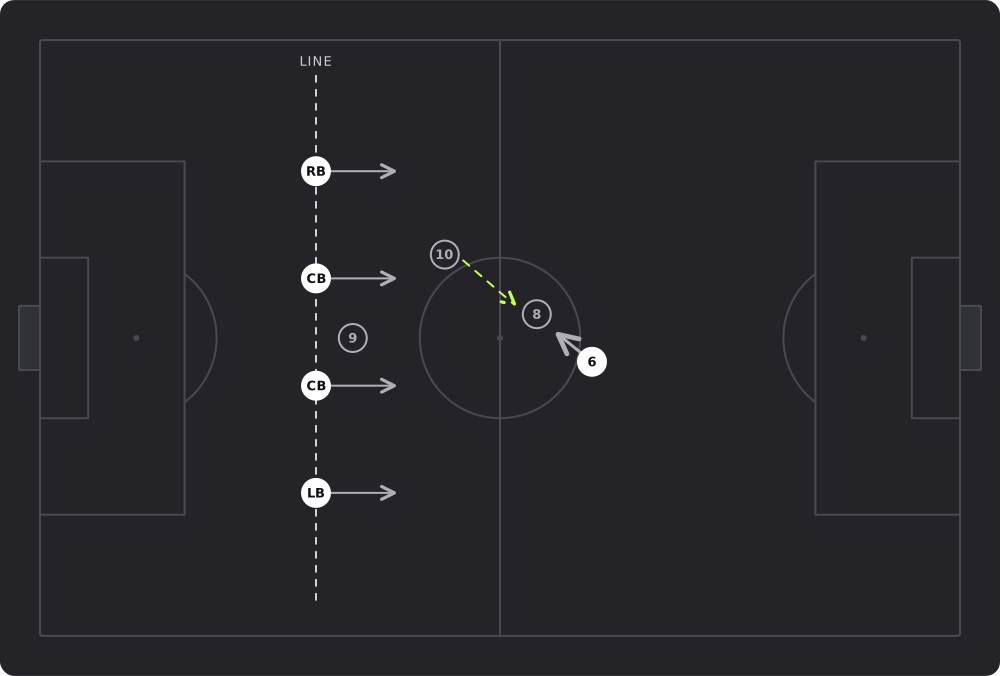
Pressure-cover-balance distributes one duel's risk across three players; remove any layer and the structure leaks.
Source: Coaching literature · applied
Outnumbered defending trades the ball for time; every second of delay shrinks the attackers' advantage.
Source: Coaching literature · applied
Blocks defend probability: central lanes produce the best chances, so compact teams sell the wings and guard the middle.
Source: Coaching literature · applied
Showing outside or inside is a pre-agreed team decision — the duel is steered, not merely contested.
Source: Coaching literature · applied
Backward ball plus pressured carrier is the line's green light: the danger of the ball in behind is momentarily off.
Source: Coaching literature · applied
The line's golden rule: pressure on the ball decides height. A free passer with a high line is a through-ball invitation.
Source: Coaching literature · applied
Zonal defending survives on hand-offs: the runner changes hands, the shape never changes shape.
Source: Coaching literature · applied
Pure schemes are museum pieces: today's blocks hold zones and grip men inside them simultaneously.
Source: Coaching literature · applied
Wing-backs are the accordion of a back five: wide in possession, folded into the line without it.
Source: Coaching literature · applied
Traps are timed to the passer's foot: step too early and he waits; too late and the runner is level and legal.
Source: Coaching literature · applied
Test 3The Great DefendersTake a test
Maldini's aphorism captures elite defending's real currency: position and anticipation, with the tackle as last resort.
Source: Football culture / interviews · recall
Five European titles across three different decades — the defender's career as a monument.
Source: UEFA official records · recall
Baresi conducted the line's steps and traps like a metronome; Milan retired his number in tribute.
Source: Club records · recall
Adams marshalled George Graham's famous back four; the raised arm became English football iconography.
Source: Premier League / club history · recall
Cannavaro's flawless Berlin summer earned defending's most recent Ballon d'Or — none has followed since.
Source: Ballon d'Or records · recall
Van Dijk reorganised everything around him: Liverpool won the Champions League in 2019 and the Premier League in 2020.
Source: Premier League / transfer records · recall
The BBC-era defence made Juventus' Serie A dominance a fortress project as much as an attacking one.
Source: Serie A records · recall
Dias' arrival rebuilt City's defence into title form; the writers' award acknowledged defending's quiet value.
Source: FWA records · recall
Cool, clean and inch-perfect against Brazil at full flight — the clip every defending course still opens with.
Source: FIFA 1970 records / football culture · recall
Kompany's leadership bridged City's first modern title to the centurion era — the defender as institution.
Source: Premier League records · recall
Test 4Defending the MomentTake a test
An unpressured passer defeats any trap: he simply waits out the step and plays the ball over it.
Source: Coaching literature · applied
The runner from deep is the trap's nightmare: the line must either track him or step perfectly — half-measures play him in.
Source: Coaching literature · applied
Line height is priced in recovery pace; when the insurance disappears, the premium is depth.
Source: Coaching literature · applied
Blocks defend as a single animal: the switch is met by collective travel, never by individual improvisation.
Source: Coaching literature · applied
The near post is the cross's fastest route to goal; owning that space kills half the delivery menu.
Source: Coaching literature · applied
The wide centre-back's channel duty is what makes a back three work; the chain behind him closes his vacancy.
Source: Coaching literature · applied
Ball-watching is defending's original sin; the shoulder-check keeps the runner and the ball in one picture.
Source: Coaching literature · applied
The keeper is the line's air-traffic control: his panorama makes his calls the trap's safety system.
Source: Coaching literature · applied
Recovery runs defend the destination, not the journey: goal-side positioning beats a losing footrace.
Source: Coaching literature · applied
Deep blocks convert quality into quantity; the siege is survivable only if the box work never switches off.
Source: Coaching literature · applied
Test 5Fortress Matches & SeasonsTake a test
The famous back four and its trap made 'one-nil to the Arsenal' a chant, a plan and a championship.
Source: English football records · recall
Cannavaro and company allowed nothing from open play in seven matches — a defensive tournament for the ages.
Source: FIFA 2006 records · recall
Fifteen against in thirty-eight games remains the league's defensive benchmark — structure as a title engine.
Source: Premier League records · recall
The hosts' defence, marshalled in front of Barthez, gave the attack a platform of near-total security.
Source: FIFA 1998 records · recall
The streak spanned the Euro 2020 triumph. Spain passed it in 2026, reaching 38 matches with the World Cup final win over Argentina.
Source: International football records · recall
The run remains the Premier League record for consecutive clean sheets: a defence and keeper in perfect sync.
Source: Premier League records · recall
Two exhausted, disciplined defences cancelled the world's best attackers until only the spot remained.
Source: FIFA 1994 records · recall
Fernando Santos' Portugal proved tournament football's oldest theorem: eliminate risk, survive, strike once.
Source: UEFA Euro 2016 records · recall
One boot, one save, one trophy: the final's margin between history and heartbreak was Martínez's left leg.
Source: FIFA 2022 records · recall
The scoreline became a philosophy: minimal risk, maximal organisation, and the offside flag as a weapon.
Source: Football culture / club history · recall
Test 6Defence in DataTake a test
Traps leave a paper trail: teams that step as a weapon harvest offsides at rates passive lines never approach.
Source: Football analytics literature · recall
Line height is defending's postcode: it tells you where a team has chosen to live before a ball is kicked.
Source: Tracking data analytics · applied
Deep defending's bargain in numbers: concede attempts, deny quality. Per-shot xG is the honest referee of that trade.
Source: Football analytics literature · applied
Action mix mirrors habitat: siege defenders clear, proactive line defenders intercept. Context reads before quality.
Source: Football analytics literature · applied
xGA prices the chances allowed; the gap to actual goals is where keeper brilliance — or misfortune — lives.
Source: Football analytics literature · recall
Where a team tackles is where a team defends: the action map is a block diagram drawn by the season itself.
Source: Football analytics literature · recall
Blame accounting matters: schemes are judged on patterns, players on the moments the pattern didn't cause.
Source: Opta definitions · applied
Duel geography follows block geography — the metric locates the war, not who is winning it.
Source: Football analytics literature · applied
The best blocks are toll gates: entries allowed is the count of vehicles that got through without paying.
Source: Football analytics literature · recall
Blocks are the deep block's final tax on shooters; the stat counts how often the wall answered before the keeper had to.
Source: Football analytics literature · applied
Test 7Schemes Against SchemesTake a test
Zones never get dragged but can lose runners between them; markers never lose their man but can be dragged anywhere.
Source: Coaching literature · recall
The fifth defender is a resource decision: more box security, less presence for pressing and possession.
Source: Coaching literature · recall
One insurance is procedural, the other physical; the best high lines carry both premiums.
Source: Coaching literature · applied
Sacchi's revolution was patricide: the country that perfected the sweeper produced the line that deleted him.
Source: Tactical history · recall
Complete teams do both, but resource allocation differs: kill the supply line, or fortify the target zone.
Source: Coaching literature · applied
High-variance versus low-variance defending: the trap is a leveraged position, the drop a savings account.
Source: Coaching literature · applied
Ball-watching collapses defending into a series of coin flips; the triangle exists to survive lost flips.
Source: Coaching literature · applied
Recruit monsters or build mazes: most elite defences quietly do both, but their training time reveals their faith.
Source: Coaching literature · recall
Every defensive shape is a bet on where danger comes from; the opponent's job is to make the other bet pay.
Source: Coaching literature · applied
Hybridity is star insurance: the scheme holds shape and still refuses the best opponent a free postcode.
Source: Coaching literature · applied
Test 8The Line in the SAOT Era: 2022-2026Take a test
Qatar 2022 introduced automated offside detection to the game's biggest stage, with decisions rendered in seconds.
Source: FIFA 2022 records · recall
Dozens of tracking points per player plus the ball's inertial sensor rebuild the offside freeze-frame automatically.
Source: FIFA technology documentation · recall
England adopted SAOT later than UEFA competitions, activating it in the closing months of 2024-25.
Source: Premier League announcements 2025 · recall
Flick bet a title on the trap — and won it, making the high line football's most argued-about idea of the season.
Source: La Liga 2024-25 season reviews · recall
The distinction decides whether a lurking attacker is played onside by the defender's touch — a regular VAR flashpoint.
Source: IFAB Laws of the Game 2022/23, Law 11 (deliberate play guidance) · recall
Marginal calls plus slow reviews drained goals of joy; SAOT's speed and consistency were the direct response.
Source: Football media / VAR history · recall
Precision cuts both ways: the trap's marginal wins are banked, and the attacker's marginal timing is protected too.
Source: Tactical literature / SAOT era analysis · applied
Lisbon 2025 was a defensive-scheme masterclass: compactness and discipline dethroning the era's dominant side.
Source: UEFA Women's Champions League 2025 records · recall
As the ball flew over presses, more defending happened in blocks again — the pendulum visible in the data.
Source: Opta Analyst / Premier League 2025-26 trends · applied
Far from killing the trap, measurement professionalised it: the line is now drilled, timed and audited to the frame.
Source: Tactical literature / SAOT era analysis · applied
Test 9When the Line FailsTake a test
Offside is measured against the second-to-last opponent: one laggard resets the entire line's work.
Source: IFAB Laws of the Game / coaching literature · applied
Traps without pressure on the ball are gifts: the free passer controls the clock the trap depends on.
Source: Coaching literature · applied
There is a floor to depth: below it, the block stops denying chances and starts hosting them.
Source: Coaching literature · applied
Ball-watching is a collective anaesthetic; the game punishes it through the man no one remembered existed.
Source: Coaching literature · applied
The line is a conversation; without constant talk it decays into individual guesses wearing the same shirt.
Source: Coaching literature · applied
Hand-offs fail in the handshake: the runner passed on but not picked up is the block's most common self-inflicted goal.
Source: Coaching literature · applied
A back five is arithmetic: minus one folding wing-back equals a back four's problems with a back three's numbers.
Source: Coaching literature · applied
Compactness is a bet, and the far post is where the opponent collects when the bet loses.
Source: Coaching literature · applied
Pressure-cover-balance is elastic, not infinite: each beaten layer spends the next one, until someone defends alone.
Source: Coaching literature · applied
The trap's old friend — human hesitation on marginal calls — has been retired; only timing survives automation.
Source: SAOT era analysis · applied
Test 10Mixed Review: Reading the LineTake a test
Line height lives on one question — is the ball pressured? — and the trap fires only when the answer is yes.
Source: Coaching literature · applied
Three numbers draw the picture: the line lives high, steps often, and rarely lets the war reach its own box.
Source: Football analytics literature · applied
The freeze-frame moment and the countable body parts are the two dials every millimetre verdict turns on.
Source: IFAB Laws of the Game, Law 11 · recall
Deflection versus deliberate play is the modern law's sharpest edge — identical positions, opposite outcomes.
Source: IFAB Laws of the Game 2022/23, Law 11 (deliberate play guidance) · applied
Two images of the coordinated line: the English trap's conductor and the Italian revolution's metronome.
Source: Football history · recall
Outnumbered defending is a rescue operation: survive the arithmetic until reinforcements change it.
Source: Coaching literature · applied
Three eras, one proof: championship mathematics can be solved from the back page of the ledger.
Source: Football records · applied
SAOT automated football's most contested line — and quietly professionalised the trap that plays against it.
Source: FIFA technology documentation · recall
The old maxims survive the new cameras: level is onside, in ink and now in pixels.
Source: IFAB Laws of the Game / SAOT era · applied
One champion trapped on the halfway line, another defended the box door shut: the scheme menu, fully priced, in one year.
Source: Season reviews 2024-25 · applied
Sources
IFAB Laws of the Game / UEFA & FIFA technical reports / Opta & StatsBomb definitions / coaching literature
- Coaching literature39
- Football analytics literature9
- IFAB Laws of the Game, Law 118
- Premier League records3
- Tactical history2
- FIFA 2022 records2
- FIFA technology documentation2
- IFAB Laws of the Game 2022/23, Law 11 (deliberate play guidance)2
- Tactical literature / SAOT era analysis2
- IFAB / football law history1
- Football law history1
- Football culture / interviews1
- UEFA official records1
- Club records1
- Premier League / club history1
- Ballon d'Or records1
- Premier League / transfer records1
- Serie A records1
- FWA records1
- FIFA 1970 records / football culture1
- English football records1
- FIFA 2006 records1
- FIFA 1998 records1
- International football records1
- FIFA 1994 records1
- UEFA Euro 2016 records1
- Football culture / club history1
- Tracking data analytics1
- Opta definitions1
- Premier League announcements 20251
- La Liga 2024-25 season reviews1
- Football media / VAR history1
- UEFA Women's Champions League 2025 records1
- Opta Analyst / Premier League 2025-26 trends1
- IFAB Laws of the Game / coaching literature1
- SAOT era analysis1
- Football history1
- Football records1
- IFAB Laws of the Game / SAOT era1
- Season reviews 2024-251