
Football · Level 5: Upper-Intermediate · Sub-level 5.2
Possession Philosophies
10 tests · 100 facts · updated 12 October 2026 · markdown
Total Football, Cruyff's Dream Team, tiki-taka, juego de posición and relationism: superiorities, the third man, rondos, possession metrics — and the failure modes of the ball-dominant game.
Each test below is ten questions on Insporta. The list under a test is what the questions check: one fact per question, with the source it was written from. Read it before the test, or come back from a wrong answer.
Test 1From Total Football to Tiki-TakaTake a test
Total Football's core was universality: defenders attacked, forwards defended, and rotations made the side impossible to mark.
Source: Coaching history / UEFA archives · recall
Cruyff carried Total Football's DNA from Amsterdam to Catalonia, creating the possession identity Barcelona still follows.
Source: Club history · recall
Barcelona won La Liga in 1991, 1992, 1993 and 1994 — the competitive proof of Cruyff's possession project.
Source: La Liga official records · recall
Koeman's thunderous extra-time free kick gave Cruyff's Dream Team the club's long-awaited first European Cup.
Source: UEFA official records · recall
The Núñez board opened the residence in October 1979; when Cruyff returned as coach in 1988 he had every age group drilled in the same Ajax-inspired skills and style, and La Masia became the production line of the possession school.
Source: Club history · recall
Montes used 'tiki-taka' to describe Spain's rapid short passing; the label stuck to the entire era that followed.
Source: Spanish football media history · recall
Guardiola was Cruyff's on-pitch brain at the base of midfield — the role he later demanded from Busquets and Rodri.
Source: Club history · recall
Euro 2008, the 2010 World Cup and Euro 2012. Argentina later matched the run with the 2021 Copa America, the 2022 World Cup and the 2024 Copa America.
Source: UEFA / FIFA official records · recall
For the Cruyff school, keeping the ball is simultaneously the best attacking and the best defensive strategy.
Source: Cruyff interviews / coaching literature · recall
The rookie coach swept everything, and by the end of calendar 2009 Barcelona had won six trophies out of six.
Source: Club / UEFA records · recall
Test 2The Grammar of Positional PlayTake a test
Positional play organises occupation of space: with the grid, staggered positions and superiorities are trained deliberately, not left to chance.
Source: Tactical literature (positional play) · applied
Adding the keeper makes it 3v2: someone must always be free, and the press can be played through.
Source: Tactical literature · applied
Positional superiority is about where you receive: between the lines, behind markers, facing play — better position, not more players.
Source: Tactical literature · applied
Qualitative superiority means winning a deliberate mismatch: the structure exists to feed your best duel repeatedly.
Source: Tactical literature · applied
Third-man combinations reach players no direct pass can find — the receiver arrives facing play, unmarked in stride.
Source: Tactical literature · applied
Finding the free man is the constant objective of positional play; superiorities exist to guarantee he appears.
Source: Tactical literature · applied
The rondo compresses the core of possession football — angles, one-touch speed and press resistance — into one drill.
Source: Coaching literature · applied
Staggering stops players occupying the same lane, which would let one defender shadow two options at once.
Source: Tactical literature (positional play) · applied
The opening circulation is preparation: only when the structure is set and the opponent stretched does penetration begin.
Source: Guardiola interviews / tactical literature · applied
Possession as defence: every minute the ball circulates safely is a minute of attack the opponent never gets.
Source: Coaching literature · applied
Test 3Architects of PossessionTake a test
The all-La Masia trio dictated the 3-1 Wembley masterclass against Manchester United — the summit of the possession era.
Source: UEFA official records · recall
Busquets was the positional reference: one touch to escape pressure, always the free angle, rarely spectacular, always essential.
Source: Club records · recall
Aragonés committed Spain to the short-passing identity and won Euro 2008; his successor inherited a machine.
Source: UEFA records · recall
Del Bosque continued Aragonés' possession blueprint and completed the historic treble of consecutive tournaments.
Source: FIFA / UEFA records · recall
Fourteen trophies in four years, including two Champions Leagues — the most decorated stretch in the club's history.
Source: Club records · recall
At the Bernabéu in May 2009, Messi dropped into midfield, Real's centre-backs had no one to mark, and Barcelona ran riot.
Source: La Liga records / tactical history · recall
Sarri's Napoli automated one-touch possession patterns at high speed — a distinct, more vertical branch of the possession family.
Source: Serie A records / tactical literature · recall
Postecoglou's teams commit to high-line, front-foot possession regardless of opponent — fans dubbed it Angeball.
Source: Premier League / SPFL records · recall
The metronome of the tiki-taka era returned as coach and delivered the 2022-23 league title.
Source: La Liga records · recall
City's 2022-23 treble — Premier League, FA Cup and Champions League — crowned Guardiola's positional project in England.
Source: Premier League / UEFA records · recall
Test 4Solving the Game with the BallTake a test
The extra man dissolves the press: with 3v2, one passer is always free, and the first line can be beaten cleanly.
Source: Tactical literature · applied
Ball-oriented blocks pay for compactness by abandoning the far side; fast switches make them defend the full width repeatedly.
Source: Tactical literature · applied
Flat structures kill possession: without different heights there are no angles, no third-man options and no line-breaking lanes.
Source: Tactical literature (positional play) · applied
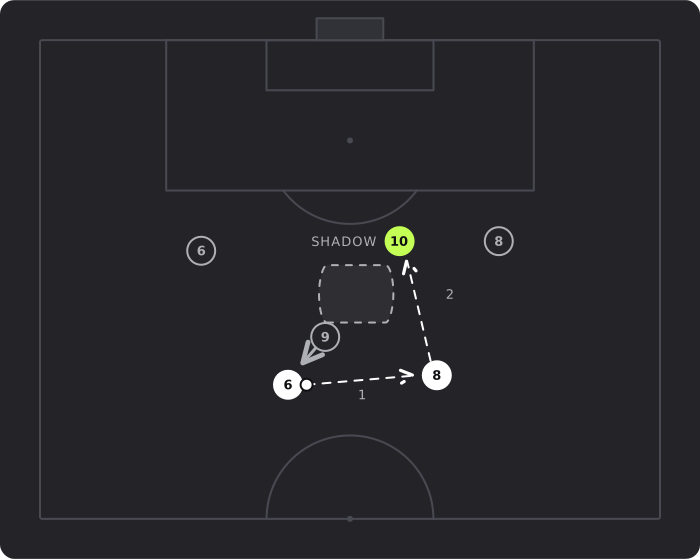
When shadows block direct lanes, the third man beats them: the ball travels around the screen faster than the presser can react.
Source: Tactical literature · applied
Against all-pitch man-marking, movement replaces station-keeping: rotations force defenders to either follow (opening space) or pass on (losing the man).
Source: Tactical literature · applied
Baiting the press is possession's counter-weapon: every opponent who steps up leaves the zone behind him unguarded.
Source: Tactical literature · applied
Circulation is scanning: the recurring late defender is the crack the possession team has been manufacturing.
Source: Tactical literature · applied
Depth runs are what stretch a defence vertically; without them, dropping movements just compress the playing space.
Source: Tactical literature · applied
Body orientation before receiving is the hidden engine of possession play: it turns circulation into penetration.
Source: Coaching literature · applied
Late-game possession is energy management and defence at once: the chasing team tires exactly when it most needs to attack.
Source: Coaching literature · applied
Test 5Possession MasterclassesTake a test
Two years of criticism about 'boring' tiki-taka ended with the most dominant final performance in Euro history.
Source: UEFA official records · recall
United barely touched the ball; even Sir Alex Ferguson conceded no one had ever given his teams such a 'hiding'.
Source: UEFA records / match history · recall
Deep into extra time, Iniesta's volley won Spain their first World Cup — possession patience rewarded at the very death.
Source: FIFA official records · recall
The five-goal dismantling — celebrated with a raised open hand, the 'manita' — was peak Guardiola-era dominance.
Source: La Liga records · recall
Torres' dinked finish beat Lahm and Lehmann; the 1-0 win opened Spain's era of tournament domination.
Source: UEFA official records · recall
Eto'o struck early and Messi — the smallest man on the pitch — headed the second: the first treble was sealed.
Source: UEFA official records · recall
Messi, Suárez and Neymar added directness to the possession base; Rakitic, Suárez and Neymar scored in Berlin.
Source: UEFA official records · recall
Football's most influential losing team dazzled the world and then watched Gerd Müller's winner take the trophy in Munich.
Source: FIFA official records · recall
Ajax won in 1971, 1972 and 1973, exporting Total Football's principles to the entire continent.
Source: UEFA official records · recall
With limited training time, Spain relied on a common football language — largely La Masia's — showing the style is an idea, not a squad.
Source: Tactical literature · applied
Test 6Measuring the BallTake a test
Most data providers derive possession from pass share, which is why it can differ slightly between sources.
Source: Football analytics literature · recall
Field tilt asks not who has the ball, but where: it separates dominant possession from harmless deep circulation.
Source: Football analytics literature · recall
Possession without tilt is circulation without threat: the ball lives far from the opponent's goal.
Source: Football analytics literature · applied
Long sequences that reach the danger zone distinguish productive positional play from passing for its own sake.
Source: Opta definitions · recall
Completion percentage rewards safety; attackers pass into the hardest zones, so their percentages are naturally lower.
Source: Football analytics literature · applied
Slow direct speed is a stylistic fingerprint, not a flaw: positional sides advance only once the structure is ready.
Source: Opta definitions · recall
Good teams tend to have the ball, but chasing the statistic without penetration produces sterile domination, not points.
Source: Football analytics literature · applied
Pass length is one of the cleanest style markers: it describes how a team plays, not how well.
Source: Football analytics literature · recall
The U is the signature of blocked possession: wide, backwards, wide again — penetration is what breaks the U.
Source: Tactical / analytics literature · applied
Volume plus accuracy at that level only occurs when a team monopolises the ball by design.
Source: Football analytics literature · applied
Test 7Schools of the BallTake a test
Positional play is possession with a destination; the criticism of tiki-taka targets passing that becomes an end in itself.
Source: Tactical literature · recall
The quote (via Perarnau) separates Guardiola's positional idea from its caricature: possession is a tool, never the goal.
Source: Perarnau, 'Pep Confidential' · recall
Diniz's players cluster, combine and improvise on the ball side — the structural opposite of staggered grid occupation.
Source: Tactical literature (relationism debate) · recall
Cruyff systematised Michels' fluidity; Guardiola tightened it further into explicit zone rules and rehearsed superiorities.
Source: Tactical literature · recall
Style should fit the players: a possession idiom monetises technique and intelligence rather than duels and sprints.
Source: Coaching literature · applied
The 3-4-3 diamond maximised passing triangles all over the pitch — geometry in service of possession.
Source: Tactical history · recall
Structure choices are trade-offs: the second pivot you push forward is the insurance you no longer have when the ball is lost.
Source: Tactical literature · applied
Rondos train retention in place; positional games train retention with progression — the step from keeping to advancing.
Source: Coaching literature · recall
Yamal and Williams gave Spain 2024 vertical teeth that the pure circulation of 2012 lacked — possession with express lanes.
Source: UEFA Euro 2024 technical observations · applied
Built on the same La Masia idiom — and stars like Bonmatí and Putellas — Barcelona Femení made positional play the women's benchmark too.
Source: UEFA Women's Champions League records · recall
Test 8Possession Now: 2023-2026Take a test
The pivote in the Busquets lineage anchored Spain's title run and claimed football's biggest individual prize months later.
Source: UEFA Euro 2024 records / Ballon d'Or 2024 · recall
Spain kept the ball but attacked with unprecedented verticality through Yamal and Williams — synthesis, not nostalgia.
Source: UEFA Euro 2024 technical observations · applied
Flick's first season delivered the 28th title, with Yamal as the face of the new generation and a 4-0 win at the Bernabéu.
Source: La Liga 2024-25 records · recall
Back-to-back titles under Flick were sealed 2-0 against Real Madrid on 10 May 2026.
Source: La Liga 2025-26 records · recall
In Munich in May 2025, Luis Enrique's possession-and-press side produced the most one-sided final in the competition's history.
Source: UEFA official records · recall
Kvaratskhelia's season crowned PSG's back-to-back triumphs — Luis Enrique's third Champions League as a coach.
Source: UEFA Champions League 2025-26 records · recall
Fluminense's fluid, ball-side combination play won South America's biggest prize, giving relationism its flagship trophy.
Source: CONMEBOL official records · recall
Fittingly, the positional side's pivot scored the goal that completed Guardiola's second continental treble.
Source: UEFA official records · recall
Built around Barcelona Femení's midfield idiom, Spain's world title confirmed the possession school's reach in the women's game.
Source: FIFA Women's World Cup 2023 records · recall
Football is dialectic: as opponents go direct and sit deeper, positional sides face fewer presses to bait and more low blocks to unlock.
Source: Opta Analyst / Premier League 2025-26 trends · applied
Test 9When Possession Goes WrongTake a test
Playing out from the back multiplies value when it works and danger when it fails; personnel must fit the idea.
Source: Coaching literature · applied
Depth threat is what pins defences; remove it and the block compresses exactly the space possession needs.
Source: Tactical literature · applied
Possession is only the precondition; without line-breaking passes and box entries it is theatre, not threat.
Source: Tactical / analytics literature · applied
Good spacing serves both phases: bad occupation in attack becomes bad protection the instant the ball turns over.
Source: Tactical literature · applied
Qualitative superiority bends the opponent's structure; the possession team's job is to find the space the bending creates.
Source: Tactical literature · applied
Blocks defend at the speed of the ball: only one- and two-touch tempo moves defenders faster than they can recover.
Source: Coaching literature · applied
Mature possession sides keep the direct escape valve: an intelligent long ball against a full press is positional play too.
Source: Coaching literature · applied
Inverted full-backs trade width for central control; without natural width elsewhere, the block can shrink the pitch safely.
Source: Tactical literature · applied
'Death by a thousand passes': the cumulative cost of chasing pays out late, which is why possession teams score so often after 70 minutes.
Source: Tactical / sports science literature · applied
Ideas are downstream of players: positional play assumes press-resistant technicians, which is why academies teach it from childhood.
Source: Coaching literature · applied
Test 10Mixed Review: Speaking PossessionTake a test
Grids, corridors and occupation caps are the visible grammar of positional play.
Source: Tactical literature · applied
Superiorities are the currency of positional play; the scout is describing its two most common denominations.
Source: Tactical literature · applied
The rondo is possession football in miniature — angles, speed, body shape and composure under pressure.
Source: Coaching literature · applied
The Euro 2012 final was tiki-taka's statistical and competitive high-water mark.
Source: UEFA records · applied
High tilt and productive long sequences are exactly what separate real dominance from empty possession.
Source: Football analytics literature · applied
Player-pivote, then the most decorated coach of the positional school across three leagues.
Source: Football history · applied
All three podium places from a single youth system remains unique — the ultimate validation of Barcelona's school.
Source: Ballon d'Or records · recall
A decade apart, Luis Enrique fused possession structure with direct attacking to sweep every trophy at two superclubs.
Source: Club / UEFA records · recall
Fourteen passes, a Cruyff surge, a foul, and Neeskens' penalty: Total Football's most famous opening statement.
Source: FIFA records · recall
The positional-versus-relationist debate — Guardiola's grid versus Diniz's relations — is modern football's liveliest stylistic argument.
Source: Tactical literature · applied
Sources
IFAB Laws of the Game / UEFA & FIFA technical reports / Opta & StatsBomb definitions / coaching literature
- Tactical literature23
- Coaching literature11
- UEFA official records9
- Football analytics literature8
- Club history3
- Tactical literature (positional play)3
- Club / UEFA records2
- Club records2
- UEFA records2
- La Liga records2
- FIFA official records2
- Opta definitions2
- Tactical / analytics literature2
- UEFA Euro 2024 technical observations2
- Coaching history / UEFA archives1
- La Liga official records1
- Spanish football media history1
- UEFA / FIFA official records1
- Cruyff interviews / coaching literature1
- Guardiola interviews / tactical literature1
- FIFA / UEFA records1
- La Liga records / tactical history1
- Serie A records / tactical literature1
- Premier League / SPFL records1
- Premier League / UEFA records1
- UEFA records / match history1
- Perarnau, 'Pep Confidential'1
- Tactical literature (relationism debate)1
- Tactical history1
- UEFA Women's Champions League records1
- UEFA Euro 2024 records / Ballon d'Or 20241
- La Liga 2024-25 records1
- La Liga 2025-26 records1
- UEFA Champions League 2025-26 records1
- CONMEBOL official records1
- FIFA Women's World Cup 2023 records1
- Opta Analyst / Premier League 2025-26 trends1
- Tactical / sports science literature1
- Football history1
- Ballon d'Or records1
- FIFA records1