
Football · Level 5: Upper-Intermediate · Sub-level 5.1
Pressing Triggers & Gegenpressing
10 tests · 100 facts · updated 12 October 2026 · markdown
From Michels and Sacchi to Klopp and Iraola: pressing triggers, counterpressing principles, cover shadows, traps, PPDA and high turnovers — and what happens when the press breaks.
Each test below is ten questions on Insporta. The list under a test is what the questions check: one fact per question, with the source it was written from. Read it before the test, or come back from a wrong answer.
Test 1Origins of the PressTake a test
Michels' Ajax won the 1971 European Cup (his successor Kovacs added 1972 and 1973), and his 1974 Netherlands hunted the ball collectively high up the pitch, laying the foundation of modern pressing.
Source: Coaching history / UEFA archives · recall
Working with scientist Anatoliy Zelentsov, Lobanovskyi treated the team as a dynamic system and drilled collective pressing decades before it became mainstream in the West.
Source: Coaching history · recall
Sacchi's compact 4-4-2 with aggressive zonal pressing and a high line won consecutive European Cups in 1989 and 1990, revolutionising defensive tactics.
Source: UEFA official records · recall
Rangnick's ZDF Sportstudio appearance introduced zonal, ball-oriented pressing to a wide German audience; his ideas later shaped a generation of coaches.
Source: German football history · recall
Gegen = against/counter: pressing immediately against the opponent's counter-attack the moment possession is lost.
Source: Coaching terminology · recall
Klopp coached Mainz first, but it was at Dortmund (2008-2015) that his gegenpressing side won back-to-back Bundesliga titles in 2011 and 2012.
Source: Bundesliga official records · recall
Klopp argued that winning the ball high, against a disorganised opponent, creates better chances than any single creative pass — hence the press is the best playmaker.
Source: Klopp interviews / coaching literature · recall
Sacchi's rule of roughly 25 metres between the first and last line compressed space, making Milan's zonal press suffocating.
Source: Coaching literature (Sacchi) · recall
As sporting director of the Red Bull clubs, Rangnick embedded high-intensity pressing and fast transitions as a shared playing identity in Salzburg and Leipzig.
Source: Club history / Red Bull football · recall
Barcelona's players counterpressed at full intensity for about six seconds after losing the ball; if it was not regained, the team dropped into its organised shape.
Source: Coaching literature (Guardiola's Barcelona) · recall
Test 2Principles & TriggersTake a test
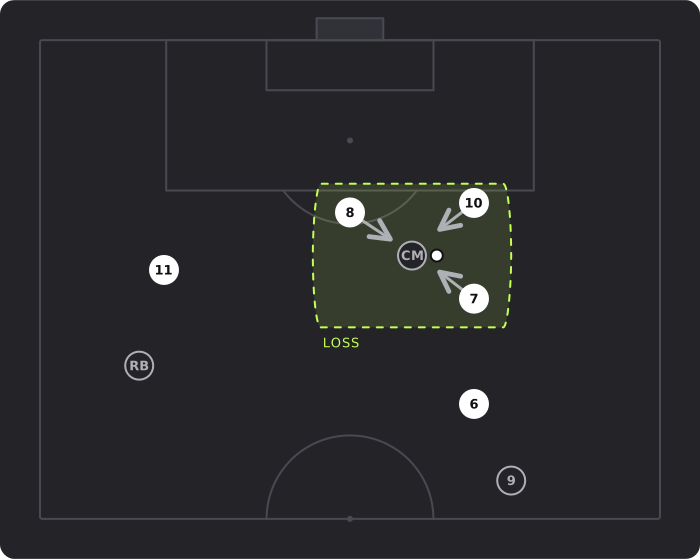
Triggers are agreed cues — like a slow square pass — that synchronise the team so everyone presses at the same moment instead of individually.
Source: Coaching literature · applied
A heavy touch means the ball is momentarily uncontrolled and the receiver's options collapse — a perfect moment to attack the ball.
Source: Coaching literature · applied
Gegenpressing attacks the opponent in the seconds after the turnover, when their structure is at its most disorganised.
Source: Coaching literature · applied
Rest defence is the shape a team keeps behind the ball while in possession, ready to counterpress or absorb a counter-attack the instant the ball is lost.
Source: Coaching terminology · applied
Vertical and horizontal compactness deny opponents space between the lines and make collective pressing possible.
Source: Coaching terminology · applied
Ball-oriented (zonal) defending compresses space around the ball; the far side is left free because the ball takes time to travel there.
Source: Coaching terminology · applied
The cover shadow is the zone behind a pressing player where passes are screened off — one player can thus remove two options at once.
Source: Coaching terminology · applied
The curve lets the presser attack the ball and screen a lane with his cover shadow simultaneously, forcing play where the team wants it.
Source: Coaching literature · applied
The five-to-six-second window reflects how long the opponent stays disorganised; beyond it, continued chasing wastes energy and breaks the team's shape.
Source: Coaching literature · applied
A 'jump' is when a defender leaves his line or zone to press a free receiver; teammates must cover the space he vacates.
Source: Coaching terminology · applied
Test 3Pressing Masters & Their TeamsTake a test
After losing the 2018 final, Liverpool beat Tottenham 2-0 in Madrid in June 2019 — the peak of Klopp's gegenpressing project.
Source: UEFA official records · recall
Nagelsmann is a product of the German pressing school: Hoffenheim, RB Leipzig, Bayern, then the national team.
Source: German football records · recall
Bielsa's teams press man-for-man all over the pitch with extreme running demands; his ideas influenced Pochettino, Guardiola and many others.
Source: Coaching history · recall
Gasperini's Atalanta accepted 1v1 duels everywhere on the pitch — the most radical man-marking press in a top-five league.
Source: Serie A records / tactical literature · recall
Pochettino, shaped by Bielsa's methods, built Spurs around an aggressive press and reached the 2019 final against Liverpool.
Source: UEFA records · recall
Simeone's Atlético shows that elite defending does not require a high press: his compact mid-low 4-4-2 block won two La Liga titles.
Source: La Liga records · recall
Klopp joked that Wenger's silent, controlled 'orchestra' was not for him: 'I like heavy metal' — fast, loud, transition-driven football.
Source: Klopp interviews · recall
Slot arrived from Feyenoord in 2024 and won the Premier League title in his very first season at Anfield.
Source: Premier League records · recall
De Zerbi's Brighton held the ball deep on purpose to lure the press, then broke the first two lines with quick combinations into the space vacated.
Source: Premier League / tactical literature · recall
At all three clubs Guardiola's positional play kept players close to the ball, allowing instant counterpressure the moment possession was lost.
Source: Club records · recall
Test 4Reading the TriggersTake a test
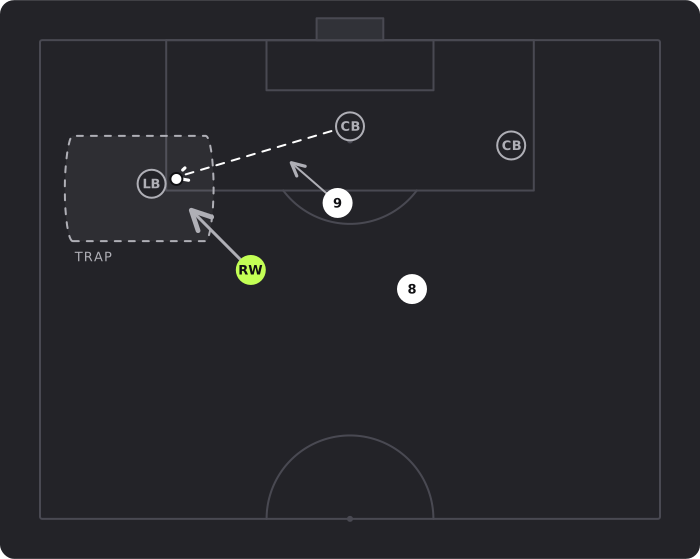
The seconds while the ball is loose from a bad touch are exactly when a press succeeds most often.
Source: Coaching literature · applied
Near the touchline the receiver can only play inside, back or long — a slow pass gives the press time to arrive and trap him.
Source: Coaching literature · applied
A closed body shape means he cannot see pressure coming; pressing the blind side often forces a turnover or a backward pass.
Source: Coaching literature · applied
A back-pass moves the opponent away from your goal; stepping up as a unit keeps the block compact and traps them deep.
Source: Coaching literature · applied
Steering play with curved runs channels the opponent into areas where the pressing side has numbers ready to win the ball.
Source: Coaching literature · applied
Once a line is broken, the priority becomes delaying the attack and re-forming; the nearest pivot presses the receiver to buy time.
Source: Coaching literature · applied
A diagonal switch takes two to three seconds in the air — enough time for the block to shift and arrive on the receiver's first touch.
Source: Coaching literature · applied
Bouncing balls and back-to-goal receptions each invite pressure; together they make a regain highly likely.
Source: Coaching literature · applied
If only the forwards press after a back-pass, gaps open behind them; the whole unit must climb together to sustain pressure.
Source: Coaching literature · applied
Game state changes the risk calculus: late on, protecting depth and denying big chances usually outweighs hunting turnovers high.
Source: Coaching literature · applied
Test 5Matches That Defined the PressTake a test
Trailing 0-3 from Camp Nou, Liverpool pressed Barcelona into repeated errors at Anfield and won the tie 4-3 on aggregate.
Source: UEFA official records · recall
Alexander-Arnold spotted Barcelona's defenders switched off and played the corner instantly for Origi to score — 'corner taken quickly!'
Source: UEFA official records · recall
The 5-2 final win completed Dortmund's 2011-12 domestic double and remains the emblem of Klopp's Dortmund at full power.
Source: DFB official records · recall
Germany scored in the 11th, 23rd, 24th, 26th and 29th minutes, ruthless pressing and transitions collapsing Brazil in 18 minutes.
Source: FIFA official records · recall
Barcelona pressed PSG from the first whistle and scored three times from the 88th minute on to complete the greatest comeback in Champions League history.
Source: UEFA official records · recall
At Anfield, Liverpool's pressure and transitions produced a record 7-0 win over their fiercest rivals.
Source: Premier League records · recall
At Wembley, two teams of the German pressing school met; Robben's late winner decided it for Bayern.
Source: UEFA official records · recall
Milan's suffocating press and movement produced one of the most dominant final performances ever: 4-0, two each for Gullit and Van Basten.
Source: UEFA official records · recall
City's press and territorial control barely let Madrid leave their half — a masterclass in sustained pressure before the 2023 treble.
Source: UEFA records / match analysis · applied
Gegenpressing is about exploiting moments of opponent disorganisation; Alexander-Arnold applied exactly that logic to a dead-ball situation.
Source: Tactical literature · applied
Test 6Numbers of the PressTake a test
PPDA divides the opponent's passes by the defending team's defensive actions in the pressing zone — the standard proxy for pressing intensity.
Source: Football analytics literature · recall
Lower PPDA means the team interrupts the opponent's passing more frequently: fewer passes are 'allowed' before a defensive action occurs.
Source: Football analytics literature · applied
The metric ignores actions near a team's own goal so that it captures deliberate pressing rather than ordinary deep defending.
Source: Football analytics literature · recall
Opta logs a high turnover whenever a team wins the ball inside the 40 metres nearest the opposition goal — the raw material of pressing attacks.
Source: Opta definitions · recall
Analysts commonly class PPDA under roughly 10 as an aggressive high press, 10-15 as mixed, and higher values as passive or deep-block defending.
Source: Football analytics literature · applied
PPDA counts active defensive interventions — tackles, interceptions, challenges and fouls — not restarts or refereeing decisions.
Source: Football analytics literature · recall
The metric connects pressing to output: a regain within 40 metres of goal that produces a shot in the same possession.
Source: Opta definitions · recall
High PPDA values mean many opposition passes go unchallenged in the pressing zone — the signature of teams that defend deep by choice.
Source: Football analytics literature · applied
PPDA measures intent and frequency, not quality: a badly synchronised press generates many defensive actions and many dangerous transitions against.
Source: Football analytics literature · applied
Counting regains inside the five-second window after a loss captures exactly the behaviour gegenpressing tries to produce.
Source: Football analytics literature · recall
Test 7Press versus PressTake a test
Man-oriented schemes assign opponents; zonal schemes assign spaces and passing lanes — most modern teams blend both.
Source: Coaching literature · applied
The counterpress is a transition behaviour; the high press is a settled out-of-possession structure. Elite teams need both.
Source: Coaching literature · recall
High press, mid-block and low block are distinguished by the line of engagement — where the team begins to defend actively.
Source: Coaching terminology · applied
Containing trades a regain attempt for control: the defender delays until support arrives, steering the attacker into less dangerous areas.
Source: Coaching literature · applied
Space-oriented counterpressing floods the zone around the loss, accepting that the far side is temporarily abandoned.
Source: Tactical literature · recall
Bielsa and Gasperini accept 1v1 duels everywhere; Klopp's press hunts the ball collectively in zones with cover shadows.
Source: Tactical literature · recall
Sitting deeper draws the opponent out and leaves space in behind — exactly what fast forwards exploit best.
Source: Coaching literature · applied
Good attacking structure is the precondition of a good counterpress: short distances mean pressure arrives within a second of the loss.
Source: Tactical literature · recall
Instead of attacking the ball directly, players occupy the escape lanes so the panicked first pass is picked off in stride.
Source: Tactical literature · recall
Traps weaponise the opponent's 'free' option: the pass everyone can see is the pass the pressing team wants played.
Source: Coaching literature · recall
Test 8The Modern Press 2023-2026Take a test
Iraola's Bournemouth allowed opponents fewer than ten passes per defensive action — the league's most aggressive press that season.
Source: Opta / Premier League 2024-25 data · recall
Bournemouth also produced the most shot-ending high turnovers (68), turning pressing directly into output better than anyone.
Source: Opta / Premier League 2024-25 data · recall
Analytics platforms observed Liverpool pressing less often under Slot while remaining defensively strong — control replaced constant chaos.
Source: Soccerment / analytics reports 2024-25 · recall
2023-24 marked the peak of the league-wide pressing era; the average then fell to 14.6 in 2024-25 as styles became more direct.
Source: Opta Analyst · recall
With passing volume at its lowest in over a decade and more long balls, there were simply fewer build-up sequences to press against.
Source: Opta Analyst / Premier League 2025-26 trends · applied
Guardiola's City defend partly through possession itself, choosing moments to press instead of hunting every ball.
Source: Analytics reports 2024-25 · applied
Bournemouth's 18-game unbeaten streak in 2025-26 crowned the project and helped secure European qualification.
Source: Premier League 2025-26 records · recall
Arsenal's fourth Premier League title in 2025-26 was built on positional pressing traps, defensive control and the league's most feared set pieces.
Source: Premier League 2025-26 records · recall
Lookman's hat-trick and Atalanta's suffocating man-to-man press handed Xabi Alonso's Leverkusen their only defeat of 2023-24.
Source: UEFA official records · recall
Luis Enrique's PSG paired positional play with ferocious counterpressing — short distances around the ball made instant regains routine.
Source: UEFA records / match analysis 2025-26 · applied
Test 9When the Press BreaksTake a test
The space behind a high line is the press's structural weakness; one accurate long ball converts it into a clear chance.
Source: Coaching literature · applied
Pressing works only as a collective, connected action; an isolated presser is bypassed with two passes.
Source: Coaching literature · applied
Beyond the disorganisation window the chase only burns energy and pulls the team apart; recovery of shape becomes the priority.
Source: Coaching literature · applied
Pressing is the most physically expensive defensive style; without rotation it decays exactly when matches are decided.
Source: Sports science / coaching literature · applied
Press-baiting teams want you to commit players forward; disciplined pressing attacks the ball and the lanes simultaneously.
Source: Coaching literature · applied
This is the logic behind 'gegenpressing is the best playmaker': the regain itself creates the chance.
Source: Coaching literature · applied
Square passes are dangerous precisely because their interception leaves the entire passing line eliminated and the field open.
Source: Coaching literature · applied
A press without connected lines creates exactly the space between units that playmakers live in.
Source: Coaching literature · applied
Traps depend on the far side being closed just enough; one player's positioning error turns the trap into an exit door.
Source: Coaching literature · applied
The space full-backs leave behind is the classic counter-attacking highway; rest defence exists precisely to close it.
Source: Coaching literature · applied
Test 10Mixed Review: The Complete PresserTake a test
The instruction captures the counterpress in one sentence: instant, time-limited collective pressure after the loss.
Source: Coaching literature · applied
A PPDA that low sits firmly in aggressive-press territory; build-up patterns and press-resistance will decide the match.
Source: Football analytics literature · applied
That career path and the 'heavy metal football' identity belong to Klopp, the face of gegenpressing for two decades.
Source: Coaching history · applied
Curved pressing runs create cover shadows: one player pressures the ball while erasing a passing option behind him.
Source: Coaching terminology · applied
Alexander-Arnold's instant delivery to Origi punished a moment of collective inattention — pressing mentality applied to a set piece.
Source: UEFA official records · recall
The line of engagement defines the block: halfway-line engagement is a mid-block, engagement near the opponent's box is a high press.
Source: Coaching terminology · applied
Opta's high-turnover definition anchors pressing analysis to the 40 metres nearest the opposition goal.
Source: Opta definitions · recall
Sacchi's 25-metre compactness rule made his Milan the reference point for every pressing team since.
Source: Coaching literature (Sacchi) · applied
Chance quality after a high regain decays within seconds as defenders recover; speed converts the turnover into the chance.
Source: Football analytics literature · applied
Andoni Iraola's Bournemouth converted the league's most productive press into ten goals directly from high turnovers.
Source: Opta / Premier League 2024-25 data · recall
Sources
IFAB Laws of the Game / UEFA & FIFA technical reports / Opta & StatsBomb definitions / coaching literature
- Coaching literature30
- Football analytics literature10
- UEFA official records9
- Coaching terminology9
- Tactical literature5
- Coaching history3
- Opta definitions3
- Opta / Premier League 2024-25 data3
- Coaching literature (Sacchi)2
- Premier League records2
- Premier League 2025-26 records2
- Coaching history / UEFA archives1
- German football history1
- Bundesliga official records1
- Klopp interviews / coaching literature1
- Club history / Red Bull football1
- Coaching literature (Guardiola's Barcelona)1
- German football records1
- Serie A records / tactical literature1
- UEFA records1
- La Liga records1
- Klopp interviews1
- Premier League / tactical literature1
- Club records1
- DFB official records1
- FIFA official records1
- UEFA records / match analysis1
- Soccerment / analytics reports 2024-251
- Opta Analyst1
- Opta Analyst / Premier League 2025-26 trends1
- Analytics reports 2024-251
- UEFA records / match analysis 2025-261
- Sports science / coaching literature1