
Football · Level 5: Upper-Intermediate · Sub-level 5.9
Formations & Their Logic
10 tests · 100 facts · updated 12 October 2026 · markdown
From the 2-3-5 pyramid and Chapman's WM to Bielsa's 3-3-1-3, Alonso's 3-4-2-1 and Guardiola's 3-2-4-1: how numeric shapes evolved, how coaches use them, how they transform between in-possession and out-of-possession, and how they break down.
Each test below is ten questions on Insporta. The list under a test is what the questions check: one fact per question, with the source it was written from. Read it before the test, or come back from a wrong answer.
Test 1Evolution of the ShapeTake a test
Wrexham FC and Cambridge University developed the 2-3-5 pyramid in the 1870s; by 1890 it was the near-universal shape across British football and its export markets.
Source: FA history / Jonathan Wilson 'Inverting the Pyramid' · recall
Chapman pulled a centre-half back into defence to answer the new two-defender offside rule, producing a 3-2-2-3 shape informally known as the 'WM' after its two triangles.
Source: Arsenal FC archives · recall
Before 1925 an attacker required three defenders between him and the goal to be onside. The change to two forced formations, tactics and coaching to shift almost immediately.
Source: IFAB Laws history · recall
Pozzo's Metodo pulled two players back to form a 2-3-2-3 shape; Italy's two consecutive World Cups made it the most successful national-team formation of the 1930s.
Source: FIFA archives · recall
Brazil's 1958 side, featuring a 17-year-old Pelé, popularised the 4-2-4 into a shape used through the 1960s across Europe, before it split into 4-3-3 and 4-4-2 variants.
Source: FIFA archives · recall
Herrera's Grande Inter won two European Cups in 1964 and 1965 with catenaccio's 1-3-3-3 shape, the sweeper's freedom transforming the reading of defensive space.
Source: UEFA archives · recall
The Total Football system operated from a nominal 4-3-3 base, though the whole point was fluid positional rotation, with any outfield player capable of occupying any role temporarily.
Source: Coaching history / Wilson 'Inverting the Pyramid' · recall
Ferguson's Manchester United used variations of 4-4-2, sometimes a 4-4-1-1 with a withdrawn striker, across five Premier League titles in the 1990s.
Source: Premier League history · recall
Sacchi's 4-4-2 was defined less by numbers than by the collective distance it maintained between lines. It became the modern reference for the shape, cited by everyone from Guardiola to Klopp.
Source: UEFA archives · recall
The modern numbering convention reads back to front, always excludes the goalkeeper, and lists the outfield lines in order. Everything else is jargon.
Source: Coaching literature · applied
Test 2The Grammar of a ShapeTake a test
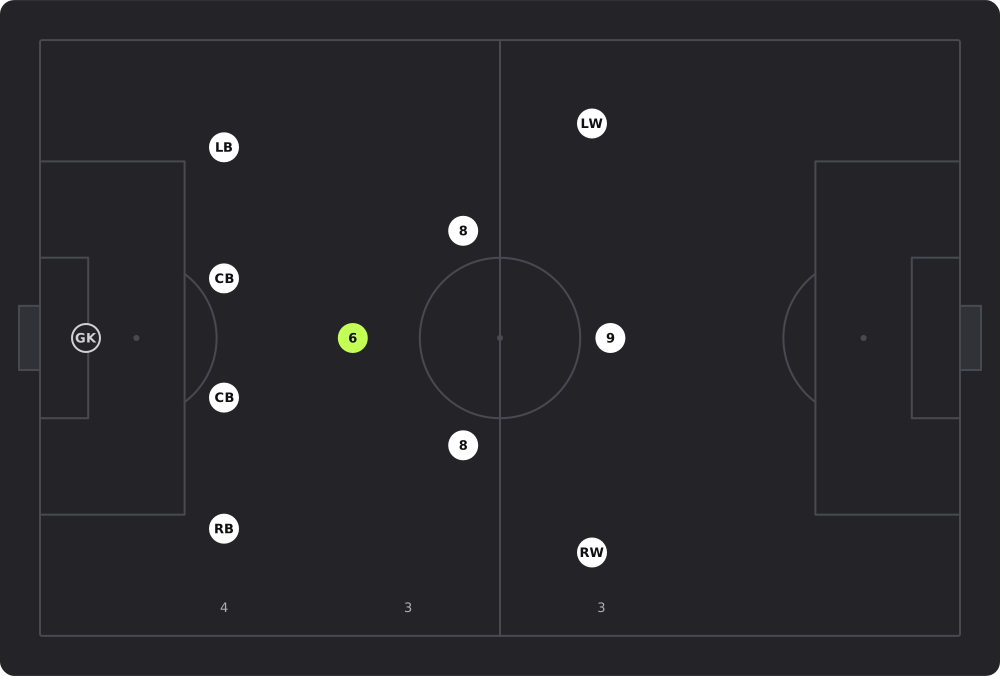
The single pivot anchors the space in front of the centre-backs; his positional discipline is what allows the two ahead of him to be more aggressive.
Source: Coaching literature · recall
The diamond is one deep, one high, and two central on flanks — creating an ideal short-passing shape that also stretches vertically.
Source: Coaching literature · recall
A 2-2 'box' places two defensive midfielders and two attacking midfielders directly ahead — a shape widely used at Bayer Leverkusen 2023-24 and elsewhere.
Source: Coaching literature 2023-25 · recall
The wing-back's job description — supplying width on his own flank — merges wide defender and wide midfielder in a way a full-back with a winger ahead does not.
Source: Coaching literature · recall
The mezzala is a shuttling half-space midfielder — literally 'half-winger' — a key role in the modern 3-4-2-1 and 4-3-3 systems.
Source: Coaching literature · recall
The inverted winger is defined by his handedness relative to the flank: a left-footed attacker on the right, or vice versa. That is the whole content of the label.
Source: Coaching literature · applied
Modern coaching separates out-of-possession from in-possession structures deliberately; the same eleven players occupy different geometries depending on who has the ball.
Source: Coaching literature 2023-25 · applied
The 10 exists to occupy the space between the opposition's midfield and defensive lines, feeding the striker and pulling defenders out of shape.
Source: Coaching literature · recall
Conceptually, 4-3-3 and 4-2-3-1 are close cousins: withdrawing one central midfielder into the pivot and pushing the highest into a 10 transforms one shape into the other cleanly.
Source: Coaching literature · applied
The regista is the deep playmaker: his output is not defensive events but tempo, angle and range of pass from the base of the shape.
Source: Italian coaching literature · recall
Test 3Coaches and Their SystemsTake a test
Guardiola's 2022-23 City used John Stones as a hybrid centre-back-cum-midfielder, producing a 3-box-3 in possession behind Haaland — one of the most-copied structures of the decade.
Source: Premier League 2022-23 analysis · recall
Simeone's 4-4-2 gave both league titles a distinctive out-of-possession identity — two rigid banks of four, protected by two strikers screening centrally.
Source: La Liga records · recall
Bielsa's 3-3-1-3 is his tactical fingerprint. He varied the specifics at Leeds and Athletic, but the shape is his signature contribution to formation grammar.
Source: Coaching history · recall
Conte's 3-5-2 became the reference for a modern back-three system, first at Juventus (three Serie A titles), then transported to Chelsea's title in 2016-17.
Source: Premier League / Serie A history · recall
Klopp's Dortmund won their titles from a 4-2-3-1 and his Liverpool settled on a 4-3-3; either way the identity lay in the gegenpress, not the shape.
Source: Bundesliga / Premier League history · recall
Iraola's Bournemouth used an aggressive 4-2-3-1 into 2025-26, delivering Europa League qualification and a distinctive high-turnover profile.
Source: Premier League 2023-26 analysis · recall
Emery's Villa reached the Champions League from a 4-4-2 base with high-line offside management and a well-drilled forward press, adapted in specific matches to a 4-2-3-1 or 3-4-3.
Source: Premier League 2023-25 analysis · recall
Beckenbauer's side defended with a libero behind two markers and attacking wing-backs, and beat Argentina 1-0 in the final.
Source: Bundesliga history · recall
Mourinho's Porto won the 2004 Champions League from a 4-4-2 diamond; his first Chelsea side switched to a 4-3-3 built on defensive shape and counter-attacking transitions.
Source: UEFA / Premier League history · recall
Alonso's Bayer Leverkusen's 3-4-2-1 (contracting to 5-4-1 out of possession, expanding to 3-2-5 in attack) delivered Germany's first unbeaten Bundesliga season and the DFB-Pokal in 2023-24.
Source: Bundesliga 2023-24 analysis · applied
Test 4Reading the FormationTake a test
Three defenders, four midfielders (two wing-backs plus two central), two attacking midfielders and one striker read as 3-4-2-1 in modern grammar.
Source: Coaching literature · applied
One holding midfielder plus four attackers on the same line above him plus a lone striker resolves to 4-1-4-1, a shape common when defending a lead.
Source: Coaching literature · applied
3-4-2-1 needs two players in the 10 zone; 3-4-3 asks the wide players to attack more like wingers. 3-5-2 needs neither, keeps the strikers as a pair and matches the described personnel.
Source: Coaching literature · applied
4-2-3-1 matches: the double pivot uses the two senior CMs, the three attacking midfielders match the two creatives plus a wide role, and the lone striker fits.
Source: Coaching literature · applied
The specific 5-4-1 → 3-2-5 transition (a wing-back becomes a fifth forward, one attacking midfielder drops beside a pivot) is the signature Alonso-era Leverkusen shape.
Source: Coaching literature 2023-25 · applied
The 4-3-3's structural weakness is the space between the winger and full-back on either side. Half-space attacks exploit precisely that gap.
Source: Coaching literature · applied
Late-game shape shifts to five defenders or five midfielders exist to add a body between the opponent and the goal, reducing the probability of concession.
Source: Coaching literature · applied
A specific opponent threat justifies a specific micro-adjustment; wholesale formation change for a single threat is over-fitting.
Source: Coaching literature · applied
Wing-backs on a yellow card in a 3-4-2-1 are the classic risk profile; dropping to a flat back four reduces the yellow-card carrier's exposure to defensive one-v-ones on the touchline.
Source: Coaching literature · applied
The inverting full-back creates a three-man defensive line plus a two-man pivot in the first phase — the Guardiola-era pattern popularised in 2022-23.
Source: Coaching literature · applied
Test 5Matches That Redefined the ShapeTake a test
Puskás's Hungary out-thought England using a fluid centre-forward system, one of the earliest and clearest matches to force a formation change across a national football culture.
Source: FIFA archives · recall
The 1974 squad brought Total Football to a global audience; despite losing the final to West Germany, its formation and role-rotation ideas defined the next generation.
Source: FIFA archives · recall
Diego Simeone's Atlético won La Liga in 2013-14 with a rigid two-banks-of-four 4-4-2 that became the modern reference for compressed defensive shape and elite counter-attacking.
Source: La Liga records · recall
PSG's 5-0 was the largest margin in a Champions League final and one of the most cited modern examples of a 4-3-3 dominating an elite opponent from start to finish.
Source: UEFA Champions League 2024-25 · recall
Germany's 1-0 win over Argentina at the Maracanã was won from Löw's 4-3-3 variant with Lahm at right-back; once Kramer went off injured the shape became a slightly stretched 4-2-3-1, with Schweinsteiger and Kroos starting the attacks from midfield.
Source: FIFA archives 2014 · recall
Mancini's side won it with a back four, mostly a 4-2-3-1 around Silva, Yaya Touré and Agüero, before experimenting with a 3-5-2 the following season.
Source: Premier League records 2011-12 · recall
Mourinho's Inter won Serie A, the Coppa Italia and the Champions League from an out-of-possession 4-2-3-1 that flexed into a 4-3-1-2, including the 3-1 semi-final first-leg win over Barcelona at San Siro.
Source: UEFA archives 2009-10 · recall
Rafael Benítez's half-time switch introducing Dietmar Hamann in a 3-5-2 shape triggered the Istanbul comeback against AC Milan, a canonical example of an in-match formation change.
Source: UEFA archives · recall
Real Madrid's 4-0 win at the Allianz Arena was one of the era's clearest tactical statements against Guardiola's Bayern, from Ancelotti's 4-3-3.
Source: UEFA archives · recall
Barcelona's 3-1 win — and specifically Messi as false 9 in a 4-3-3 — was the era's clearest public case that 4-4-2 English variants were vulnerable to a positional 4-3-3 with a role-fluid striker.
Source: UEFA archives 2010-11 · recall
Test 6Numbers of the ShapeTake a test
Formations describe the ten outfield players; the goalkeeper is by convention not included in the numbering.
Source: IFAB / coaching literature · recall
Three plus four plus three equals ten, matching the ten outfield players every side is required to arrange.
Source: Coaching literature · recall
The WM name comes from the two triangles formed by 3-2-2-3: a 'W' among the forwards and midfielders and an 'M' among the defenders and midfielders.
Source: Arsenal FC archives · recall
Bayer Leverkusen had never before gone unbeaten in the Bundesliga; the 2023-24 achievement — 28 wins, 6 draws in 34 games — was the first in German top-flight history.
Source: Bundesliga records 2023-24 · recall
Inverting one full-back into midfield converts the first phase from 4-3 to 3-2, matching the Guardiola-era City pattern of 2022-23 onwards.
Source: Coaching literature 2022-25 · recall
Analytics providers reported 4-2-3-1 and 4-3-3 as the most-used shapes across the recent seasons, with 4-4-2 in third and back-three variants growing but still minority.
Source: Premier League analytics 2023-25 · recall
The 1-3-3-3 notation counts the sweeper on his own. Written the modern way, with the sweeper as a fourth defender, the same shape is a 4-3-3.
Source: Coaching history · recall
Zidane's Real Madrid won the Champions League in 2015-16, 2016-17 and 2017-18, three consecutive titles from a 4-3-3 base — the first side to do so in the modern era.
Source: UEFA archives · recall
The 3-4-2-1 requires three centre-backs — its constitutive feature — and cannot be run 'clean' with fewer.
Source: Coaching literature · applied
The single-pivot 4-3-3 has exactly one deep-lying midfielder; the two 8s ahead of him are box-to-box rather than pure holders.
Source: Coaching literature · applied
Test 7Formation versus FormationTake a test
The 4-2-3-1's double pivot is a specific answer to the moment of transition after a lost ball; the single pivot 4-3-3 delegates that defensive work to a single player.
Source: Coaching literature · recall
The 3-4-3's wingers occupy the outside lanes directly; a 3-5-2's strikers occupy central lanes, meaning the width comes only from the wing-backs.
Source: Coaching literature · recall
The diamond has one high central midfielder as the 10; the flat 4-4-2 has no natural 10 zone at all, hence the historical rise of 4-4-1-1 as a compromise.
Source: Coaching literature · recall
Committing both wing-backs high leaves only three centre-backs against an entire counter — the specific structural risk of an aggressive 3-4-3 or 3-4-2-1.
Source: Coaching literature · recall
The 3-4-2-1 becomes a 3-2-5 when it has the ball, with the wing-backs pushing on and the two 10s inside; the Simeone 4-4-2 stays a 4-4-2 with the ball too.
Source: Analytics literature 2023-25 · recall
The trade-off is between neutralising the 10 and protecting the central pivot's cover; the correct answer depends on the 10's threat level and your pivot's mobility.
Source: Coaching literature · applied
A 3-5-2 needs two strikers; with one striker and two creative players, the 3-4-2-1 fits the personnel.
Source: Coaching literature · applied
The 5-3-2 keeps two strikers on the pitch as a counter-attacking outlet, at the cost of one fewer body across the midfield line.
Source: Coaching literature · applied
Guardiola's inverting full-back produces central superiority in the build-up; Klopp's overlapping full-back keeps the numerical fight in wide areas. Both are 4-3-3 shapes with different logics.
Source: Coaching literature 2022-25 · applied
Wing-backs cover both the wide midfield and the wide defence over the same 90 minutes; that vertical shuttle is what makes the role physically distinctive.
Source: Coaching literature · applied
Test 8Formations 2023-2026Take a test
Alonso's Leverkusen won a Bundesliga-DFB-Pokal double and became the first ever unbeaten team in Bundesliga history — 28 wins and 6 draws across 34 matches.
Source: Bundesliga records 2023-24 · recall
Slot's Liverpool worked from a nominal 4-2-3-1, but the No.10 pushed up beside the striker, turning the build-up shape into a 4-2-4.
Source: Premier League 2024-25 analysis · recall
Guardiola's use of John Stones as a hybrid CB-CM created the 3-2-4-1 shape widely imitated across Europe in 2023-24 and 2024-25.
Source: Premier League 2022-23 analysis · recall
Amorim built Sporting on a 3-4-3, and his move to Manchester United in November 2024 brought the same shape to a much larger club.
Source: Premier League 2024-25 analysis · recall
Hürzeler took over Brighton at 31, adapting the De Zerbi-era 4-2-3-1 with progressive personal touches through 2024-25.
Source: Premier League 2024-25 analysis · recall
Alonso-style 3-4-2-1 to 3-2-5 build-up is the single most-cited high-impact idea of the era, copied in different forms by Arteta and various imitators.
Source: Coaching trends 2023-26 · applied
The 3-2-4-1 in possession depends on the inverting FB creating a spare man in midfield; targeting his receptions denies the specific structural advantage the shape creates.
Source: Coaching literature 2022-25 · applied
The 2023-26 pattern is a broad back-three revival, Alonso and Amorim among its best-known users, often specifically against elite crossing threats.
Source: Premier League analysis 2023-26 · applied
The wing-back role is the load-bearing member of a 3-4-2-1; cheap wing-backs typically break the shape structurally, so the specific check is on the two wing-backs' technical and physical fit.
Source: Coaching literature 2023-25 · applied
The 3-4-2-1 → 3-2-5 transformation is a specific bet: five attackers overload the defensive line, three defenders plus two pivots retain rest defence. The trade is deliberate.
Source: Coaching literature 2023-25 · applied
Test 9When Shapes BreakTake a test
Wing-backs are defined by the vertical shuttle; asking full-backs to fulfil that role usually collapses the shape into a defensive block by default.
Source: Coaching literature · applied
Any man-marking assignment on a mobile 10 creates space specifically behind the marker; sides that press this pattern win goals via a third-man run into that vacated area.
Source: Coaching literature · applied
The 4-4-2 is structurally short by one against a 3-plus-goalkeeper build-up; without a specific man-hunting adjustment, the shape leaks in the first phase.
Source: Coaching literature · applied
The 10's job is to occupy the space between opposition lines; a drifting 10 leaves that zone for the opponent to receive between the lines with no marker.
Source: Coaching literature · applied
The 3-4-3 without a rest defence structurally invites 3v3 or 3v4 counters; the trade-off is baked into the shape and is the specific price of committing wingers high.
Source: Coaching literature · applied
Splitting centre-backs deliberately outnumbers two pressing strikers; the pressing side must accept its structural minority or specifically trigger a midfielder to jump.
Source: Coaching literature · applied
The single pivot alone cannot cover both channels ahead of the centre-backs; a coordinated press-high requires a designed cover pattern or a shape change.
Source: Coaching literature · applied
The 4-4-2 narrow block is designed to protect the centre; its known counter is the diagonal switch to the far winger, precisely the pattern Simeone's specific compressions were designed to survive.
Source: Coaching literature · applied
The 3-4-2-1 outsources width entirely to its wing-backs; if they mistime, the attacking midfielders have no outlets on the flanks and the shape becomes central and easy to defend.
Source: Coaching literature · applied
The 3-2-5 rest defence is three centre-backs plus two pivots; if the pivots are bypassed, the arithmetic reduces to 3v3 in front of goal — the specific price of committing five to the attack.
Source: Coaching literature · applied
Test 10Mixed Review: The Complete Formation PractitionerTake a test
Every modern notation lists the ten outfield players; the goalkeeper is by convention always excluded.
Source: Coaching literature · recall
The 1925 offside change forced Chapman to withdraw a centre-half into the defensive line, producing the WM shape that dominated for decades.
Source: IFAB / Arsenal FC archives · recall
Bielsa's 3-3-1-3 is his tactical fingerprint across Argentina, Chile, Athletic Bilbao, Leeds and beyond.
Source: Coaching history · recall
Half-space receipts, vertical runs and between-the-lines reception fingerprint the 10 role; the 4-2-3-1 has exactly one such position by design.
Source: Coaching literature 2023-25 · applied
The specific squad constraint — three CBs plus no FBs — points to a back-three shape that uses existing strengths and requires only wing-back recruitment, historically cheaper than full-back recruitment.
Source: Recruitment strategy literature · applied
The flat 4-4-2 has only two central midfielders; any opponent with a 4-3-3 or 4-2-3-1 outnumbers it in the middle third by construction.
Source: Coaching literature · applied
The one-sentence justification is a specific structural trade: attacking width without abandoning defensive numbers, giving the shape its unusually balanced modern profile.
Source: Coaching literature 2023-26 · applied
The 3-2-5 counter-argument is a specific numerical claim about the shape's rest defence: three defenders plus two pivots is enough to absorb standard counter-attacks against most opponents.
Source: Coaching literature 2023-26 · applied
Both shapes deliberately produce asymmetric in-possession structures — the inverting FB creates a 3-2 base, the wing-backs create a 3-2-5. Symmetry is not the modern goal.
Source: Coaching literature 2022-25 · applied
Formations set the geometry; player quality, tactical detail and in-game adjustments decide the result within that geometry. Neither purely deterministic nor irrelevant.
Source: Coaching literature · applied
Sources
IFAB Laws of the Game / UEFA & FIFA technical reports / Opta & StatsBomb definitions / coaching literature
- Coaching literature41
- Coaching literature 2023-256
- UEFA archives5
- FIFA archives4
- Coaching literature 2022-254
- Coaching history3
- Premier League 2024-25 analysis3
- Arsenal FC archives2
- Premier League 2022-23 analysis2
- La Liga records2
- Bundesliga records 2023-242
- Coaching literature 2023-262
- FA history / Jonathan Wilson 'Inverting the Pyramid'1
- IFAB Laws history1
- Coaching history / Wilson 'Inverting the Pyramid'1
- Premier League history1
- Italian coaching literature1
- Premier League / Serie A history1
- Bundesliga / Premier League history1
- Premier League 2023-26 analysis1
- Premier League 2023-25 analysis1
- Bundesliga history1
- UEFA / Premier League history1
- Bundesliga 2023-24 analysis1
- UEFA Champions League 2024-251
- FIFA archives 20141
- Premier League records 2011-121
- UEFA archives 2009-101
- UEFA archives 2010-111
- IFAB / coaching literature1
- Premier League analytics 2023-251
- Analytics literature 2023-251
- Coaching trends 2023-261
- Premier League analysis 2023-261
- IFAB / Arsenal FC archives1
- Recruitment strategy literature1