
Futsal · Level 3: Pre-Intermediate · Sub-level 3.2
Positions and Formations
10 tests · 100 facts · updated 15 October 2026 · markdown
This sub-level teaches the four positions, goleiro, fixo, ala and pivô, and the job each one does; the three base formations, the 4-0 (fully rotating), the 3-1 (a fixed pivô ahead of three), and the 2-2 (simple, no specialist pivô needed); named rotation patterns, the Y and the L, and what a rotation is generally for; why width matters even on a narrow court; and what "playing through the pivô" means as a way of organising an attack; tests 6-10 add the fixo, the ala and the pivô in detail, balance and cover behind the ball, and how a coach chooses a base formation.
Each test below is ten questions on Insporta. The list under a test is what the questions check: one fact per question, with the source it was written from. Read it before the test, or come back from a wrong answer.
Test 1The Four PositionsTake a test
"Fixo" is Portuguese for "fixed," reflecting that this defender is usually found holding the back of the team's shape.
Source: General futsal coaching · recall
The pivô is futsal's target player, receiving with his back to goal to hold up play and bring others into it.
Source: General futsal coaching · applied
A team typically fields two alas, left and right, giving the team width on a narrow court.
Source: General futsal coaching · recall
The modern goleiro's job has grown beyond shot-stopping to include launching attacks and, in special situations, playing outfield.
Source: General futsal coaching · applied
The fixo's main defensive priority is shielding the space in front of the goalkeeper, particularly against the opposing pivô.
Source: General futsal coaching · recall
The ala role rewards pace and dribbling in wide one-on-one situations, exactly this player's profile.
Source: General futsal coaching · applied
Dealing with the opposing pivô is treated as the fixo's main defensive priority.
Source: General futsal coaching · recall
Since the fixo's job includes shielding the goalkeeper, pushing forward creates exactly that gap if the ball is lost.
Source: General futsal coaching (synthesis) · applied
The goleiro alone may use his hands, and only inside his own penalty area.
Source: General futsal coaching · recall
The pivô's job (holding up play, back to goal, centrally) and the ala's job (width, pace, wide one-on-ones) are genuinely different roles.
Source: General futsal coaching (contrast) · applied
Test 2Base Formations — 4-0, 3-1 and 2-2Take a test
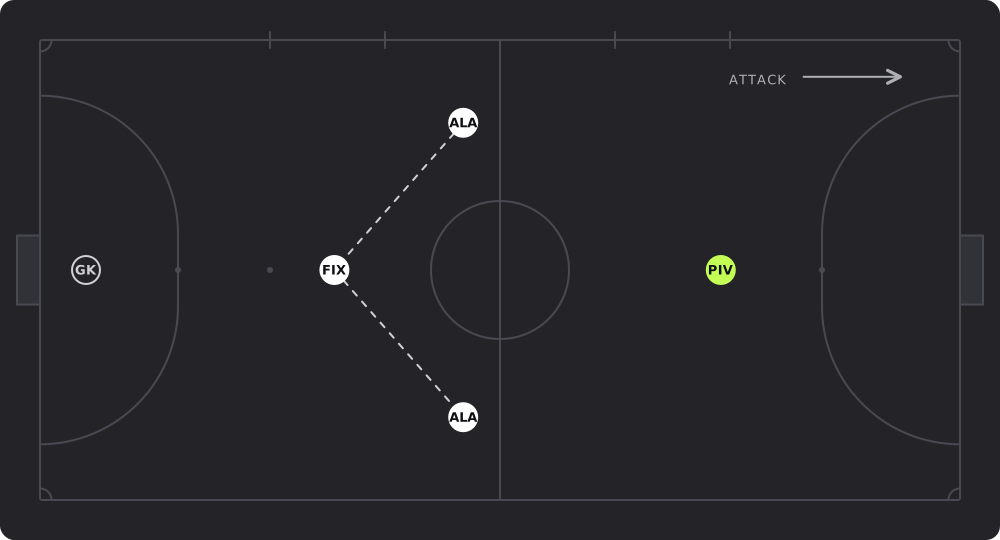
The 3-1 sets three outfield players across the back line with a single pivô ahead of them.
Source: General futsal coaching · recall
The 2-2, splitting evenly into two defenders and two attackers, is often chosen precisely because it doesn't require a dedicated pivô.
Source: General futsal coaching · applied
The 4-0 base has no fixed roles among the four outfield players, who instead rotate freely.
Source: General futsal coaching · recall
Losing the single pivô doesn't force a rebuild of the back three itself; a team can hold its defensive shape while attacking with fewer players forward.
Source: General futsal coaching (synthesis) · applied
The 3-1 is widely regarded as futsal's most common base formation.
Source: General futsal coaching · recall
The 4-0's entire premise is free rotation among all four outfield players, exactly this interchangeable philosophy.
Source: General futsal coaching · applied
The 2-2's simplicity, not needing a dedicated pivô, is exactly why newer or less specialised teams often favour it.
Source: General futsal coaching · recall
The 3-1's pivô is a fixed target; the 4-0 has no real equivalent, since all four players rotate.
Source: General futsal coaching (contrast) · applied
The numbers in 4-0, 3-1 and 2-2 all describe the four outfield players; the goalkeeper sits outside every one of these names.
Source: General futsal coaching (synthesis) · recall
Teams routinely adjust their base formation during a match to suit the score, opponent or moment, rather than being locked in from kick-off.
Source: General futsal coaching (synthesis) · applied
Test 3Rotations — the Y and the LTake a test
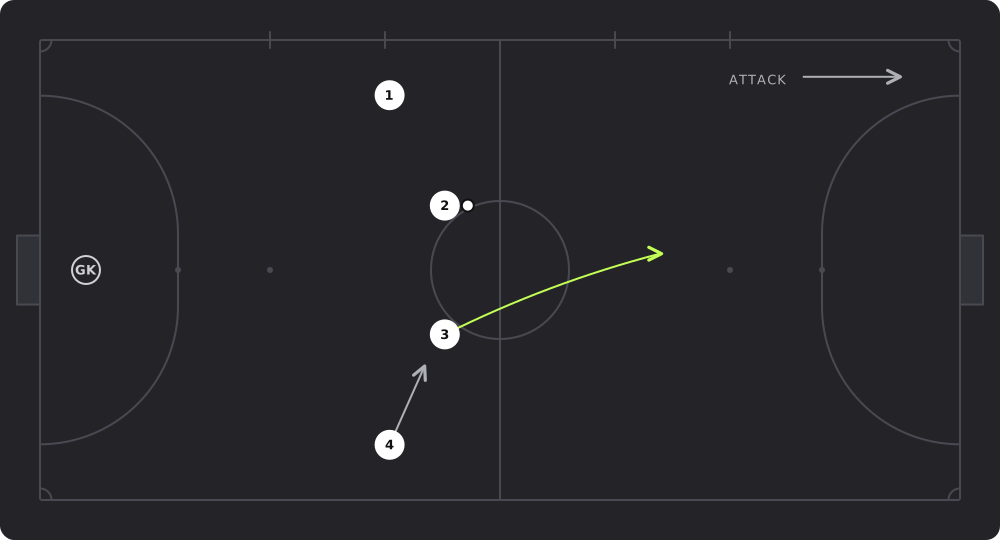
A rotation is a coordinated movement pattern where players exchange positions, aiming to unbalance the defence or open space.
Source: General futsal coaching · recall
A rotation whose player movements trace a Y shape is named after that letter.
Source: General futsal coaching · applied
The L rotation traces an L-shaped movement pattern, commonly used to draw a defender out and open space behind or elsewhere.
Source: General futsal coaching · recall
Drawing defenders toward the ball is valuable precisely because it opens space elsewhere, not because of any automatic reward.
Source: General futsal coaching (synthesis) · applied
Nothing links them beyond both being named rotations; the actual shapes they trace on the court are unrelated.
Source: General futsal coaching (contrast) · recall
The L rotation's own defining shape, running into a corner before cutting back, is exactly what draws a defender out of position that way.
Source: General futsal coaching (synthesis) · applied
Every rotation pattern shares the same underlying purpose: unbalancing the defence to create space or an advantage somewhere on the court.
Source: General futsal coaching (synthesis) · recall
The Y and the L are specific, named shapes; a simple, unstructured swap between two players isn't automatically one of them.
Source: General futsal coaching (contrast) · applied
With a fixed pivô as a reference point, the 3-1 gives rotations like the Y a stable target to build the pattern around.
Source: General futsal coaching (synthesis) · recall
Like any set pattern, a rotation loses its unbalancing effect once opponents learn to read and anticipate it.
Source: General futsal coaching (synthesis) · applied
Test 4Width on a Narrow CourtTake a test
Even on a narrow court, using the full width stretches the defence horizontally, opening space centrally that a compact defence would otherwise deny.
Source: General futsal coaching · recall
Alas standing centrally rather than out near the touchline give up the stretching effect that width against a compact defence provides.
Source: General futsal coaching (synthesis) · applied
The ala's wide positioning is exactly what gives a team its width, in contrast with the more central fixo, pivô and goleiro.
Source: General futsal coaching · recall
Staying narrow protects the dangerous central areas at the cost of conceding space out wide, exactly the trade-off on offer here.
Source: General futsal coaching (synthesis) · applied
Stretching defenders wide can loosen the pressure around a central pivô, since fewer defenders remain free to double up on him.
Source: General futsal coaching (synthesis) · recall
If nobody replaces the alas out wide when they drift inside, the team loses the very stretching effect width was providing.
Source: General futsal coaching (synthesis) · applied
Even a modest literal distance can stretch a defence's shape meaningfully on a narrow court, which is the real point of width there.
Source: General futsal coaching (synthesis) · recall
A smaller court doesn't remove the value of width; it simply means the same stretching effect happens over shorter distances.
Source: General futsal coaching (contrast) · applied
The fixo and the pivô both operate centrally by design, leaving the width-providing job to the alas out on the flanks.
Source: General futsal coaching (synthesis) · recall
Hugging the touchline is a direct instruction to preserve width, keeping the defensive shape stretched rather than narrowing it.
Source: General futsal coaching (synthesis) · applied
Test 5Playing Through the Pivô and Putting It TogetherTake a test
Playing through the pivô means routing attacking moves via passes into him, using his hold-up play to bring team-mates into the attack.
Source: General futsal coaching · recall
With enough space, a pivô can turn and drive at goal himself rather than needing the usual hold-up-and-lay-off sequence.
Source: General futsal coaching (synthesis) · applied
Of the three bases, only the 3-1 fixes a single dedicated pivô as a consistent target to play through.
Source: General futsal coaching (synthesis) · recall
Marking the opposing pivô tightly is specifically the fixo's job.
Source: General futsal coaching · applied
Playing through the pivô is defined around a fixed central target; a Y rotation can, in principle, be run without one.
Source: General futsal coaching (contrast) · recall
Width and playing through the pivô work together: width stretches defenders away from the middle, easing the path for central passes into the pivô.
Source: General futsal coaching (synthesis) · applied
Every one of these topics is really about how a team arranges and moves its four outfield players to create space and advantages, the essence of team shape.
Source: General futsal coaching · recall
These position names describe functional roles within a team's shape, not fixed legal labels; players can and do move between them as play develops.
Source: General futsal coaching (synthesis) · applied
The 4-0's whole premise is free interchange among the four outfield players, making it the least structured of the three bases.
Source: General futsal coaching (synthesis) · recall
Width, rotation and playing through the pivô are three of the central organisational ideas of team shape; a team using none of them is missing most of what team shape is about.
Source: General futsal coaching · applied
Test 6The Fixo in DetailTake a test
The fixo is often the first outfield receiver in the build-up; from the deepest outfield position he sees the whole court and chooses when to speed play up or slow it down.
Source: General futsal coaching · recall
From the back of the outfield shape the fixo has all his team-mates and the ball in view, which is why he usually directs the marking and the shape.
Source: General futsal coaching · recall
A misplaced pass from the deepest outfield player leaves almost nobody between the ball and the goal, so reliability comes first.
Source: General futsal coaching · recall
Defenders usually protect the area around goal, so the deepest outfield player often has room to shoot from distance, and a shot through bodies can also create rebounds.
Source: General futsal coaching · recall
In a 3-1 the nearest ala usually drops into the fixo's position, so the team keeps someone between the ball and its own goal.
Source: General futsal coaching · applied
A fixo's error is usually made with few or no team-mates behind him, so a hurried clearance or a loose touch is punished more than anywhere else on court.
Source: General futsal coaching · recall
The fixo defends centrally, often against the opposing pivô, so strength in duels and reading of the game matter more than raw speed.
Source: General futsal coaching · recall
The fixo receives, reads the picture ahead of him, releases the ball, and then keeps his covering position behind it rather than chasing the attack.
Source: General futsal coaching · applied
The fixo protects the space in front of the goalkeeper, the alas help from the flanks, and the pivô, the most advanced player, is the farthest from his own goal.
Source: General futsal coaching · applied
The fixo stays central and behind the ball, around the middle of the court, as the last outfield player; B is out on a flank, C is up by the opponents' goal and D is inside his own penalty area.
Source: General futsal coaching · applied
Test 7The Ala in DetailTake a test
The ala works in the wide spaces where he often meets a single defender, so dribbling past him or creating a yard for a cross or shot is his main weapon.
Source: General futsal coaching · recall
An ala comfortable on both feet can go either way, so the defender cannot simply show him onto his weaker side.
Source: General futsal coaching · recall
Alas defend as well as attack: when the ball is lost they recover down their own side so the opponents cannot use the width against them.
Source: General futsal coaching · recall
A diagonal run from wide starts outside the defender's view and ends in the central scoring area, often at the far post.
Source: General futsal coaching · recall
Showing an attacker down the line keeps him out of the central, more dangerous areas and pins him against the touch line.
Source: General futsal coaching · applied
The 3-1 has a fixo, a pivô and two alas, one on each flank, which is where its width comes from.
Source: General futsal coaching · recall
An ala runs the full length of his side, forward in attack and back in defence, many times a period, which is why fitness matters so much there.
Source: General futsal coaching · recall
The ala receives in the width, attacks his defender one against one, and once past him moves towards the centre where the shooting angle opens.
Source: General futsal coaching · applied
Recovering alas get back goal-side first and then pick up the runner on their own flank, so the opponents cannot use the free side for the break.
Source: General futsal coaching · applied
White's 11 is the ala on that side of the court and the nearest to grey's 7, so tracking back to defend his own flank is his job; 7 is on the far side and 4 must stay central.
Source: General futsal coaching · applied
Test 8The Pivô in DetailTake a test
The pivô receives with his back to goal and a marker on him, so being strong enough to keep the ball under that contact is the core of the role.
Source: General futsal coaching · recall
The pivô is the most advanced player, central and close to the opponents' area, where he can hold the ball, turn or finish.
Source: General futsal coaching · recall
With his back to goal, the pivô often plays the ball back or sideways into the path of a team-mate running onto it, who arrives facing the goal.
Source: General futsal coaching · recall
A short movement away and back creates the half-metre he needs to receive the ball cleanly before the marker can get tight or step in front.
Source: General futsal coaching · recall
The pivô feels which side the marker is pressing from and turns the other way, into the space the defender is not covering.
Source: General futsal coaching · applied
A pivô who keeps the ball under pressure gives his team a safe forward pass and the seconds they need to join the attack.
Source: General futsal coaching · recall
As the most advanced player he is the first one who can pressure the new ball carrier, which buys time for his team-mates to recover.
Source: General futsal coaching · recall
The pivô first creates space, then receives and holds the ball under the marker's contact, and finally sets up the team-mate who arrives facing the goal.
Source: General futsal coaching · applied
Contact tells the pivô where the marker is; he takes the ball into the free side, turns, and finishes quickly because the cover is never far away.
Source: General futsal coaching · applied
White's 7 is arriving close by, free and facing the goal. Number 11 has a marker on him and 4 is far back near halfway, so neither is a good lay-off.
Source: General futsal coaching · applied
Test 9Balance and Cover in Team ShapeTake a test
Balance means the team keeps enough players in position behind the ball, so that losing it does not leave the goal open to a counter-attack.
Source: General futsal coaching · recall
On a court of about forty metres, a single pass forward from the opponents can put an attacker one against one with the goalkeeper.
Source: General futsal coaching · recall
The fixo holds the back of the shape when his team has the ball, so there is always an outfield player between the ball and his own goal.
Source: General futsal coaching · recall
Keeping a player behind the ball costs one attacker, but it protects the team against the counter-attack if the move breaks down.
Source: General futsal coaching · recall
Transitions are the moments possession changes hands; teams must switch at once from attacking to defending, or the other way round.
Source: General futsal coaching · recall
A team that has just lost the ball is still in its attacking shape, so a quick opponent can exploit the gaps before it reorganises.
Source: General futsal coaching · recall
Protecting a lead makes safety more important than numbers in attack, so teams usually keep more players back and take fewer risks.
Source: General futsal coaching · applied
The immediate press slows the opponents down and buys the seconds the rest of the team needs to get back goal-side and close up.
Source: General futsal coaching · applied
Each step commits one more player forward: the more attackers, the less cover there is if the ball is lost, down to an empty goal with a flying goalkeeper.
Source: General futsal coaching · applied
All four white outfield players are high up near the grey area, while grey's 10 waits free near halfway. If white lose the ball, one pass sends him through against the keeper.
Source: General futsal coaching · applied
Test 10Choosing a Base FormationTake a test
The 3-1 puts one player up front as a fixed target, so a pivô who holds the ball well becomes the reference point of every attack.
Source: General futsal coaching · recall
In a 4-0 all four outfield players rotate through every position, so each must be able to defend, build up, attack and cover.
Source: General futsal coaching · recall
The 2-2 splits the outfield players evenly into two at the back and two in front, an easy shape to understand that does not depend on a specialist target player.
Source: General futsal coaching · recall
Against a high press, having more players near the ball gives the ball carrier short, safe options to play through or around the pressure.
Source: General futsal coaching · applied
Coaches pick a base to suit the players they have, the opposition's strengths and the state of the match, and change it as those change.
Source: General futsal coaching · recall
In a 4-0 there is no fixed target up front; the four outfield players move and swap positions instead of playing through one pivô.
Source: General futsal coaching · recall
The base describes where players start; in play they rotate, drop and push on, so the shape on the court keeps changing around that starting point.
Source: General futsal coaching · recall
The choice is made before the match from the opponents and his own squad, adapted during the match, and judged afterwards.
Source: General futsal coaching · applied
The 3-1 fixes a pivô and a fixo; the 2-2 fixes only a split between two back and two front players; the 4-0 has no fixed roles at all.
Source: General futsal coaching · applied
Two white players stand level at the back and two level further up, with nobody alone ahead as a pivô: that is the 2-2.
Source: General futsal coaching · applied
Sources
FIFA Futsal Coaching Manual (2025), chapters 10-13, for the skills and tactics this level covers, supplemented by well-established general futsal coaching knowledge where the manual itself isn't pinned down to a specific figure or clause. This level is softer and more judgement-based than Levels 1-2's Law citations.
- General futsal coaching73
- General futsal coaching (synthesis)21
- General futsal coaching (contrast)6