
Football · Laws of the Game
Law 17: The Corner Kick
3 parts · 4 tests · 40 facts · updated 12 October 2026 · markdown
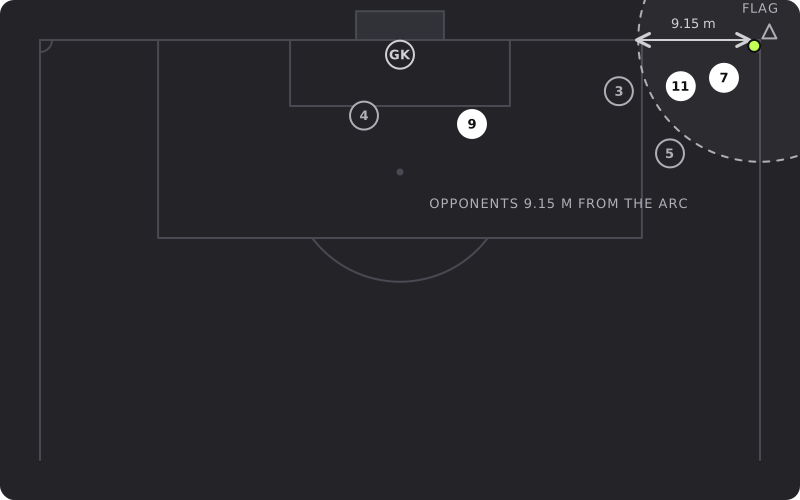
Law 17 governs the corner kick, the restart awarded to the attacking team when the whole of the ball passes over the goal line outside the goal, on the ground or in the air, having last touched a defending-team player, and a goal is not scored. The ball is placed inside the corner arc at the corner nearest to where it left the field, and the corner flagpost must not be moved. Opponents must remain at least 9.15 m from the corner arc until the ball is in play, which happens as soon as the ball is kicked and clearly moves; the ball does not need to leave the corner arc, so the kick may be played short. The kick needs no referee signal and may be taken quickly. If the taker plays the ball again before it has touched another player an indirect free kick is awarded to the opponents, a direct free kick if the second touch is a handball offence, and a penalty kick if that handball is inside the taker's own penalty area, unless the taker is the goalkeeper, in which case it stays an indirect free kick. A goal may be scored directly from a corner kick, but only against the opposing team; a ball that goes straight into the taker's own goal gives a corner kick to the opponents. A player cannot be penalised for offside directly from a corner kick. An opponent who does not retreat the required distance and interferes with the kick is cautioned and the corner is retaken.
17.171The procedure
How a corner kick is taken, stated as positive rules with the sanctions left to sub-level 17.172. The ball is placed inside the corner arc, the quarter-circle at the corner nearest to where the ball passed over the goal line, and the corner flagpost is not moved. Opponents must stay at least 9.15 m (10 yds) from the corner arc until the ball is in play. The ball is in play as soon as it is kicked and clearly moves; it does not have to leave the corner arc, so a corner may be played short to a nearby team-mate. The kick needs no referee signal and may be taken quickly. A corner kick is awarded to the attacking team when the whole of the ball passes over the goal line outside the goal, on the ground or in the air, having last touched a defender, without a goal being scored.
Test 1Where the ball is placed and when it is in playTake a test
The ball is placed within the corner arc at the corner nearest to where it left the field.
Source: IFAB Laws of the Game 2026/27, Law 17 · recall
The corner used is the one nearest the point where the ball passed over the goal line.
Source: IFAB Laws of the Game 2026/27, Law 17 · recall
The corner flagpost must not be moved, whatever the inconvenience to the taker.
Source: IFAB Laws of the Game 2026/27, Law 17 · recall
Opponents must be at least 9.15 m from the corner arc, not from the ball, until it is in play.
Source: IFAB Laws of the Game 2026/27, Law 17 · recall
The ball is in play the instant it is kicked and clearly moves.
Source: IFAB Laws of the Game 2026/27, Law 17 · recall
The ball need not leave the corner arc; it is in play as soon as it is kicked and moves.
Source: IFAB Laws of the Game 2026/27, Law 17 · recall
A short corner is legal; the ball was in play once it was kicked and moved.
Source: IFAB Laws of the Game 2026/27, Law 17 · applied
If the ball does not clearly move it is not in play, so the corner is retaken.
Source: IFAB Laws of the Game 2026/27, Law 17 · applied
The taker is not obliged to wait; a quick corner may be taken with an opponent still close.
Source: IFAB Laws of the Game 2026/27, Law 17 · applied
No signal is needed; the corner may be taken as soon as the ball is correctly placed.
Source: IFAB Laws of the Game 2026/27, Law 17 · recall
Test 2Quick corners, the award, and setting up the kickTake a test
Ball over the goal line outside the goal, last touched by a defender, no goal: it is a corner.
Source: IFAB Laws of the Game 2026/27, Law 17 · recall
The corner is given whether the ball crossed the goal line on the ground or in the air.
Source: IFAB Laws of the Game 2026/27, Law 17 · applied
Where the shot was heading is irrelevant; a defender had the final contact before the ball went out, so the attackers get a corner.
Source: IFAB Laws of the Game 2026/27, Law 17 · applied
A corner may be taken quickly; there is no requirement to wait for team-mates to get forward.
Source: IFAB Laws of the Game 2026/27, Law 17 · recall
An opponent still retreating who does not play or challenge for the ball does not stop play.
Source: IFAB Laws of the Game 2026/27, Law 17 · applied
A ball touching the arc line is within the corner arc, so the kick may be taken.
Source: IFAB Laws of the Game 2026/27, Law 17 · applied
The ball was not yet in play, so it is simply replaced inside the corner arc.
Source: IFAB Laws of the Game 2026/27, Law 17 · applied
The ball was live once kicked and moving, so leaving over a touchline is an ordinary throw-in.
Source: IFAB Laws of the Game 2026/27, Law 17 · applied
Team-mates may stand anywhere on the field; Law 17 sets no position limit for them.
Source: IFAB Laws of the Game 2026/27, Law 17 · recall
Only opponents within 9.15 m of the arc are an issue; a defender on the goal line is fine.
Source: IFAB Laws of the Game 2026/27, Law 17 · applied
17.172Infringements and sanctions
What the referee gives when a corner-kick rule is broken. If the taker plays the ball a second time before it has touched another player, an indirect free kick is awarded to the opposing team; if that second touch is a handball offence a direct free kick is awarded, and a penalty kick if the handball is inside the taker's own penalty area, unless the taker is the goalkeeper, in which case it stays an indirect free kick. A goal may be scored directly from a corner kick but only against the opposing team; a ball that goes straight into the taker's own goal gives a corner kick to the opponents. A player cannot be penalised for offside directly from a corner kick. An opponent who fails to respect the 9.15 m distance and interferes with the kick is cautioned and the corner is retaken. If, while correctly taking the kick, a player deliberately kicks the ball at an opponent without carelessness, recklessness or excessive force, play continues. For any other offence with no specific sanction, the corner kick is retaken.
Test 1Second touches, direct goals, offside and the distanceTake a test
The taker may not play the ball twice in a row; an indirect free kick goes to the opponents.
Source: IFAB Laws of the Game 2026/27, Law 17 · recall
A handball second touch is a direct-free-kick offence, so the sanction becomes direct.
Source: IFAB Laws of the Game 2026/27, Law 17 · applied
A direct-free-kick offence inside the taker's own penalty area is a penalty, the taker not being the goalkeeper.
Source: IFAB Laws of the Game 2026/27, Law 17 · applied
The penalty for handball in one's own area does not apply to a goalkeeper, so it stays an indirect free kick.
Source: IFAB Laws of the Game 2026/27, Law 17 · applied
A goal may be scored directly from a corner, but only against the opposing team.
Source: IFAB Laws of the Game 2026/27, Law 17 · recall
A ball straight into the taker's own goal from a corner gives the opponents a corner, not a goal.
Source: IFAB Laws of the Game 2026/27, Law 17 · applied
A player is not penalised for offside when receiving the ball directly from a corner kick.
Source: IFAB Laws of the Game 2026/27, Law 11 and Law 17 · applied
An opponent inside 9.15 m who interferes is cautioned for the distance and the corner is retaken.
Source: IFAB Laws of the Game 2026/27, Law 17 · applied
Where Law 17 sets no specific sanction for an offence, the corner kick is retaken.
Source: IFAB Laws of the Game 2026/27, Law 17 · recall
Deliberately playing the ball off an opponent, without carelessness, recklessness or excessive force, is allowed.
Source: IFAB Laws of the Game 2026/27, Law 17 · applied
17.173The goalkeeper's corner and corners from other Laws
The rest of Law 17: the corner kick after a goalkeeper holds the ball over eight seconds and where it is taken, a kick from the wrong arc, a moving ball or a moved flagpost, the rebound off the frame, and the other restarts that end in a corner kick.
Test 1The eight-second corner and other offencesTake a test
After the eight-second offence, the corner kick is taken from the corner area nearest to the goalkeeper's position when penalised.
Source: IFAB Laws of the Game 2025/26, Law 17 · applied
A goalkeeper who controls the ball with the hands for more than eight seconds before releasing it concedes a corner kick (Law 12).
Source: IFAB Laws of the Game 2025/26, Law 17 · recall
The ball must be stationary when a corner kick is taken; for this offence the kick is retaken.
Source: IFAB Laws of the Game 2025/26, Law 17 · applied
The corner flagpost must not be moved; for this offence the corner kick is retaken.
Source: IFAB Laws of the Game 2025/26, Law 17 · applied
The ball must be placed in the corner area nearest to where it passed over the goal line; for this offence the kick is retaken.
Source: IFAB Laws of the Game 2025/26, Law 17 · applied
A direct or indirect free kick kicked directly into the team's own goal gives the opponents a corner kick (Law 13).
Source: IFAB Laws of the Game 2025/26, Law 17 · applied
The goal frame is not a player: the taker's second touch before anyone else plays the ball is an indirect free kick.
Source: IFAB Laws of the Game 2025/26, Law 17 · applied
The referee counts down the last five of the eight seconds with a raised hand; past eight, a corner kick is awarded.
Source: IFAB Laws of the Game 2025/26, Law 17 · applied
A goal can be scored from a kick-off only against the opponents; straight into the kicker's own goal, a corner kick follows (Law 8).
Source: IFAB Laws of the Game 2025/26, Law 17 · applied
The corner kick is taken from the corner area nearest to the goalkeeper's position (A), not the far corner (B), the penalty mark (C) or the goal line (D).
Source: IFAB Laws of the Game 2025/26, Law 17 · applied
Sources
IFAB Laws of the Game 2026/27, Law 17 (paraphrased in original wording; original questions authored from the Law, not reproduced)
- IFAB Laws of the Game 2026/27, Law 1729
- IFAB Laws of the Game 2025/26, Law 1710
- IFAB Laws of the Game 2026/27, Law 11 and Law 171