
Football · Laws of the Game
Law 10: Determining the Outcome of a Match
4 parts · 6 tests · 60 facts · updated 12 October 2026 · markdown
Law 10 sets out when a goal is scored and how a match is won. A goal is scored when the whole of the ball passes over the goal line, between the goalposts and under the crossbar, provided the scoring team has committed no offence: no handball by the team scoring, no foul and no offside in the passage of play, and the referee has not already stopped play. A goalkeeper who throws the ball directly into the opponents' goal concedes a goal kick, not a goal, and a goal cannot be scored directly from a throw-in. The team scoring the greater number of goals is the winner; equal scores, nil included, make the match drawn. Where competition rules require a winner, Law 10 permits only three procedures: the away-goals rule, two equal periods of extra time no longer than fifteen minutes each, and kicks from the penalty mark; the competition, not the referee, chooses which. Kicks from the penalty mark are taken at one goal, at the penalty mark, with the teams reduced to equal numbers, every eligible player taking one kick before any player takes a second, five kicks each and then one kick each until a result, and they are neither part of the match nor extra time.
10.101A goal scored and a goal disallowed
When Law 10 counts a goal: the whole of the ball over the goal line, between the goalposts and under the crossbar, with no offence by the scoring team. The cases that void a goal even though the ball entered the net - a foul, an accidental or deliberate handball by the scoring team, the referee having already stopped play, and an outside agent interfering with the ball. The goalkeeper who throws the ball directly into the opponents' goal (a goal kick), the ball played directly into a goal from a throw-in (no goal), and the fact that a deflection off a defender, or a goal scored with the head, chest or knee, still counts.
Test 1A goal scored and a goal disallowedTake a test
A goal needs the whole ball over the line and within the goal frame: between the posts and below the bar, nowhere else on the line.
Source: IFAB Laws of the Game 2026/27, Law 10 · recall
Every part of the ball must be under the crossbar as well as over the line; a ball clipping the plane of the bar has not wholly entered the goal.
Source: IFAB Laws of the Game 2026/27, Law 10 · applied
A goal counts only if the scoring team has committed no offence in the passage of play, and a foul by the scorer voids it.
Source: IFAB Laws of the Game 2026/27, Law 10 · applied
A goal scored or created immediately after the ball touches the scoring team's hand or arm is disallowed even when the contact is accidental.
Source: IFAB Laws of the Game 2026/27, Law 10 and Law 12 · applied
Law 10 states that a goalkeeper who throws the ball directly into the opponents' goal concedes a goal kick rather than a goal.
Source: IFAB Laws of the Game 2026/27, Law 10 · recall
A goal cannot be scored directly from a throw-in; into the thrower's own goal the restart is a corner, into the opponents' goal a goal kick.
Source: IFAB Laws of the Game 2026/27, Law 10 and Law 15 · recall
The ball is out of play the instant the referee stops play, so anything that happens after the whistle cannot produce a goal.
Source: IFAB Laws of the Game 2026/27, Law 10 · applied
A goal needs the ball to cross the line under the play alone; interference by an outside agent means no goal, and play restarts with a dropped ball.
Source: IFAB Laws of the Game 2026/27, Law 10 and Law 3 · applied
A deflection off a defender does not stop a goal being scored; with no offence by the attackers the goal stands for the attacking team.
Source: IFAB Laws of the Game 2026/27, Law 10 · applied
Any part of the body except a deliberate hand or arm may score; a headed, chested or kneed goal is as valid as a kicked one.
Source: IFAB Laws of the Game 2026/27, Law 10 · recall
10.102Deciding a drawn match
How Law 10 settles the result: the team scoring more goals is the winner, and an equal score, nil-nil included, is a drawn match. Where competition rules require a winner, Law 10 permits only three procedures - the away-goals rule, two equal periods of extra time of no more than fifteen minutes each, and kicks from the penalty mark - and the competition, not the referee, decides which is used. Extra time is played in full with no golden goal; goals in extra time count exactly as normal-time goals; the away-goals rule is still listed by Law 10 though major competitions have dropped it; and goals in kicks from the penalty mark decide only the winner without changing the match score.
Test 1Deciding a drawn matchTake a test
The result rests on goals alone: the team that has scored the greater number is the winner, whatever the run of play.
Source: IFAB Laws of the Game 2026/27, Law 10 · recall
Any equal score is a draw, whether nil-nil or several goals each; possession, corners and cards never decide the result.
Source: IFAB Laws of the Game 2026/27, Law 10 · recall
Law 10 permits exactly three: the away-goals rule, two periods of extra time, and kicks from the penalty mark, and no other method.
Source: IFAB Laws of the Game 2026/27, Law 10 · recall
The choice among the permitted procedures belongs to the competition rules, not to the referee or the teams on the day.
Source: IFAB Laws of the Game 2026/27, Law 10 · recall
Extra time is two equal periods of at most fifteen minutes each, played after a short interval at the end of normal time.
Source: IFAB Laws of the Game 2026/27, Law 10 · recall
The golden-goal and silver-goal methods were removed years ago; both periods of extra time are always completed.
Source: IFAB Laws of the Game 2026/27, Law 10 · applied
The away-goals rule remains one of the three procedures in Law 10, though UEFA dropped it from its club competitions from 2021/22.
Source: IFAB Laws of the Game 2026/27, Law 10 · recall
When extra time leaves the tie level, the remaining permitted procedure is kicks from the penalty mark.
Source: IFAB Laws of the Game 2026/27, Law 10 · applied
Extra time is part of the match, so a goal in it is added to the score in the ordinary way.
Source: IFAB Laws of the Game 2026/27, Law 10 · applied
Kicks from the penalty mark determine which team advances; the match score is unchanged and still reads as the draw it ended on.
Source: IFAB Laws of the Game 2026/27, Law 10 · recall
10.103Kicks from the penalty mark
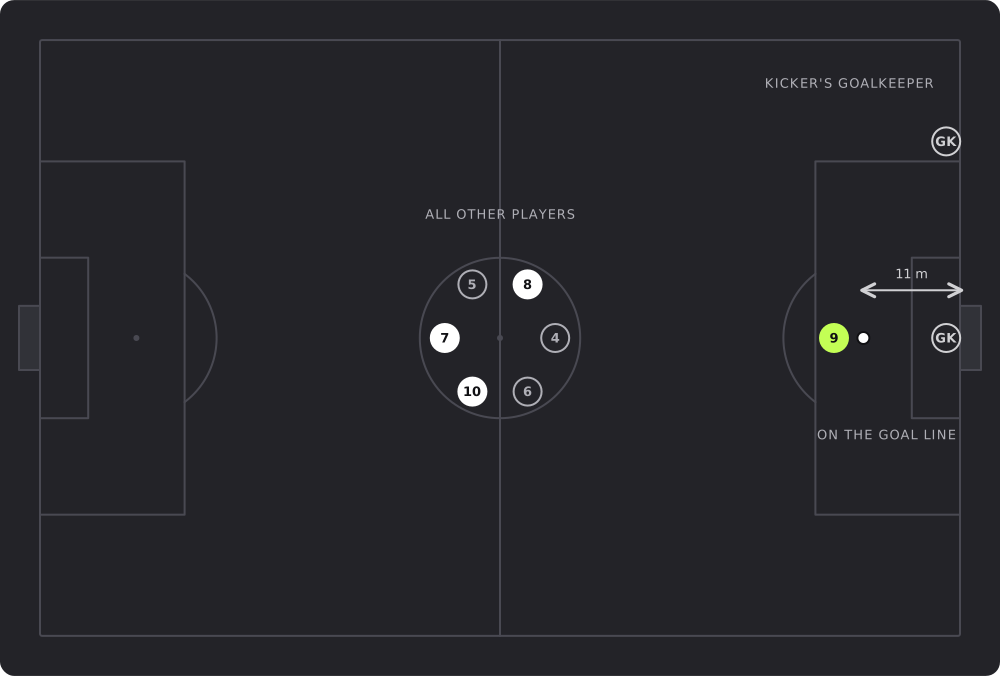
The full procedure for kicks from the penalty mark. Setting up: one goal chosen by the referee, kicks from the penalty mark, a coin toss for the goal and then for whether the toss-winner kicks first or second, eligible players are those on the field when play ended - a bench substitute who never came on is not eligible - a team with more players reduces to equal numbers, all players but the kicker and both goalkeepers wait in the centre circle, the kicking team's goalkeeper stands on the field outside the penalty area on the goal line, the defending goalkeeper keeps to the goal line facing the kicker, and only eligible players and match officials stay on the field. Taking them: kicks alternate, every eligible player kicks once before any second kick, five kicks each and then one kick each to a result, kicks end as soon as the outcome is settled, an injured outfield player is not replaced, a goalkeeper may be replaced, a player sent off during the match may not take part, match cautions do not carry over, and the kicks are neither part of the match nor extra time.
Test 1Setting up the kicks from the penalty markTake a test
All the kicks are taken from the penalty mark at a single goal, chosen by the referee, not shared between the two ends.
Source: IFAB Laws of the Game 2026/27, Law 10 · recall
One toss fixes the goal, a second lets the team that wins it choose to take the first or the second kick.
Source: IFAB Laws of the Game 2026/27, Law 10 · recall
Eligible players are those on the field of play at the final whistle, including anyone briefly off it for injury or equipment.
Source: IFAB Laws of the Game 2026/27, Law 10 · recall
The team with more players reduces to the number its opponents have, and tells the referee which players are left out.
Source: IFAB Laws of the Game 2026/27, Law 10 · recall
Eligibility is fixed at the final whistle: a named substitute who never came onto the field of play cannot take a kick.
Source: IFAB Laws of the Game 2026/27, Law 10 · applied
All the other players gather in the centre circle until it is their turn to walk up and take a kick.
Source: IFAB Laws of the Game 2026/27, Law 10 · recall
The kicker's goalkeeper stays on the field but out of the way: outside the penalty area, on the goal line at the point it meets the area boundary.
Source: IFAB Laws of the Game 2026/27, Law 10 · recall
As at any penalty, the goalkeeper must be on the goal line between the posts, facing the kicker, with at least part of one foot on or level with the line when the ball is kicked.
Source: IFAB Laws of the Game 2026/27, Law 10 and Law 14 · recall
The field holds only the eligible players and the match officials; everyone else clears off it for the duration of the kicks.
Source: IFAB Laws of the Game 2026/27, Law 10 · applied
A goalkeeper who cannot carry on may be replaced by a player who was excluded to level the numbers, or by a named substitute if the team still has a substitution available; the replaced keeper takes no further part.
Source: IFAB Laws of the Game 2026/27, Law 10 · applied
Test 2Taking the kicks to a resultTake a test
The teams kick in turn, one from each side at a time, all the way through the first five and any kicks that follow.
Source: IFAB Laws of the Game 2026/27, Law 10 · recall
The whole eligible list has to take a kick before any player is allowed a second one, in the first five and in sudden death.
Source: IFAB Laws of the Game 2026/27, Law 10 · recall
The first round is five kicks per team; only if the sides are level after that does it go to one kick each.
Source: IFAB Laws of the Game 2026/27, Law 10 · recall
Once one team cannot be caught within the five kicks, the round ends there and the surplus kicks are not taken.
Source: IFAB Laws of the Game 2026/27, Law 10 · applied
After five each with the scores level, the teams take one kick each in turn until one has scored more from the same number.
Source: IFAB Laws of the Game 2026/27, Law 10 · recall
An outfield player who cannot continue during the kicks simply takes no further part, and the team carries on a player short.
Source: IFAB Laws of the Game 2026/27, Law 10 · applied
A dismissed goalkeeper is replaced in goal by one of the team's remaining eligible players; no one comes on from outside.
Source: IFAB Laws of the Game 2026/27, Law 10 · applied
A send-off during the match keeps that player out of the kicks, and the team is one of those reduced to equal numbers.
Source: IFAB Laws of the Game 2026/27, Law 10 · recall
Cautions from the match are not carried into the kicks; a player starts the kicks with a clean disciplinary sheet for that phase.
Source: IFAB Laws of the Game 2026/27, Law 10 · recall
The kicks sit outside the match: they are neither extra time nor added minutes, and they decide only which team goes through.
Source: IFAB Laws of the Game 2026/27, Law 10 · recall
10.104Shoot-out offences and special cases
The rest of Law 10: a goal signalled too early, offences by goalkeepers and kickers during penalties (the shoot-out), when a kick is complete, who chooses the kicking order, excluding players to equal numbers, replacing a goalkeeper, a player who leaves the field, and why a shoot-out is not abandoned below seven players.
Test 1Shoot-out offences and completing a kickTake a test
If a referee signals a goal before the ball has passed wholly over the goal line, play restarts with a dropped ball.
Source: IFAB Laws of the Game 2025/26, Law 10 · applied
A goalkeeper whose offence leads to a retake is warned for the first offence and cautioned for any later one.
Source: IFAB Laws of the Game 2025/26, Law 10 · applied
After the first warning, any further goalkeeper offence causing a retake is cautioned.
Source: IFAB Laws of the Game 2025/26, Law 10 · applied
A kicker penalised for an offence committed after the signal has the kick recorded as missed and is cautioned.
Source: IFAB Laws of the Game 2025/26, Law 10 · applied
If both commit an offence at the same time, the kick is recorded as missed and the kicker is cautioned.
Source: IFAB Laws of the Game 2025/26, Law 10 · applied
The kick is completed when the ball stops moving, goes out of play or the referee stops play for any offence.
Source: IFAB Laws of the Game 2025/26, Law 10 · recall
In a shoot-out the kicker may not play the ball a second time.
Source: IFAB Laws of the Game 2025/26, Law 10 · applied
The signal had been given, so the kicker's offence costs the attempt and earns a yellow card.
Source: IFAB Laws of the Game 2025/26, Law 10 · applied
Goalkeepers get one warning in a shoot-out; the next offence that forces a retake is a caution.
Source: IFAB Laws of the Game 2025/26, Law 10 · applied
Team B's offending kicker has the attempt counted as a miss, which leaves Team A ahead 4-3 after five kicks each.
Source: IFAB Laws of the Game 2025/26, Law 10 · applied
Test 2Order, eligibility and goalkeepersTake a test
Each team selects the order from its eligible players, and the referee is not informed of it.
Source: IFAB Laws of the Game 2025/26, Law 10 · recall
The referee is not informed of the order in which a team will take its kicks.
Source: IFAB Laws of the Game 2025/26, Law 10 · recall
The team reduces to the same number as its opponents and informs the referee of the name and number of each excluded player.
Source: IFAB Laws of the Game 2025/26, Law 10 · recall
If the goalkeeper has already taken a kick, the replacement may not take a kick until the next round.
Source: IFAB Laws of the Game 2025/26, Law 10 · applied
The principle of all taking a kick before any second one continues for later sequences, but a team may change the order of kickers.
Source: IFAB Laws of the Game 2025/26, Law 10 · applied
The shoot-out must not be delayed for a player who leaves the field; that player's kick is forfeited if they are not back in time.
Source: IFAB Laws of the Game 2025/26, Law 10 · applied
The referee must not abandon the match if a team is reduced to fewer than seven players during the shoot-out.
Source: IFAB Laws of the Game 2025/26, Law 10 · applied
A goalkeeper unable to continue may be replaced by an excluded player or, if substitutes remain, a named substitute; the replacement waits for the next round to kick.
Source: IFAB Laws of the Game 2025/26, Law 10 · applied
The goal chosen by the toss may be changed only for safety reasons or if the goal or playing surface becomes unusable.
Source: IFAB Laws of the Game 2025/26, Law 10 · applied
Level after five each, the kicks go on one each until a team leads; teams may change the order of kickers for the new sequence.
Source: IFAB Laws of the Game 2025/26, Law 10 · applied
Sources
IFAB Laws of the Game 2026/27, Law 10 (paraphrased in original wording; original questions authored from the Law, not reproduced)
- IFAB Laws of the Game 2026/27, Law 1036
- IFAB Laws of the Game 2025/26, Law 1020
- IFAB Laws of the Game 2026/27, Law 10 and Law 121
- IFAB Laws of the Game 2026/27, Law 10 and Law 151
- IFAB Laws of the Game 2026/27, Law 10 and Law 31
- IFAB Laws of the Game 2026/27, Law 10 and Law 141