
Football · Laws of the Game
Law 13: Free Kicks
4 parts · 8 tests · 80 facts · updated 12 October 2026 · markdown
Law 13 covers free kicks. A free kick is either direct, from which a goal may be scored straight against the opponents, or indirect, from which a goal counts only after the ball has touched another player. The referee signals an indirect free kick by raising one arm above the head and keeps it up until the ball has touched another player, gone out of play, or it is clear a direct goal is impossible. A free kick sent straight into the kicking team's own goal gives the opponents a corner kick. The ball must be stationary and is in play once it is kicked and clearly moves; there is no minimum distance and, since 2019, a free kick to the defending team in their own penalty area is in play as soon as it is kicked and clearly moves and may be played to any team-mate inside the area. The kick is taken from where the offence occurred, except that a defending free kick in the goal area may be taken from anywhere in that area and an attacking indirect free kick in the opponents' goal area is taken from the goal-area line nearest the offence. Until the ball is in play all opponents stay at least 9.15 m from it, or on their own goal line between the posts for a free kick in the penalty area, and where three or more defenders form a wall the attackers must stay at least 1 m from it. If the kicker plays the ball again before another player touches it, an indirect free kick is awarded, a direct free kick or penalty for a handball, and an indirect free kick if the kicker was the goalkeeper. Opponent encroachment brings a retake unless advantage applies, and an attacker within 1 m of a three-plus-player wall brings an indirect free kick to the defenders.
13.131Direct and indirect free kicks
The two kinds of free kick and how a goal is judged from each. A goal may be scored directly against the opponents from a direct free kick with no other player touching the ball. From an indirect free kick a goal counts only once the ball has touched another player, a team-mate or an opponent, after the kick; sent straight into the opponents' goal untouched it becomes a goal kick, and a dummy in which no player makes contact is not a touch. A free kick of either kind driven straight into the kicking team's own goal gives the opponents a corner kick, never an own goal. The referee signals an indirect free kick by raising one arm above the head and holds it there until the ball has touched another player, has gone out of play, or a direct goal has become impossible; if the referee forgets the signal and the ball goes straight in, the kick is retaken. The ball is in play once it is kicked and clearly moves, with no minimum distance and no marked circle to leave; if it only wobbles it is not in play and the kick is taken again. A quick free kick is taken at once without waiting for the wall or a whistle, and by going quickly the attacking team gives up its right to the full distance; a ceremonial free kick is one the referee will restart with a whistle, and taking it before the whistle means a retake.
Test 1Scoring from a direct or indirect free kickTake a test
A direct free kick can be scored directly against the opponents, so a kick straight into their goal is a goal to the attackers.
Source: IFAB Laws of the Game 2026/27, Law 13 · recall
A goal cannot be scored straight from an indirect free kick; sent into the opponents' goal untouched, it becomes a goal kick to them.
Source: IFAB Laws of the Game 2026/27, Law 13 · recall
A free kick cannot become an own goal; straight into the kicker's own net, it gives the opponents a corner.
Source: IFAB Laws of the Game 2026/27, Law 13 · recall
An indirect free kick can only produce a goal once the ball has been touched by another player, whether a team-mate or an opponent.
Source: IFAB Laws of the Game 2026/27, Law 13 · recall
Any other player touching the ball meets the requirement, so an indirect free kick that goes in off a defender is a valid goal.
Source: IFAB Laws of the Game 2026/27, Law 13 · applied
A dummy is not a touch. With nobody making contact, the indirect free kick cannot become a goal and a goal kick is given.
Source: IFAB Laws of the Game 2026/27, Law 13 · applied
Nothing requires a direct free kick to be a shot; it may be passed, and a team-mate finishing the move scores a valid goal.
Source: IFAB Laws of the Game 2026/27, Law 13 · applied
The goalkeeper is another player, so once the shot is deflected in off the keeper the indirect free kick has produced a valid goal.
Source: IFAB Laws of the Game 2026/27, Law 13 · applied
The signal stays up until the ball touches another player or a direct goal is impossible, so a first-touch strike from an indirect free kick will not be given.
Source: IFAB Laws of the Game 2026/27, Law 13 · applied
A direct free kick counts if it goes straight in; an indirect one does not and gives a goal kick, so the type of free kick decides the outcome.
Source: IFAB Laws of the Game 2026/27, Law 13 · recall
Test 2The signal, quick kicks and when the ball is in playTake a test
An indirect free kick is shown with one arm raised above the head; a direct free kick carries no such signal.
Source: IFAB Laws of the Game 2026/27, Law 13 · recall
The signal is held until the ball has touched another player, gone out of play, or a direct goal has become impossible, so everyone knows a first-touch goal will not count.
Source: IFAB Laws of the Game 2026/27, Law 13 · recall
If the referee fails to signal an indirect free kick and it is scored directly, the goal is not given and the indirect free kick is taken again.
Source: IFAB Laws of the Game 2026/27, Law 13 · applied
A free kick puts the ball in play the instant it is kicked and clearly moves; no whistle or minimum distance is needed for a quick free kick.
Source: IFAB Laws of the Game 2026/27, Law 13 · recall
If the ball does not clearly move it is not in play and the free kick has not been taken; it is simply taken again, with no sanction.
Source: IFAB Laws of the Game 2026/27, Law 13 · applied
There is no minimum travel distance for a free kick; as soon as it is kicked and clearly moves it is in play and any team-mate can play it.
Source: IFAB Laws of the Game 2026/27, Law 13 · recall
A quick free kick is taken immediately without waiting for the wall or a whistle; a ceremonial free kick is one the referee will restart with a whistle.
Source: IFAB Laws of the Game 2026/27, Law 13 · recall
A team may take a quick free kick and accept opponents being closer than the full distance; if they gain from it, the referee lets play continue.
Source: IFAB Laws of the Game 2026/27, Law 13 · applied
Once the referee has told the players the restart will be whistled, that free kick is ceremonial and taking it early means it must be retaken.
Source: IFAB Laws of the Game 2026/27, Law 13 · applied
Since 2019 a free kick to the defending team in their own penalty area is in play once it is kicked and clearly moves, and may be played to any team-mate inside the area.
Source: IFAB Laws of the Game 2026/27, Law 13 · applied
13.132Procedure and positions
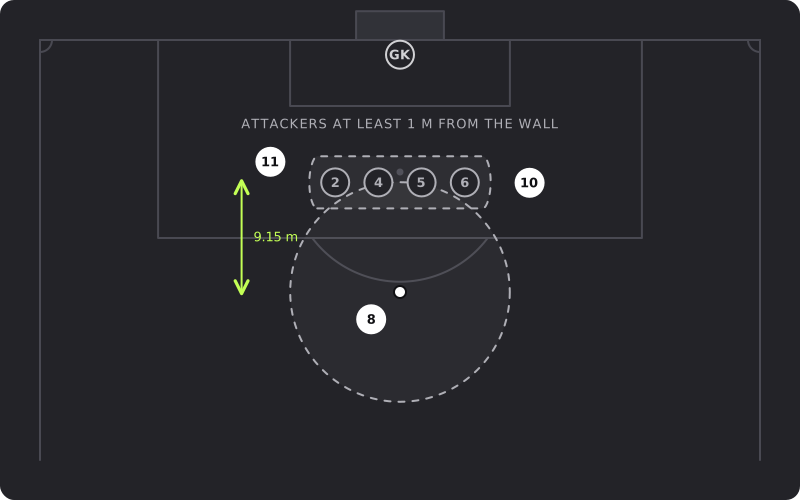
Where a free kick is taken from and where the players stand, stated as positive rules with the sanctions left to sub-level 13.133. The ball must be stationary, and the kick is taken from where the offence occurred, except that a free kick to the defending team anywhere in their own goal area may be taken from any point in that area, and an indirect free kick to the attacking team in the opponents' goal area is taken from the goal-area line running parallel to the goal line at the point nearest to where the offence happened. Until the ball is in play every opponent must be at least 9.15 m from it, or on their own goal line between the goalposts when the free kick is inside their penalty area. For a free kick to the defending team inside their own penalty area, opponents must also be outside the penalty area; if an opponent does not have time to leave when a quick kick is taken, play continues. Where three or more defenders form a wall, all attackers must stay at least 1 m from that wall until the ball is in play; the restriction is on the attackers only, so that they cannot jostle into or join the wall, and defenders may still stand on the goal line between the posts.
Test 1Where the kick is taken and the required distanceTake a test
A free kick is taken from where the offence was committed, apart from a few stated exceptions for kicks in the goal areas.
Source: IFAB Laws of the Game 2026/27, Law 13 · recall
A free kick to the defending team inside their own goal area may be taken from anywhere in that goal area, not only the spot of the offence.
Source: IFAB Laws of the Game 2026/27, Law 13 · recall
An attacking indirect free kick within the opponents' goal area is moved out to the goal-area line parallel to the goal line, at the point nearest the offence.
Source: IFAB Laws of the Game 2026/27, Law 13 · recall
Opponents must be at least 9.15 metres, ten yards, from the ball at a free kick until it is in play.
Source: IFAB Laws of the Game 2026/27, Law 13 · recall
When the required distance cannot fit inside the penalty area, opponents may stand on their goal line between the goalposts instead of 9.15 m from the ball.
Source: IFAB Laws of the Game 2026/27, Law 13 · applied
At a defending free kick in its own penalty area, attackers must be both outside the penalty area and at least 9.15 m from the ball until it is in play.
Source: IFAB Laws of the Game 2026/27, Law 13 · recall
If a defending free kick is taken quickly and an opponent had no time to leave the penalty area, play is allowed to continue.
Source: IFAB Laws of the Game 2026/27, Law 13 · applied
The ball must be stationary before a free kick is taken; it is then in play once it is kicked and clearly moves.
Source: IFAB Laws of the Game 2026/27, Law 13 · recall
The 9.15 m distance is measured from the ball, not from the goal or the penalty area, so the defenders retreat that far from the ball.
Source: IFAB Laws of the Game 2026/27, Law 13 · applied
The distance applies to all opponents wherever the free kick is on the field, until the ball is in play, whether or not they seem to be interfering.
Source: IFAB Laws of the Game 2026/27, Law 13 · recall
Test 2The defensive wall as a positive ruleTake a test
Where three or more defenders form a wall, all attacking players must remain at least one metre, one yard, from it until the ball is in play.
Source: IFAB Laws of the Game 2026/27, Law 13 · recall
The one-metre rule is triggered only by a wall of three or more defending players; a smaller group does not count as a wall for this purpose.
Source: IFAB Laws of the Game 2026/27, Law 13 · recall
A pair of defenders is not a wall for this Law, so an attacker standing against two defenders does not break the one-metre requirement.
Source: IFAB Laws of the Game 2026/27, Law 13 · applied
The one-metre rule is a restriction on the attacking team; the defenders are the ones forming the wall, so it does not limit them.
Source: IFAB Laws of the Game 2026/27, Law 13 · recall
The rule was introduced to remove the confrontations that came from attackers standing in among the defensive wall or trying to join it.
Source: IFAB Laws of the Game 2026/27, Law 13 · recall
The one-metre distance is checked at the moment the free kick is taken; moving toward the wall once the ball is in play is not an infringement of this rule.
Source: IFAB Laws of the Game 2026/27, Law 13 · applied
For a free kick in the penalty area, defenders may stand on their own goal line between the goalposts as an alternative to being 9.15 m from the ball.
Source: IFAB Laws of the Game 2026/27, Law 13 · applied
The Law sets no maximum on wall size; three or more simply triggers the attackers' one-metre stand-off.
Source: IFAB Laws of the Game 2026/27, Law 13 · recall
Standing closer than one metre to a wall of three or more defenders is the specific requirement being broken here.
Source: IFAB Laws of the Game 2026/27, Law 13 · applied
Like the opponents' distance rule, the one-metre stand-off from the wall applies until the ball is in play and not afterwards.
Source: IFAB Laws of the Game 2026/27, Law 13 · recall
13.133Infringements and sanctions
What the referee gives when the free-kick rules are broken. If, after the ball is in play, the kicker touches it again before it has touched another player, an indirect free kick is awarded to the opponents; if that second touch is a handball offence, a direct free kick is awarded, or a penalty kick if it was in the kicker's own penalty area, and an indirect free kick if the kicker was the goalkeeper. There is no minimum distance before the kicker may play the ball a second time: the moment another player touches it, the kicker is free again. If an opponent is closer to the ball than the required distance when the free kick is taken, the kick is retaken unless advantage can be applied, and an opponent who deliberately prevents a free kick being taken quickly is cautioned for delaying the restart of play. If, when the kick is taken, an attacker is less than 1 m from a wall of three or more defenders, an indirect free kick is awarded to the defending team. A free kick taken from the wrong place, or before the ball is stationary, is retaken.
Test 1The kicker playing the ball a second timeTake a test
Touching the ball a second time before another player does is an indirect free kick to the opponents, taken from where the second touch occurred.
Source: IFAB Laws of the Game 2026/27, Law 13 · recall
The post is not another player, so the taker who scores the rebound has touched the ball twice; the opponents get an indirect free kick.
Source: IFAB Laws of the Game 2026/27, Law 13 · applied
If the kicker's second touch is a deliberate handball, the restart is a direct free kick, not the indirect free kick an ordinary second touch brings.
Source: IFAB Laws of the Game 2026/27, Law 13 · applied
A handball as the kicker's own second touch inside their penalty area is punished with a penalty kick, just as a defender handling there would be.
Source: IFAB Laws of the Game 2026/27, Law 13 · applied
When the kicker who handles the second touch is the goalkeeper, the restart is an indirect free kick, not the penalty an outfield player would concede.
Source: IFAB Laws of the Game 2026/27, Law 13 · recall
Once any other player, an opponent included, has touched the ball, the taker is free to play it again with no offence.
Source: IFAB Laws of the Game 2026/27, Law 13 · applied
No distance is set: the taker may play the ball again only after another player has touched it, whether that is soon or late.
Source: IFAB Laws of the Game 2026/27, Law 13 · recall
An ordinary second touch by the kicker is only an indirect free kick to the opponents; no card is added unless a separate offence occurs.
Source: IFAB Laws of the Game 2026/27, Law 13 · recall
The offence is complete the moment the taker touches the ball a second time before another player; a team-mate scoring afterwards does not save it.
Source: IFAB Laws of the Game 2026/27, Law 13 · applied
If the first touch did not clearly move the ball it was never in play, so the kick is simply retaken; if it did, the second touch is an indirect free kick offence.
Source: IFAB Laws of the Game 2026/27, Law 13 · applied
Test 2Encroachment and other free-kick infringementsTake a test
If an opponent is inside the required distance when the kick is taken, it is retaken, unless the referee can instead apply advantage.
Source: IFAB Laws of the Game 2026/27, Law 13 · recall
The retake for encroachment gives way to advantage: if the attacking team gains despite the close opponent, the referee lets play run on.
Source: IFAB Laws of the Game 2026/27, Law 13 · applied
An opponent who deliberately stops a free kick being taken quickly, such as by standing over the ball, is cautioned for delaying the restart.
Source: IFAB Laws of the Game 2026/27, Law 13 · recall
An attacker within one metre of a wall of three or more defenders when the kick is taken gives the defending team an indirect free kick.
Source: IFAB Laws of the Game 2026/27, Law 13 · applied
A free kick taken from the wrong place is retaken from the correct position; there is no card for a first, non-deliberate error.
Source: IFAB Laws of the Game 2026/27, Law 13 · applied
Encroachment alone brings a retake, not a card; a caution is added only if the opponent was deliberately delaying the restart or offending repeatedly.
Source: IFAB Laws of the Game 2026/27, Law 13 · recall
A kicker who goes quickly accepts the risk: when an opponent who was inside the distance intercepts a quick free kick, the referee lets play continue. A retake is for an opponent who is penalised for being too close, not for a kick the taker chose to hurry.
Source: IFAB Laws of the Game 2026/27, Law 13 · applied
The ball must be stationary before a free kick is taken; playing it while it is still moving means the kick is taken again.
Source: IFAB Laws of the Game 2026/27, Law 13 · applied
The indirect free kick for a second touch is taken from the place where the kicker made that second contact with the ball.
Source: IFAB Laws of the Game 2026/27, Law 13 · recall
A team that chooses to take a free kick quickly gives up its right to the full distance, so it cannot then ask for a retake because an opponent was close.
Source: IFAB Laws of the Game 2026/27, Law 13 · applied
13.134Technique, positions and the defending team's area
The rest of Law 13: lifting the ball and feinting, playing the ball at an opponent, who free kicks are awarded against, how long the indirect signal lasts, the goalkeeper's second touch, where kicks are taken after leaving or entering without permission and after off-field offences, opponents entering the penalty area early, and advantage when an opponent is too close.
Test 1Technique and the signalTake a test
A free kick can be taken by lifting the ball with a foot or with both feet simultaneously.
Source: IFAB Laws of the Game 2025/26, Law 13 · recall
Feinting to take a free kick to confuse opponents is permitted as part of football.
Source: IFAB Laws of the Game 2025/26, Law 13 · applied
Kicking the ball at an opponent in order to play it again, without carelessness, recklessness or excessive force, is allowed and play continues.
Source: IFAB Laws of the Game 2025/26, Law 13 · applied
When the ball is played at an opponent using excessive force, the player is sent off for violent conduct.
Source: IFAB Laws of the Game 2025/26, Law 13 · applied
Free kicks go to the opposing team of a player, substitute, substituted or sent-off player, or team official guilty of an offence.
Source: IFAB Laws of the Game 2025/26, Law 13 · recall
The signal stays until the kick has been taken and the ball touches another player, goes out of play or it is clear a goal cannot be scored directly.
Source: IFAB Laws of the Game 2025/26, Law 13 · recall
A kicker's handball after the kick is a direct free kick, or a penalty in their own area, unless the kicker was the goalkeeper: then it is an indirect free kick.
Source: IFAB Laws of the Game 2025/26, Law 13 · applied
Playing the ball against an opponent to play it again is allowed as long as it is not careless, reckless or using excessive force.
Source: IFAB Laws of the Game 2025/26, Law 13 · applied
Feinting is part of football; the ball comes into play once it is kicked and clearly moves.
Source: IFAB Laws of the Game 2025/26, Law 13 · applied
Out of play ends the need for the signal just as another player's touch would.
Source: IFAB Laws of the Game 2025/26, Law 13 · recall
Test 2Special positions and the defending areaTake a test
Free kicks for entering, re-entering or leaving the field without permission are taken from the position of the ball when play was stopped.
Source: IFAB Laws of the Game 2025/26, Law 13 · applied
An offence off the field is restarted with a free kick on the boundary line nearest to where it occurred.
Source: IFAB Laws of the Game 2025/26, Law 13 · applied
For direct-free-kick offences off the field, a penalty kick is awarded if the nearest boundary-line point is within the offender's penalty area.
Source: IFAB Laws of the Game 2025/26, Law 13 · recall
If an opponent in the area touches or challenges for the ball before it is in play, the defending team's free kick is retaken.
Source: IFAB Laws of the Game 2025/26, Law 13 · applied
An opponent who enters the penalty area before the ball is in play and touches or challenges for it causes a retake.
Source: IFAB Laws of the Game 2025/26, Law 13 · applied
Advantage can override the retake when the attacking team benefits from playing on.
Source: IFAB Laws of the Game 2025/26, Law 13 · applied
Free kicks are taken from where the offence occurred, except where a Law such as 3, 11 or 12 designates another position.
Source: IFAB Laws of the Game 2025/26, Law 13 · recall
Until the ball is in play opponents must stay outside the area; one who enters and challenges for the ball causes a retake.
Source: IFAB Laws of the Game 2025/26, Law 13 · applied
Leaving without leave is judged by where the ball lay when the whistle went, not where the player stepped off.
Source: IFAB Laws of the Game 2025/26, Law 13 · applied
The returning player's entry point does not matter; the free kick goes where the ball lay (C).
Source: IFAB Laws of the Game 2025/26, Law 13 · applied
Sources
IFAB Laws of the Game 2026/27, Law 13 (paraphrased in original wording; original questions authored from the Law, not reproduced)
- IFAB Laws of the Game 2026/27, Law 1360
- IFAB Laws of the Game 2025/26, Law 1320