
Football · Laws of the Game
Law 8: The Start and Restart of Play
2 parts · 5 tests · 50 facts · updated 12 October 2026 · markdown
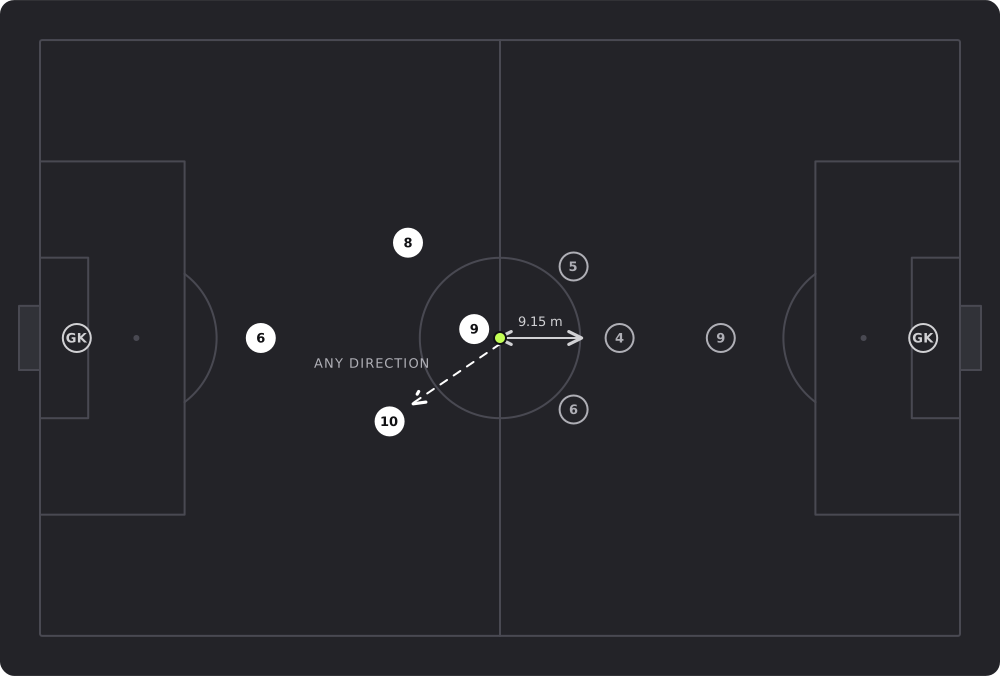
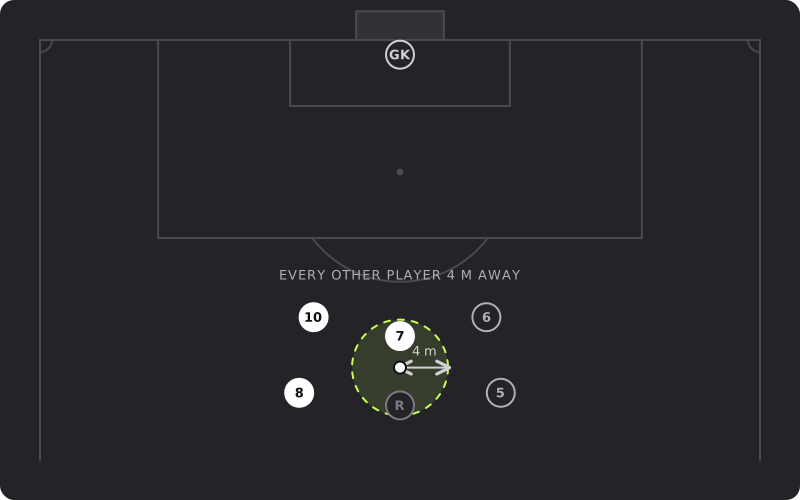
Law 8 governs two restarts. A kick-off starts each half and each period of extra time and restarts play after a goal: the team that wins the coin toss chooses which goal to attack, the other team takes the first kick-off, and after a goal the kick-off is taken by the team that conceded. All players except the kicker must be in their own half, the opponents of the kicking team must be at least 9.15 m from the ball, the ball must be stationary on the centre mark, and the ball is in play when it is kicked and clearly moves; since 2016 it may be played in any direction. A goal may be scored directly from a kick-off against the opponents, but a ball played directly into the kicker's own goal gives a corner to the opponents. An illegal second touch by the kicker is an indirect free kick (a direct free kick or penalty for a handball offence); any other procedural fault means the kick-off is retaken. A dropped ball is the restart whenever the referee stops play for a reason the Laws do not otherwise cover, including a defective ball, outside interference and serious injury, and when the ball touches a match official, stays on the field and then goes into the goal, starts a promising attack or changes the team in possession. Since 2019 the ball is not contested: it is dropped for the defending goalkeeper if play stopped in that team's penalty area, otherwise for one player of the team that last touched it, with all other players at least 4 m away; the ball is in play when it touches the ground and is dropped again if a player touches it first or if it leaves the field untouched. A goal cannot be scored directly from a dropped ball: at least two players must touch it, and a ball that goes straight into a goal gives a goal kick or a corner.
8.81The kick-off
The occasions on which a kick-off is taken - the start of each half, each period of extra time and the restart after a goal - and the mechanics around it: the coin toss deciding which goal a team attacks, the opponents taking the first kick-off, the conceding team restarting after a goal, and the change of ends and fresh toss for the second half and for extra time. Then the procedure itself: all players except the kicker in their own half, opponents at least 9.15 m from the ball, the ball stationary on the centre mark, the referee's signal, the ball in play once it is kicked and clearly moves, and its being playable in any direction; a goal direct from the kick-off against the opponents but a corner if it goes into the kicker's own goal; an indirect free kick for an illegal second touch by the kicker, a direct free kick or penalty for a handball second touch, and a retake for any other procedural fault.
Test 1When a kick-off is taken and the coin tossTake a test
A kick-off begins each half and each period of extra time and restarts play after a goal; the other stoppages use a throw-in, corner, goal kick, free kick or dropped ball.
Source: IFAB Laws of the Game 2026/27, Law 8 · recall
Only one team kicks off; if the toss winner opts for the goal choice, that duty falls to their opponents.
Source: IFAB Laws of the Game 2026/27, Law 8 · recall
The current Law lets the coin-toss winner pick either which goal to attack in the first half or to take the kick-off.
Source: IFAB Laws of the Game 2026/27, Law 8 · recall
Once a goal is scored, the team that conceded restarts play with a kick-off.
Source: IFAB Laws of the Game 2026/27, Law 8 · recall
For the second half the sides swap ends, and the team that did not kick off to start the match takes the kick-off.
Source: IFAB Laws of the Game 2026/27, Law 8 · recall
Every player except the one taking the kick-off must be within their own half when it is taken.
Source: IFAB Laws of the Game 2026/27, Law 8 · applied
Opponents of the team taking the kick-off must be at least 9.15 m from the ball, which is exactly why the centre circle has that radius.
Source: IFAB Laws of the Game 2026/27, Law 8 · recall
Since opponents must be outside the centre circle when the kick-off is taken, the referee just has the encroacher retreat first.
Source: IFAB Laws of the Game 2026/27, Law 8 · applied
Any breach of the kick-off procedure other than an early second touch by the kicker is dealt with by retaking the kick-off.
Source: IFAB Laws of the Game 2026/27, Law 8 · recall
Extra time counts as a new kick-off, so the referee holds a fresh coin toss beforehand, with the same procedure as at the start of the match.
Source: IFAB Laws of the Game 2026/27, Law 8 · applied
Test 2Kick-off procedure and scoring from itTake a test
The ball has to be stationary and sitting on the centre mark for the kick-off to be taken.
Source: IFAB Laws of the Game 2026/27, Law 8 · recall
A kick-off puts the ball in play only when it has been kicked and visibly moves; a mere touch does not count.
Source: IFAB Laws of the Game 2026/27, Law 8 · recall
The 2016 change lets the ball go in any direction from a kick-off; until then it had to be played forward.
Source: IFAB Laws of the Game 2026/27, Law 8 · recall
A kick-off can produce a goal directly, but only against the opponents; straight into the kicker's own net does not stand as a goal.
Source: IFAB Laws of the Game 2026/27, Law 8 · recall
Scoring straight into your own goal from the kick-off is not permitted; play resumes with a corner to the other side.
Source: IFAB Laws of the Game 2026/27, Law 8 · applied
Until another player touches it, the taker may not play the ball twice; the punishment is an indirect free kick to the opposition where that touch happened.
Source: IFAB Laws of the Game 2026/27, Law 8 · applied
The kicker's early second touch is normally an indirect free kick, but a handball offence makes it a direct free kick to the opponents.
Source: IFAB Laws of the Game 2026/27, Law 8 · recall
The Law sets no restriction on who takes the kick-off; any player on the team may do it, goalkeeper included.
Source: IFAB Laws of the Game 2026/27, Law 8 · recall
Here the ball stayed on the mark, so play never started; the kick-off must be taken again.
Source: IFAB Laws of the Game 2026/27, Law 8 · applied
A kick-off may be taken only after the referee has given the signal for it.
Source: IFAB Laws of the Game 2026/27, Law 8 · recall
8.82The dropped ball
When a dropped ball is the correct restart - any time the referee stops play, while the ball is in play, for a reason the Laws do not otherwise provide for, such as a serious injury, outside interference or a ball that becomes defective, and the separate case of the ball touching a match official, staying on the field and then going into the goal, starting a promising attack or changing the team in possession. Then the procedure since the 2019 change: the ball dropped, not contested, for the defending goalkeeper if play stopped in that team's penalty area and otherwise for one player of the team that last touched it, at the place it last touched a player, an official or the ground; all other players at least 4 m away; the ball in play when it touches the ground; and a re-drop if a player touches it before it lands or if it leaves the field untouched after landing. Finally the restrictions: no goal directly from a dropped ball, at least two players required, and a goal kick or corner if the ball goes straight in.
Test 1When a dropped ball is awardedTake a test
When the referee halts play and no throw-in, corner, goal kick, free kick or penalty fits, the ball is dropped; typical causes are injury, a defective ball or outside interference.
Source: IFAB Laws of the Game 2026/27, Law 8 · recall
A ball that becomes defective during play, no offence involved, is replaced and play resumes with a dropped ball.
Source: IFAB Laws of the Game 2026/27, Law 8 · recall
Interference from outside the game, not from a match official, brings a dropped ball taken from the place the match ball had reached when play stopped.
Source: IFAB Laws of the Game 2026/27, Law 8 · recall
The ball off a match official brings a stoppage when it then puts a team into a promising attack; play restarts with a dropped ball.
Source: IFAB Laws of the Game 2026/27, Law 8 · applied
A ball off a match official stops play only if it goes into the goal, sparks a promising attack or changes who is in possession; none applies, so play carries on.
Source: IFAB Laws of the Game 2026/27, Law 8 · applied
The ball touching a match official matters only while the ball stays on the field; once it has gone out, the normal throw-in restart applies.
Source: IFAB Laws of the Game 2026/27, Law 8 · applied
A stoppage purely for a serious injury carries no free kick, so play resumes with a dropped ball.
Source: IFAB Laws of the Game 2026/27, Law 8 · applied
A dropped ball covers only stoppages the Laws leave otherwise unprovided for; an offence that carries a free kick is restarted with that free kick.
Source: IFAB Laws of the Game 2026/27, Law 8 · recall
Because nobody has broken a Law, the referee cannot award a kick either way. Play restarts with a dropped ball: for the defending goalkeeper if the ball was in the penalty area, otherwise for a player of the team that had or would have gained possession, with the last touch as the fallback.
Source: IFAB Laws of the Game 2026/27, Law 8 · applied
The 2019 change ended the contested drop: the ball now goes to a single player, the defending goalkeeper if it was in the penalty area, otherwise a player of the team that had or would have gained possession, with the last touch only as the fallback.
Source: IFAB Laws of the Game 2026/27, Law 8 · recall
Test 2Dropped ball procedure and restrictionsTake a test
Away from the penalty area the ball goes to one player of the team that had or would have gained possession; only if that cannot be judged does it go to the team that touched it last.
Source: IFAB Laws of the Game 2025/26, Law 8 · recall
If the stoppage came with the ball in the penalty area, the drop is made to that team's goalkeeper, inside the area.
Source: IFAB Laws of the Game 2026/27, Law 8 · recall
Every other player from both teams has to be at least 4 m from the ball until the drop is in play.
Source: IFAB Laws of the Game 2026/27, Law 8 · recall
The drop is in play the moment the ball meets the ground, whether or not a player has touched it yet.
Source: IFAB Laws of the Game 2026/27, Law 8 · recall
A ball touched by any player before it reaches the ground must be dropped once more.
Source: IFAB Laws of the Game 2026/27, Law 8 · applied
A drop that leaves the pitch untouched by anyone, after bouncing, is retaken; it does not become a throw-in or goal kick.
Source: IFAB Laws of the Game 2026/27, Law 8 · applied
No goal may come straight from a dropped ball; at least two separate players must play it before it goes in.
Source: IFAB Laws of the Game 2026/27, Law 8 · recall
Since the ball reached the opponents' goal untouched by a second player, no goal is given and the opponents take a goal kick.
Source: IFAB Laws of the Game 2026/27, Law 8 · applied
A ball put into the defenders' own goal off a single touch at a drop cannot count; the attackers get a corner.
Source: IFAB Laws of the Game 2026/27, Law 8 · applied
That 4 m gap is required of team-mates just as much as of opponents.
Source: IFAB Laws of the Game 2026/27, Law 8 · recall
Test 3The dropped ball under the 2025/26 LawTake a test
Outside the penalty area the ball is dropped for one player of the team that has or would have gained possession, if the referee can judge it.
Source: IFAB Laws of the Game 2025/26, Law 8 · applied
When the referee cannot say who was about to win the ball, the last touch decides which team receives it.
Source: IFAB Laws of the Game 2025/26, Law 8 · applied
The ball is dropped at its position when play was stopped.
Source: IFAB Laws of the Game 2025/26, Law 8 · recall
An offence that occurs when the ball is not in play does not change how play is restarted.
Source: IFAB Laws of the Game 2025/26, Law 8 · applied
Sanctions for offences while the ball is out of play are applied, but the restart stays the one already due.
Source: IFAB Laws of the Game 2025/26, Law 8 · applied
A kick-off starts both halves of a match, both halves of extra time and restarts play after a goal.
Source: IFAB Laws of the Game 2025/26, Law 8 · recall
Free kicks, penalty kicks, throw-ins, goal kicks and corner kicks are the other restarts, set out in Laws 13 to 17.
Source: IFAB Laws of the Game 2025/26, Law 8 · recall
The 2025/26 Law drops the ball at its position for the team that has or would have gained possession, else for the team that touched it last.
Source: IFAB Laws of the Game 2025/26, Law 8 · applied
With the ball out of play, the sending-off does not change the restart that was already due.
Source: IFAB Laws of the Game 2025/26, Law 8 · applied
Under the 2025/26 Law the drop goes to the team that has or would have gained possession, here lime player C's team, not the grey team that touched it last.
Source: IFAB Laws of the Game 2025/26, Law 8 · applied
Sources
IFAB Laws of the Game 2026/27, Law 8 (paraphrased in original wording; original questions authored from the Law, not reproduced)
- IFAB Laws of the Game 2026/27, Law 839
- IFAB Laws of the Game 2025/26, Law 811