
Football · Level 6: Advanced · Sub-level 6.63
Striker Roles
10 tests · 100 facts · updated 12 October 2026 · markdown
What a centre-forward does rather than what he is called: pinning the last line, movement to receive, hold-up and link play, what happens after a false nine drops, pressing from the front, timing runs against the offside line, finishing decisions, playing as a pair, and facing two centre-backs or three.
Each test below is ten questions on Insporta. The list under a test is what the questions check: one fact per question, with the source it was written from. Read it before the test, or come back from a wrong answer.
Test 1Pinning the last lineTake a test
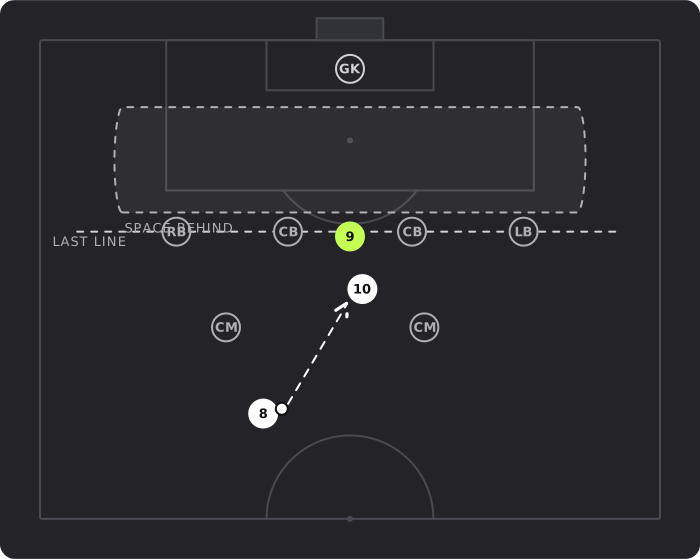
A line that fears the ball over the top cannot step up, and the space between it and the midfield is the space his team-mates are using.
Source: Coaching literature (centre-forward play) · applied
Staying between the two keeps both occupied; going ball-side releases the far one to cover, and the box is defended by an extra man before the cross arrives.
Source: Coaching literature (centre-forward play) · applied
A sweeper's value is time to read the game; giving one of the two in front of him a live duel turns him into cover for it instead.
Source: Coaching literature (attacking defensive shapes) · applied
The pin is a threat, and the threat is only credible where the striker would win the race, which is why the choice is made on the defenders rather than on the pitch.
Source: Coaching literature (centre-forward play) · applied
The two jobs belong to different phases, and the only moment both look urgent is the second after the ball changes hands, when it is not yet clear which phase the team is in.
Source: Coaching literature (centre-forward play) · applied
Moving sideways keeps him level with the defenders, so the depth is never given up, and it changes which defender has to deal with him.
Source: Coaching literature (movement and timing of runs) · applied
A throw-in is taken with the pitch in front of the taker and nothing behind him, so the danger is the pass back inside, and the striker's start decides whether it is available.
Source: Coaching literature (centre-forward play) · applied
The dropped defender is insurance against depth, which is why sides that fear pace do it, and why it costs them the compactness a flat line would have kept.
Source: Coaching literature (centre-forward play) · applied
Pinning ends the moment the delivery is prepared: standing on the defender who has been tracking him is the one place he cannot attack the ball from.
Source: Coaching literature (centre-forward play) · applied
One forward against three defenders leaves the extra man with no direct opponent, so nobody is genuinely held in place.
Source: Coaching literature (centre-forward play) · applied
Test 2Movement to receiveTake a test
The double movement works because the defender's weight goes forward with the first step, and reversing costs him the metre the run needs.
Source: Coaching literature (movement and timing of runs) · applied
Crossing the defender's path means the marker has to reach through him to get to the ball, and the first contact is the striker's.
Source: Coaching literature (movement and timing of runs) · applied
Two refusals usually mean the option is not available rather than badly made, so the third movement has to offer a different pass, not a louder version of the first.
Source: Coaching literature (movement and timing of runs) · applied
Distance decides it: with a defender pressed against him there is no room to turn, and with a gap the same movement is a chance to run into it.
Source: Coaching literature (movement and timing of runs) · applied
Attacking the near post first moves the marker with him, and the check back arrives at the spot the defender has just vacated.
Source: Coaching literature (movement and timing of runs) · applied
A defender who can predict the movement is defending it before it happens; one contrary run makes the pattern unreliable and the original run live again.
Source: Coaching literature (movement and timing of runs) · applied
A pass cannot be played to a run the carrier cannot see; when he is pressed, the useful movement is the one that appears in front of him.
Source: Coaching literature (movement and timing of runs) · applied
The gap closes by a slide, not by the defender coming back, so the run into it has to be already moving when the follower commits.
Source: Coaching literature (movement and timing of runs) · applied
There is no space behind a deep block, so the forward's value moves to receiving in front of it and combining, which drags defenders out.
Source: Coaching literature (movement and timing of runs) · applied
Separation is bought with a step in the wrong direction; without it, the defender arrives with the ball and the reception is a duel rather than a pass.
Source: Coaching literature (movement and timing of runs) · applied
Test 3Hold-up and link playTake a test
Hold-up play buys the seconds his team-mates need to get past him; losing the ball there hands possession to a defence that is already facing the right way.
Source: Coaching literature (centre-forward play) · applied
Orientation decides what he can play next: facing the far side means the ball can leave him towards the space, rather than back where it came from.
Source: Coaching literature (centre-forward play) · applied
The point of the reception is to turn the team, not the ball: a runner meeting the layoff attacks the space the striker cannot see behind him.
Source: Coaching literature (centre-forward play) · applied
Possession kept is the minimum return on the reception; forcing a turn against a defender who has support is how the counter-attack starts.
Source: Coaching literature (centre-forward play) · applied
The layoff is the point of the reception, and a ball arriving in the air has to be brought down first, which is the touch the defence is waiting for.
Source: Coaching literature (centre-forward play) · applied
The reception is the start of the move rather than the end of it: the player who was facing his own goal is the one the defence stops watching once the ball has gone.
Source: Coaching literature (centre-forward play) · applied
The pattern is a response to pressure, not a rule: with nobody on his back the striker is a carrier, and holding the ball gives back the advantage he was handed.
Source: Coaching literature (centre-forward play) · applied
The ball goes to the striker and back out beyond the line that was screening it, which is progression bought with one pass rather than with a duel.
Source: Coaching literature (centre-forward play) · applied
A lost race there gives the opponent the ball facing forward, so the forward's job becomes getting his body in first, which either wins the ball back or at least delays the defender's clearance.
Source: Coaching literature (centre-forward play) · applied
If the duel cannot be won, the answer is to stop having it: the same player receiving side-on in a wider area faces nobody at his back.
Source: Coaching literature (centre-forward play) · applied
Test 4After the false nine dropsTake a test
Turning is worth a risk only when it can be completed; unpressed he should always turn, and the reception is wasted if he plays backwards out of habit.
Source: Coaching literature (centre-forward play) · applied
The whole mechanism depends on pulling a defender out of the line; a midfielder dropping onto him costs the opponent nothing at the back.
Source: Coaching literature (centre-forward play) · applied
With the forward in midfield, the opposing line is free to step up and the team has no depth to threaten while it reorganises.
Source: Coaching literature (centre-forward play) · applied
The players already highest on the pitch are the wide ones, so the counter starts with them running past the defence rather than with the forward turning around.
Source: Coaching literature (centre-forward play) · applied
The movement is designed to pull a defender out; a line that refuses gives him the ball instead, which is a different, smaller gain.
Source: Coaching literature (centre-forward play) · applied
Depth has to come from somewhere, and wide forwards standing on the shoulder of the full-backs keep the line honest without abandoning the width.
Source: Coaching literature (centre-forward play) · applied
The role produces receptions by design; without a runner beyond the ball, those receptions end with the same defence in the same shape.
Source: Coaching literature (centre-forward play) · applied
He receives facing the game rather than the ball, so the ball can be released forward immediately, which is exactly what a player with his back to goal cannot do.
Source: Coaching literature (centre-forward play) · applied
Without a target in the box, the attack is built around runs behind the defence, and pace rather than height is what those runs need.
Source: Coaching literature (centre-forward play) · applied
The role converts a defender's decision into space; a block that has already dropped has no decision to make and no space behind it to give.
Source: Coaching literature (centre-forward play) · applied
Test 5Pressing from the frontTake a test
With ten men there is no second presser to close the far side, so the shadow has to be cast across the pitch and the near pass conceded instead.
Source: Coaching literature (pressing from the front) · applied
Pressing the keeper hands the outfield players time; pressing the defender with a shadow behind you takes options away without conceding it.
Source: Coaching literature (pressing from the front) · applied
Steering a build-up is about which foot finishes the pass; sending it to the goalkeeper's weaker side buys the press an inaccuracy without winning a duel.
Source: Coaching literature (pressing from the front) · applied
A press collapses when the ball can go back and start again, and the player already beyond the ball is the one who removes that escape.
Source: Coaching literature (pressing from the front) · applied
The first ball is lost or won by the defender, and the second is the one the game turns on, so the forward's job is the space behind the duel.
Source: Coaching literature (pressing from the front) · applied
Pressing is a collective action; a solo effort removes the shadow he was casting and leaves the pass he was covering wide open.
Source: Coaching literature (pressing from the front) · applied
Pressing without the shape behind it opens the lines the presser was screening, so a press is worth what the team behind it can support rather than what the striker can run.
Source: Coaching literature (pressing from the front) · applied
Against three he can never reach them all, so the job becomes steering: closing the middle and sending the ball to the side his team has loaded.
Source: Coaching literature (pressing from the front) · applied
Most presses are escaped; the return is a hurried decision rather than a turnover, and hurried decisions are what the rest of the shape feeds on.
Source: Coaching literature (pressing from the front) · applied
A side that wants to be pressed lets the striker come, and the pass past him arrives exactly as he commits, which is the pattern rather than an accident.
Source: Coaching literature (pressing from the front) · applied
Test 6Runs in behind and the offside lineTake a test
Level with the second-last opponent is the legal limit, so every metre of the run happens after the pass and none of it is spent getting back onside.
Source: Coaching literature (movement and timing of runs) · applied
A diagonal is handed from one defender to the next while the line is also trying to hold its shape, so the moment of the hand-over is the gap.
Source: Coaching literature (movement and timing of runs) · applied
Running away from the ball takes him out of everybody's field of view, which is why the far-post arrival is so often unmarked.
Source: Coaching literature (movement and timing of runs) · applied
A touch across the body opens the angle and puts the striker's body between the ball and the recovering defender, which the straight touch does neither of.
Source: Coaching literature (movement and timing of runs) · applied
A curved path keeps him level with the line while the ball is being prepared, so the run begins from the latest legal moment.
Source: Coaching literature (movement and timing of runs) · applied
The run is spent if the pass cannot be played, so it starts from what the passer can do rather than from what the defence is doing.
Source: Coaching literature (movement and timing of runs) · applied
Two identical runs give the defence one decision instead of two; keeping one player on the line preserves the option and the depth.
Source: Coaching literature (movement and timing of runs) · applied
The run still exists, but it arrives in the few metres between the line and the keeper rather than in open space, which is why the same movement produces so much less.
Source: Coaching literature (movement and timing of runs) · applied
The contest is with the ball's landing point; a striker who watches the defender arrives where the defender is rather than where the ball will be.
Source: Coaching literature (movement and timing of runs) · applied
A defence that pushes out after dealing with one ball leaves the same space again, and the runner who resets quickest finds it open.
Source: Coaching literature (movement and timing of runs) · applied
Test 7Shot selectionTake a test
A shot that gets blocked is worth less than a pass, and a shot that gets away before the defender is set is worth more than either, so the timing decides.
Source: Coaching literature (finishing) · applied
The margin there is a fraction of a second: the extra touch invites the block that the strike would have beaten.
Source: Coaching literature (finishing) · applied
Once the keeper is set the far side is the bigger target; before he sets, the near post is the live one, which is why the timing decides the choice.
Source: Coaching literature (finishing) · applied
Placement needs a moment that pressure removes; with a defender arriving, the ball has to be gone before the picture is perfect.
Source: Coaching literature (finishing) · applied
A low shot across the goalkeeper is the hardest to hold and the rebound stays where attackers are, so the shot has a second life the high one does not.
Source: Coaching literature (finishing) · applied
A poor touch turns a chance into a possession, and keeping the ball there produces a better one; forcing the shot ends the attack.
Source: Coaching literature (finishing) · applied
Bringing the ball down needs two touches the defender is arriving to prevent; the shot taken on the drop is the one that beats him to it.
Source: Coaching literature (finishing) · applied
Close to goal the value of a saved shot is high, because the ball stays in a crowded area where the next contact is often an attacker's.
Source: Coaching literature (finishing) · applied
A set keeper's stance says which side he can reach; the finish is chosen from that rather than from a favourite corner.
Source: Coaching literature (finishing) · applied
A shot from distance is a low-probability action that becomes reasonable when the follow-up is covered, which turns a save into a second chance rather than a turnover.
Source: Coaching literature (finishing) · applied
Test 8Playing as a pairTake a test
A pair is only worth two players if the defenders have two problems; standing in one zone lets a single centre-back deal with both.
Source: Coaching literature (centre-forward play) · applied
Opposite movements split the pair's markers: one is dragged out of the line and the other threatens the space he leaves.
Source: Coaching literature (centre-forward play) · recall
The counter needs a first contact that survives contact and a second that arrives at speed, which is exactly the division of labour that pairing provides.
Source: Coaching literature (centre-forward play) · applied
Two pressers against a back four and a goalkeeper always leave a spare man, so the pair decides in advance who is responsible for him rather than both chasing the ball.
Source: Coaching literature (centre-forward play) · applied
Leaving a forward up occupies at least one defender and gives the clearance somewhere to go, and pace matters more than height for a ball that will be run onto.
Source: Coaching literature (centre-forward play) · applied
Separating them by depth rather than by width keeps both central and still gives the defenders two different problems.
Source: Coaching literature (centre-forward play) · applied
The three's advantage is its spare defender, and a pair reduces it: two of the three are tied up, and the third has to cover rather than roam.
Source: Coaching literature (attacking defensive shapes) · applied
The pair's product is the space their movement opens, and that shows in defenders being separated rather than in either player's own touches.
Source: Coaching literature (centre-forward play) · applied
It is a trade rather than a rule: the team defends with two players fewer behind the ball in exchange for somewhere to play when it wins possession.
Source: Coaching literature (centre-forward play) · applied
A pair is worth two players only when the defenders have to solve two different problems, which is why the target-and-runner split has outlived most other pairings.
Source: Coaching literature (centre-forward play) · applied
Test 9Against a back two and against a back threeTake a test
The space in front of the back four is the one the opponent has doubled up on, so a forward who drops there is receiving where the extra men are.
Source: Coaching literature (attacking defensive shapes) · applied
The spare man is only spare while he has nothing to do; standing between two of them turns him into cover for a duel rather than a free observer.
Source: Coaching literature (attacking defensive shapes) · applied
The third defender is paid for somewhere, and in the three-four variants it is paid for in central midfield, which is the zone the forward drops into.
Source: Coaching literature (attacking defensive shapes) · applied
Against a four, following him breaks the line; against a three it does not, which is why the same movement produces less.
Source: Coaching literature (attacking defensive shapes) · applied
Narrow defenders concede the channel; drifting into it means the centre-back must leave the middle or the full-back must come inside.
Source: Coaching literature (attacking defensive shapes) · applied
A single forward covers the middle, so the width is free by definition and the team has to occupy the wing-backs with its own wide players instead.
Source: Coaching literature (attacking defensive shapes) · applied
A back three concedes space in front of it, which is easy to occupy and worth little; the reception matters only when it is close enough to force a defender to decide.
Source: Coaching literature (attacking defensive shapes) · applied
High wing-backs leave the space they vacated, and the defender who has to cover it is travelling sideways, which is the slowest way to defend a run.
Source: Coaching literature (attacking defensive shapes) · applied
Standing between them makes both responsible, and a defender who is jointly responsible is slower to step than one who is clearly the marker.
Source: Coaching literature (attacking defensive shapes) · applied
A marker who follows is a defender who can be taken anywhere; pulling him towards the touchline separates him from the two who were covering him.
Source: Coaching literature (attacking defensive shapes) · applied
Test 10One against one with the goalkeeperTake a test
A goalkeeper in motion cannot spread himself, so the ball goes early; a set keeper has to be moved first, which is what a carry does.
Source: Coaching literature (finishing) · applied
The move takes a second or two, and those seconds are exactly what a chasing centre-back needs to clear the shot off the line.
Source: Coaching literature (finishing) · applied
A keeper spread low covers the ground and concedes the air; the chip is the answer his own shape creates, provided the goal line is far enough away.
Source: Coaching literature (finishing) · applied
The duel is with two opponents, not one, and moving away from the recovering defender keeps the shot available while the challenge is still a metre away.
Source: Coaching literature (finishing) · applied
The keeper's job is to delay the decision until he is on top of the striker; the finish is chosen before that, or it is chosen for him.
Source: Coaching literature (finishing) · applied
Staying back keeps the whole frame covered and concedes the shot; the striker gets to strike, but at a keeper who is set and central.
Source: Coaching literature (finishing) · applied
A keeper starting high has already left the space behind him and can be chipped; one on his line has to be beaten along the ground, and the choice is read before the duel begins.
Source: Coaching literature (finishing) · applied
From a tight angle the goalkeeper covers most of the goal, and an unmarked team-mate in the middle is a far better chance than the one the striker holds.
Source: Coaching literature (finishing) · applied
Every metre he comes narrows what the striker can see of the goal, and if he arrives first the duel never happens at all.
Source: Coaching literature (finishing) · recall
Parries travel where the keeper pushes them rather than back to the shooter, so the rebound belongs to whoever is standing in that zone when the shot is struck.
Source: Coaching literature (finishing) · applied
Sources
IFAB Laws of the Game / UEFA & FIFA technical reports / Opta & StatsBomb definitions / coaching literature
- Coaching literature (centre-forward play)37
- Coaching literature (movement and timing of runs)21
- Coaching literature (finishing)20
- Coaching literature (attacking defensive shapes)12
- Coaching literature (pressing from the front)10