
Football · Level 6: Advanced · Sub-level 6.68
Midfield Structures: Pivots, Box and Rest Defence
10 tests · 100 facts · updated 12 October 2026 · markdown
How the centre of the pitch is arranged and what each arrangement costs: the single and double pivot, the box midfield, the shape a team leaves behind while it attacks, the runner from midfield, and who is responsible at the moment the ball is lost.
Each test below is ten questions on Insporta. The list under a test is what the questions check: one fact per question, with the source it was written from. Read it before the test, or come back from a wrong answer.
Test 1The single pivotTake a test
One holder covers a width he cannot hold alone, so the structure only works if his replacement is arranged rather than hoped for.
Source: Coaching literature (midfield structure and roles) · applied
The whole point of the single pivot is arithmetic further forward: the player saved at the base appears where the opponent has to defend him.
Source: Coaching literature (midfield structure and roles) · applied
He can cover one channel at a time, so a side that occupies both at once forces him to choose which goal-side pass to allow.
Source: Coaching literature (midfield structure and roles) · applied
The pass into the space he vacates is the whole reason an opponent invites him forward, so the cover is part of the press rather than a reaction to it.
Source: Coaching literature (midfield structure and roles) · applied
A booked holder cannot be the player who steps into contact, so the tackle is handed to a team-mate while he keeps the position that needs no challenge.
Source: Coaching literature (midfield structure and roles) · applied
A holder facing his own goal has to turn under pressure, and the turn is the moment the presser is running at; opening the body first removes it.
Source: Coaching literature (midfield structure and roles) · applied
If the ten sits in the passing lane, the ball has to arrive from a player the ten cannot cover, and a defender carrying it forward is the one nobody has picked up.
Source: Coaching literature (midfield structure and roles) · applied
The line's height is priced on what is screening in front of it, so removing the screen is a decision about the whole defence rather than about one position.
Source: Coaching literature (midfield structure and roles) · applied
Alone he cannot cover a mistake by moving faster, so the position is decided by anticipation rather than by ground covered after the fact.
Source: Coaching literature (midfield structure and roles) · applied
A high press leaves a large middle behind it, and the more of the team is committed forward, the less realistic it is to leave one man holding that ground.
Source: Coaching literature (midfield structure and roles) · applied
Test 2The double pivotTake a test
Two holders are rarely both needed at once; the value is that either can step, press or advance knowing the base is still occupied.
Source: Coaching literature (midfield structure and roles) · applied
One forward cannot cover two players either side of him, so the pair's spacing turns his single press into the wrong choice whichever way he goes.
Source: Coaching literature (midfield structure and roles) · applied
Two holders level with one another are a single obstacle for passing purposes, so an opponent has one line to play through rather than two.
Source: Coaching literature (midfield structure and roles) · applied
Full-backs high means the wide areas behind them are open, and the pair in the middle is what stops the counter reaching them at speed.
Source: Coaching literature (midfield structure and roles) · applied
Cover has to arrive from the side the ball is travelling away from, so the pair's roles are decided by position at that second rather than by profile.
Source: Coaching literature (midfield structure and roles) · applied
Staggering gives the ball two heights to travel between, which is what breaks a two-forward press: one of them has to leave a passing line open.
Source: Coaching literature (midfield structure and roles) · applied
Pressure from the blind side arrives before he can turn into it, while the player in his eyeline is the one he was already planning to beat.
Source: Coaching literature (midfield structure and roles) · applied
A throw-in leaves the taker unmarked for a second, so the way to punish it is to take away the pass that puts him back into the game.
Source: Coaching literature (midfield structure and roles) · applied
Chasing means one of the two stops being a holder, which is the flexibility the pairing was chosen for in the first place.
Source: Coaching literature (midfield structure and roles) · applied
The pair splits the two jobs a turnover creates at once: somebody has to give the ball an option forward, and somebody has to be standing where it will come back.
Source: Coaching literature (rest defence and transition) · applied
Test 3The box midfieldTake a test
Four central players is four players not on a touchline, so the shape only functions if the width comes from the two defenders wide of them.
Source: Coaching literature (midfield structure and roles) · applied
A three defends one line at a time; the box puts players on two lines at once, so pressing the deep pair concedes the pair behind it.
Source: Coaching literature (midfield structure and roles) · applied
Four central players lose the ball in a crowd, so the counter-press is available immediately; if the front pair does not join it, the shape becomes two against many.
Source: Coaching literature (midfield structure and roles) · applied
The four central players are the only bodies available, so the pair that attacked becomes the line that defends, which is why the shape asks so much running of them.
Source: Coaching literature (midfield structure and roles) · applied
The pair behind the striker exists to attack the ground between the centre-back and the full-back, which is the space a lone forward cannot occupy on both sides at once.
Source: Coaching literature (midfield structure and roles) · applied
A block sitting on its own box gives the second holder little to screen while the ball is in front of him, though the counter such a side hopes to launch is why coaches hesitate to push him up.
Source: Coaching literature (midfield structure and roles) · applied
Four players standing in a crowd with four markers is a stalemate, so the answer is movement that drags a marker away rather than another body in the middle.
Source: Coaching literature (midfield structure and roles) · applied
The extra body is the whole idea: a defence that has picked up the striker and the two behind him still has a fourth runner unaccounted for.
Source: Coaching literature (midfield structure and roles) · applied
The wide centre-backs of a five can step onto the two advanced midfielders without breaking the line, so the box's extra bodies find markers who were already assigned.
Source: Coaching literature (midfield structure and roles) · applied
One forward cannot press two defenders, so the players behind him step up first while the holders stay to cover the midfield the press empties.
Source: Coaching literature (midfield structure and roles) · applied
Test 4Rest defenceTake a test
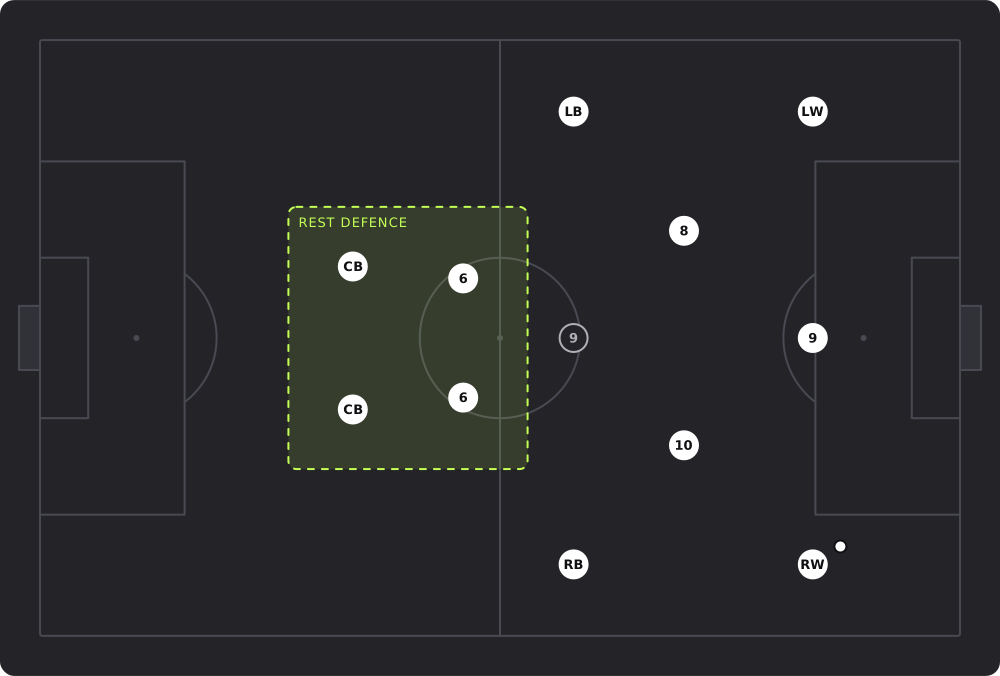
The same five players are arranged either to cover the middle first or to cover the flanks first, and the choice follows where the opponent breaks.
Source: Coaching literature (rest defence and transition) · applied
A counter breaks into the ground behind the attack, so on a left-sided attack the right-hand defender is the one already standing where it will arrive.
Source: Coaching literature (rest defence and transition) · applied
Most counters begin with a clearance rather than a pass, so the useful position is the landing area rather than a man or a line.
Source: Coaching literature (rest defence and transition) · applied
His height is a function of recovery distance, and the moment he passes the point where he can get back, the shape behind the ball is a player short.
Source: Coaching literature (rest defence and transition) · applied
Every body kept back is one the defending side does not have to account for, so safety at the back is paid for in the crowding of the box.
Source: Coaching literature (rest defence and transition) · applied
A corner draws bodies forward and returns the ball at speed, which is why the shape behind it is arranged before the kick rather than after the clearance.
Source: Coaching literature (rest defence and transition) · applied
The measure is the speed from turnover to danger: a shape that holds slows the counter even when it does not win the ball back.
Source: Coaching literature (rest defence and transition) · applied
The counter starts with a pass into the opposing holder, and a player standing on the wrong side of him is a body in the picture rather than in the way.
Source: Coaching literature (rest defence and transition) · applied
Game state changes the price of a counter rather than the mechanics of one, so the usual adjustment is arithmetic rather than a new arrangement.
Source: Coaching literature (rest defence and transition) · applied
The unit is built on a plus-one: enough to win the first duel and still have a spare body for the runner behind it, which two against two does not provide.
Source: Coaching literature (rest defence and transition) · applied
Test 5The runner from midfieldTake a test
A counter is won by the seconds nobody spends turning around, so the runner is chosen by where he was standing rather than by what he is best at.
Source: Coaching literature (rest defence and transition) · applied
Arriving early makes him another body to be marked; the run is worth something only if it is still moving when the defence has settled on the ball.
Source: Coaching literature (midfield structure and roles) · applied
A run that has been seen three times is a run the defence is now waiting for, and the part of it that can be hidden is where it begins rather than how fast it is.
Source: Coaching literature (midfield structure and roles) · applied
A line that must respect a runner cannot step up, and the space the striker wanted to receive in is created by the run rather than by the pass.
Source: Coaching literature (midfield structure and roles) · applied
A runner who is beside the ball is in the picture the defenders are already looking at; the value is in arriving from where nobody is watching.
Source: Coaching literature (midfield structure and roles) · applied
A cut-back from the byline travels back across defenders who are facing their own goal and watching the ball, which is the moment the runner arriving behind them is unseen.
Source: Coaching literature (midfield structure and roles) · applied
The same player is a different threat on the other side: the run that used to end with a cross now ends with a shot, because the foot he arrives on has changed.
Source: Coaching literature (midfield structure and roles) · applied
Arrivals stop when everybody has been given a reason to stay, so the fix is usually a permission rather than a personnel change.
Source: Coaching literature (midfield structure and roles) · applied
The far-side runner arrives across the defence into the space the ball has pulled everybody away from, while the near-side player is needed to support the ball.
Source: Coaching literature (midfield structure and roles) · applied
The edge is where clearances and cut-backs arrive, and the player who is too late for the box is exactly the one who reaches it in time.
Source: Coaching literature (midfield structure and roles) · applied
Test 6The moment the ball is lostTake a test
Pressing needs bodies around the ball and cover behind it; with the midfield in front of the play there is nothing to press with and nothing to press for.
Source: Coaching literature (rest defence and transition) · applied
The winner of a tackle looks forward before he looks up, so the pass he wants is the one worth taking away rather than the man who has the ball.
Source: Coaching literature (rest defence and transition) · applied
The shape's counter-pressing depends on numbers near the ball, and a loss that leaves half of the four upfield turns its own compactness into an overload against it.
Source: Coaching literature (rest defence and transition) · applied
A break is fast only while nobody has to make a decision, and the carrier is the player whose decision can be forced by the first defender back.
Source: Coaching literature (rest defence and transition) · applied
Stopping the first runner buys seconds, not safety: the players who set off behind him arrive into a midfield that has already committed to the ball.
Source: Coaching literature (rest defence and transition) · applied
Delay is what a lone defender does because a tackle he loses is a goal; the second defender is what turns the same tackle into a risk worth taking.
Source: Coaching literature (rest defence and transition) · applied
Every player who committed to the ball is behind it once the opponent escapes, so a failed counter-press hands over both the ball and the numbers.
Source: Coaching literature (rest defence and transition) · applied
Nobody can reach the flanks in time, so the answer is to make the flanks the slower route rather than to try to defend them.
Source: Coaching literature (rest defence and transition) · applied
Looking forward first is the right instinct; what loses the ball again is a touch that stays inside the group he has just taken it from.
Source: Coaching literature (rest defence and transition) · applied
The chase is usually lost already, and the useful contribution is filling the hole his own advance created rather than following the ball into it.
Source: Coaching literature (rest defence and transition) · applied
Test 7The diamondTake a test
The diamond's two shuttlers are its width, so any ball into a wide area drags them out and leaves the single player behind them facing the middle alone.
Source: Coaching literature (midfield structure and roles) · applied
The tip is the only player positioned in front of the opponent's deepest passer, and a diamond that lets that player receive freely defends everything else a pass too late.
Source: Coaching literature (midfield structure and roles) · applied
A diamond has nobody stationed wide, so the same two players are asked to support the middle in possession and to arrive on a touchline when the ball goes there.
Source: Coaching literature (midfield structure and roles) · applied
The shuttlers can follow a winger who starts wide, but a full-back arriving from behind them is a second wide player on the same flank, and the shape has no third.
Source: Coaching literature (midfield structure and roles) · applied
Four players on four heights means an opponent's line has somebody in front of it and somebody behind it at once, which a flat four never presents.
Source: Coaching literature (midfield structure and roles) · applied
The tip's value is receiving between the lines, and that is only available while the defenders behind him are occupied by somebody else.
Source: Coaching literature (midfield structure and roles) · applied
He is the player the ball has just gone past, so he is both closest and facing the right way; leaving it to the base opens the space the whole shape sits in front of.
Source: Coaching literature (midfield structure and roles) · applied
A man-marker who follows the tip has left the ground behind himself, and the players who can reach it are the two already running from midfield.
Source: Coaching literature (midfield structure and roles) · applied
A lone holder who is permanently marked stops being the route through midfield, and the shape provides the marker without giving up a body anywhere else.
Source: Coaching literature (midfield structure and roles) · applied
The pair presses on a curve so a narrow shape defends one side of the pitch at a time; screening the opposing pivot stays the tip's job.
Source: Coaching literature (midfield structure and roles) · applied
Test 8Distances between midfieldersTake a test
The pair shifts with the ball, so the far half-space is the price compactness agrees to pay in advance and the defender behind it answers for it.
Source: Coaching literature (midfield structure and roles) · applied
A shape that follows the ball is always one pass late, so the far side is covered by players who set off while the ball was still travelling.
Source: Coaching literature (midfield structure and roles) · applied
The gap has to be big enough that a pass into it beats a line of pressers, so the opponent's arrangement decides it rather than the team's preference.
Source: Coaching literature (midfield structure and roles) · applied
Compactness is a concentration of players, and everything concentrated in one place is absent from another; the far flank is the price agreed in advance.
Source: Coaching literature (midfield structure and roles) · applied
In possession the distances are set to stretch an opponent; out of possession they are set to deny space, which means measuring from the ball rather than from the pitch.
Source: Coaching literature (midfield structure and roles) · applied
One presser is beaten by one pass; the press only traps if a second player is close enough to take the escape route the first one leaves.
Source: Coaching literature (midfield structure and roles) · applied
Compactness is maintained by repeated short recoveries, which is the first thing tiredness takes away, so the shape loosens before anybody's technique fails.
Source: Coaching literature (midfield structure and roles) · applied
Three players spread across sixty-eight metres would stand about seventeen to twenty metres apart, which is more than any of them can press, so the shape borrows help from the flanks.
Source: Coaching literature (midfield structure and roles) · applied
The distances that matter are relative to the space being defended, so a narrower field lets the same players hold the same coverage from closer together.
Source: Coaching literature (midfield structure and roles) · applied
Fixed spacing is a pattern, and a pressing side that has learned the pattern knows where the next pass is going before it is played.
Source: Coaching literature (midfield structure and roles) · applied
Test 9Choosing the players for the slotsTake a test
Everything else in the role can be arranged around him, but a base who can only pass sideways under pressure turns every build-up back towards his own goal.
Source: Coaching literature (midfield structure and roles) · applied
A side that defends high needs the ball won early and a side that defends deep needs it kept when it arrives, so the plan chooses the profile rather than the other way round.
Source: Coaching literature (midfield structure and roles) · applied
Direct play is settled in the middle third by whoever collects the knock-down, which is a duel the centre of midfield contests several times a match.
Source: Coaching literature (midfield structure and roles) · applied
The pair exists to do different things at the same moment, so two runners leave nobody receiving and two receivers leave nobody attacking the last line.
Source: Coaching literature (midfield structure and roles) · applied
A first season is a season of errors, and the pair is the only central role arranged so that one of them does not become a chance against.
Source: Coaching literature (midfield structure and roles) · applied
Receiving on the outside foot turns him towards the field, while the opposite foot turns him into the touchline and towards the pressure arriving behind him.
Source: Coaching literature (midfield structure and roles) · applied
Both are standard: a midfielder brings the receiving and turning the base needs, a defender brings the duels and the reading, and the choice follows which of the two the plan cannot do without.
Source: Coaching literature (midfield structure and roles) · applied
Technique and fitness travel with the player, but a licence to roam was granted by a particular arrangement of team-mates, and the new one may have spent it elsewhere.
Source: Coaching literature (midfield structure and roles) · applied
The two demands select for different players, and a side that signs only for the ball loses its first line of pressure while a side that signs only for the press stops creating.
Source: Coaching literature (midfield structure and roles) · applied
A shape written for one player's range is not a shape anybody else can fill, so his absence costs the plan as well as the player.
Source: Coaching literature (midfield structure and roles) · applied
Test 10Midfield behind a back threeTake a test
In a four the centre of midfield slides across to help the full-backs; with wing-backs holding both touchlines, the same players stay in the middle where they were picked to be.
Source: Coaching literature (midfield structure and roles) · applied
The extra central player is the shape's whole argument, and a flat two cannot cover three lanes without pulling a winger inside to help.
Source: Coaching literature (midfield structure and roles) · applied
A back three defends the width with five, so the midfield's job is the two channels between the centre-backs and the wing-backs rather than the ground behind them.
Source: Coaching literature (midfield structure and roles) · applied
The wide lane behind an advanced wing-back is the shape's standing weakness, and the player nearest to it when the ball turns over is a central midfielder.
Source: Coaching literature (midfield structure and roles) · applied
If all three defenders are pinned, none of them can step into midfield, and the central three is left to win its battles without the help the shape was built to provide.
Source: Coaching literature (midfield structure and roles) · applied
The pair of strikers is where the shape carries its spare player, so the cheapest way to fix the count is to spend one of them rather than to break the defensive line.
Source: Coaching literature (midfield structure and roles) · applied
In a four the full-backs are covered by the players ahead of them; with only two players between defence and attack, both wide recoveries fall to the pair in the middle.
Source: Coaching literature (midfield structure and roles) · applied
The third defender is the shape's spare man, and a spare man who can carry the ball into midfield creates the superiority the midfield could not create for itself.
Source: Coaching literature (midfield structure and roles) · applied
Both wide players start every recovery from the highest positions on the pitch, so the first seconds of a counter are defended by a shape with two of its outfield players still upfield.
Source: Coaching literature (midfield structure and roles) · applied
A five behind two or three midfielders leaves a band in front of the box that belongs to nobody by default, and it is where a patient opponent takes its shots from.
Source: Coaching literature (midfield structure and roles) · applied
Sources
IFAB Laws of the Game / UEFA & FIFA technical reports / Opta & StatsBomb definitions / coaching literature
- Coaching literature (midfield structure and roles)78
- Coaching literature (rest defence and transition)22