
Cricket · Level 2: Elementary · Sub-level 2.5
Match Regulations
10 tests · 100 facts · updated 12 October 2026 · markdown
This sub-level teaches the regulations layered on top of the Laws for the limited-overs and championship game — the powerplays and fielding restrictions in a one-day international and in a Twenty20, the free hit and exactly what can and cannot happen off it, how a slow over rate is punished by the stop clock and by an in-match penalty, the intervals and the extra time a day can borrow, and, in outline, the Duckworth-Lewis-Stern method and the concussion replacement. It also covers the Super Over, pitch and outfield ratings, boundary sizes in international cricket, and washouts and reserve days.
Each test below is ten questions on Insporta. The list under a test is what the questions check: one fact per question, with the source it was written from. Read it before the test, or come back from a wrong answer.
Test 1Powerplays in a one-day internationalTake a test
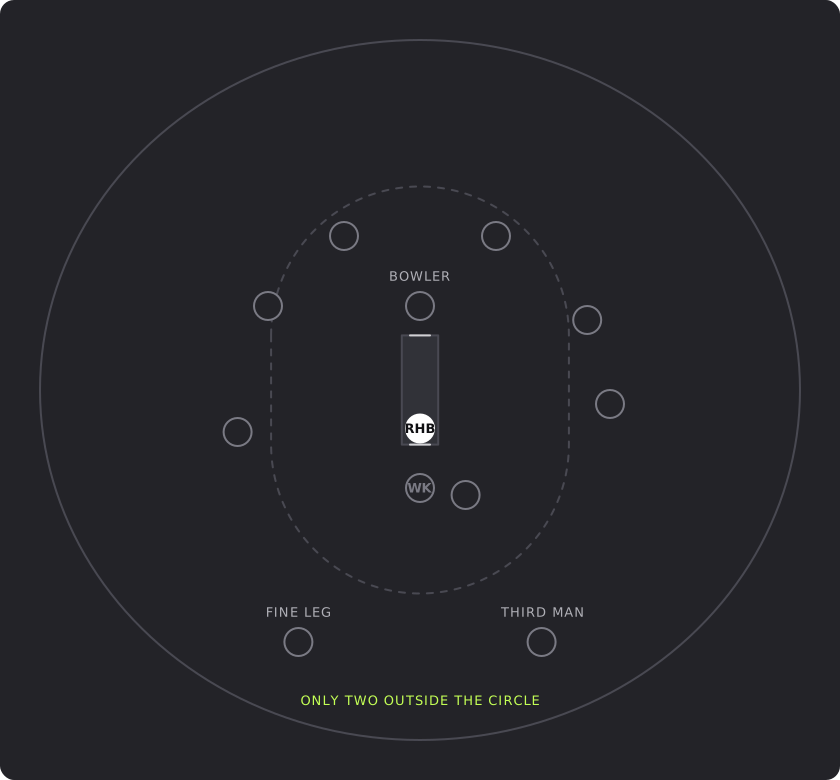
Powerplay 1 covers the opening ten overs of a fifty-over innings.
Source: ICC Playing Conditions (ODI) · recall
Only two fielders may be outside the thirty-yard circle in the first ten overs.
Source: ICC Playing Conditions (ODI) · recall
From over 11 to over 40 up to four fielders may be outside the circle.
Source: ICC Playing Conditions (ODI) · recall
In the final phase up to five fielders may be outside the circle, the most of any phase.
Source: ICC Playing Conditions (ODI) · recall
Three fielders out in the first powerplay breaks the two-fielder limit, so the delivery is a no-ball.
Source: ICC Playing Conditions (ODI) · applied
Two arcs thirty yards from each middle stump, joined by straight lines, form the fielding circle.
Source: ICC Playing Conditions (ODI) · recall
When an innings is shortened in advance, the phase boundaries are scaled to the reduced number of overs.
Source: ICC Playing Conditions (ODI) · applied
The Law's two-behind-square leg-side limit applies throughout, on top of the powerplay circle rules.
Source: MCC Laws of Cricket 2017 code (3rd edition 2022), Law 28 · recall
Since July 2025 the ICC's ODI conditions use the two new balls, one from each end, only until the end of the 34th over; the fielding side then picks one of them for overs 35 to 50.
Source: ICC Playing Conditions (ODI) · recall
Fewer boundary riders early and late forces gaps and rewards aggressive batting.
Source: ICC Playing Conditions (ODI) · recall
Test 2Fielding restrictions in a Twenty20Take a test
A T20I powerplay is the opening six overs of the twenty.
Source: ICC Playing Conditions (T20I) · recall
Just two fielders may be outside the thirty-yard circle in the T20 powerplay, matching the ODI figure.
Source: ICC Playing Conditions (T20I) · recall
After over six, up to five fielders may be outside the circle.
Source: ICC Playing Conditions (T20I) · recall
A third fielder outside the circle during the T20 powerplay is one too many, so it is a no-ball.
Source: ICC Playing Conditions (T20I) · applied
With five allowed outside, the four remaining fielders have to be inside the circle.
Source: ICC Playing Conditions (T20I) · recall
The leg-side limit of two behind square is a Law and holds for every delivery of the match.
Source: MCC Laws of Cricket 2017 code (3rd edition 2022), Law 28 · recall
A rain-reduced T20 has its powerplay scaled down from the playing-conditions table, keeping the same rough proportion.
Source: ICC Playing Conditions (T20I) · applied
The five-outside limit holds for every over after the powerplay, so a ring of nine on the rope is illegal.
Source: ICC Playing Conditions (T20I) · applied
Five outside is the most allowed, not a number that must be used; a captain may keep more fielders in.
Source: ICC Playing Conditions (T20I) · applied
A bowler is capped at four of the twenty overs; once they are gone the umpire will not let him bowl a fifth.
Source: ICC Playing Conditions (T20I) · applied
Test 3The free hitTake a test
The free hit now follows every kind of no-ball, where once it was only for a foot fault.
Source: ICC Men's ODI and T20I Playing Conditions, Law 21 (No ball), free hit · recall
Only the dismissals available off a no-ball apply on a free hit: run out, obstruction, and hit the ball twice.
Source: ICC Playing Conditions (free hit) · recall
He cannot be bowled off a free hit; the ball stays live, so runs, including byes off the stumps, can be taken.
Source: ICC Playing Conditions (free hit) · applied
Run out is one of the dismissals a free hit does not protect against, so a batter short of his ground is out.
Source: ICC Playing Conditions (free hit) · applied
The field is frozen for the free hit; the main exception is that a new batter is on strike after a completed run.
Source: ICC Playing Conditions (free hit) · recall
A no-ball or a wide on the free-hit ball means the free hit carries over to the following delivery.
Source: ICC Playing Conditions (free hit) · applied
After the no-ball signal the umpire circles a raised arm to show that a free hit is coming.
Source: ICC Playing Conditions (free hit) · recall
The ball is live on a free hit, so byes and leg-byes are run and scored in the normal way.
Source: ICC Playing Conditions (free hit) · applied
A near-risk-free delivery on top of the extra run makes bowling a no-ball much more expensive, and deters it.
Source: ICC Playing Conditions (free hit) · recall
The field may not be altered for a free hit unless the striker has changed ends, so an unauthorised move is undone.
Source: ICC Playing Conditions (free hit) · applied
Test 4Over rates and the stop clockTake a test
An on-ground clock counts down sixty seconds from the end of one over to the first ball of the next.
Source: ICC Playing Conditions (stop clock) · recall
The first two breaches in an innings bring warnings; every breach after that costs five penalty runs.
Source: ICC Playing Conditions (stop clock) · recall
The third umpire operates the countdown clock that is shown on the ground.
Source: ICC Playing Conditions (stop clock) · recall
After a trial from late 2023 it was made mandatory in all men's ODIs and T20Is from 1 June 2024.
Source: ESPNcricinfo · recall
Once the two warnings are gone, each further slow over costs the fielding side five runs.
Source: ICC Playing Conditions (stop clock) · applied
If the side is not on schedule by a set point, one more fielder must come inside the circle for the rest of the innings.
Source: ICC Playing Conditions (over rates) · recall
WTC places are set by a percentage of points available, and teams have points docked for bowling their overs too slowly.
Source: ICC Playing Conditions (World Test Championship) · recall
Slow field-setting is exactly the delay the clock is meant to catch; the countdown does not pause for it.
Source: ICC Playing Conditions (stop clock) · applied
Genuine stoppages such as a wicket, an injury, DRS or drinks stop the clock; ordinary dawdling does not.
Source: ICC Playing Conditions (stop clock) · recall
Trials showed roughly twenty minutes an ODI were being lost between overs, and the clock was meant to claw that back.
Source: ESPNcricinfo · recall
Test 5Intervals and lost timeTake a test
Lunch is usually forty minutes and tea twenty, though the playing conditions can adjust them.
Source: ICC Playing Conditions (intervals) · recall
One brief drinks break is scheduled per session, with extras only by agreement in extreme heat.
Source: ICC Playing Conditions (intervals) · recall
An interval is taken at the fall of the last wicket, or a declaration, if that comes within a short window of the scheduled time.
Source: ICC Playing Conditions (intervals) · applied
The umpires may extend the day by up to half an hour where they judge it could bring a result.
Source: ICC Playing Conditions (hours of play) · recall
At least fifteen overs must be bowled in the last hour, with time added if the over rate is slow.
Source: ICC Playing Conditions (hours of play) · recall
Lost overs are recovered by starting earlier or finishing later on the following days, up to the daily limits.
Source: ICC Playing Conditions (hours of play) · applied
The innings break in an ODI is typically thirty to forty-five minutes, and shorter in a T20.
Source: ICC Playing Conditions (intervals) · recall
A brief stoppage that does not eat into scheduled time costs nothing; overs are lost only when time genuinely runs out.
Source: ICC Playing Conditions (hours of play) · applied
Overs short of the ninety are made up on later days, and a persistent slow rate brings match-referee sanctions on the captain.
Source: ICC Playing Conditions (over rates) · applied
Test 6Duckworth-Lewis-Stern and concussion replacementsTake a test
DLS produces a revised target, or a par score, when overs are lost to rain in a one-day match.
Source: ICC Playing Conditions (DLS) · recall
The method treats an innings as the overs still to be bowled and the wickets still standing.
Source: ICC Playing Conditions (DLS) · recall
At any interruption DLS gives a par score, and the side is ahead or behind by how its total compares.
Source: ICC Playing Conditions (DLS) · recall
Finishing above the DLS par score means the chasing side has won the rain-shortened match.
Source: ICC Playing Conditions (DLS) · applied
At least twenty overs a side must be possible in an ODI (five in a T20) for a DLS result to count.
Source: ICC Playing Conditions (DLS) · recall
A T20 needs at least five overs a side; below that the match is a no-result.
Source: ICC Playing Conditions (DLS) · recall
A concussion replacement is a full like-for-like replacement who takes over the injured player's role entirely.
Source: ICC Playing Conditions (concussion replacements) · recall
The match referee approves the replacement and normally expects a like-for-like player.
Source: ICC Playing Conditions (concussion replacements) · recall
The replacement should match the injured player's role, so a clear upgrade may be blocked or restricted.
Source: ICC Playing Conditions (concussion replacements) · applied
Without the minimum twenty overs for the chasing side there can be no DLS result, so the game is a no-result.
Source: ICC Playing Conditions (DLS) · applied
Test 7The Super Over in detailTake a test
A Super Over is a single over for each side.
Source: ICC Men's Playing Conditions · recall
Many limited-overs internationals and leagues settle a tie with a Super Over.
Source: ICC Men's Playing Conditions · recall
Each side names its batters and its bowler before the Super Over begins.
Source: ICC Men's Playing Conditions · recall
Tests have their own results, including the draw and the tie, so no tie-breaker is needed.
Source: General playing principle · applied
With three batters named, the second wicket ends the side's Super Over.
Source: ICC Men's Playing Conditions · recall
The Super Over is a playing-condition tie-breaker used widely in limited-overs cricket.
Source: ICC Men's Playing Conditions · recall
Three batters allow for two wickets, after which the Super Over ends.
Source: ICC Men's Playing Conditions · recall
Since 2019, a tied Super Over is followed by further Super Overs until there is a winner.
Source: ICC Men's Playing Conditions · applied
The side that batted second in the match bats first in the Super Over.
Source: ICC Men's Playing Conditions · applied
Side B must pass Side A's 12, so it needs 13.
Source: ICC Men's Playing Conditions · applied
Test 8Pitch and outfield ratingsTake a test
An unfit rating brings three demerit points; an unsatisfactory one brings one.
Source: ICC Pitch and Outfield Monitoring Process · recall
Unsatisfactory is the milder of the two poor ratings.
Source: ICC Pitch and Outfield Monitoring Process · recall
Both pitch and outfield are rated after an international.
Source: ICC Pitch and Outfield Monitoring Process · recall
Variable, dangerous bounce is the clearest sign of a poor surface; normal wear and help for bowlers is not.
Source: ICC Pitch and Outfield Monitoring Process · applied
Ratings push venues to produce pitches that give bat and ball a fair contest.
Source: ICC Pitch and Outfield Monitoring Process · applied
Demerit points count over a rolling five-year period.
Source: ICC Pitch and Outfield Monitoring Process · recall
The ICC process covers international cricket.
Source: ICC Pitch and Outfield Monitoring Process · recall
The five ratings run from very good down to unfit.
Source: ICC Pitch and Outfield Monitoring Process · applied
The match referee rates the surfaces, and the ICC confirms any poor rating before points are given.
Source: ICC Pitch and Outfield Monitoring Process · applied
Four points plus three for an unfit pitch makes seven; six points means a 12-month suspension from hosting.
Source: ICC Pitch and Outfield Monitoring Process · applied
Test 9Boundary sizes in international cricketTake a test
Men's international boundaries must be at least 65 yards.
Source: ICC Men's Playing Conditions · recall
Boundaries may be no longer than 90 yards.
Source: ICC Men's Playing Conditions · recall
Pitches sit side by side on the square, so a match pitch away from the middle leaves one side short.
Source: General playing principle · applied
A short boundary turns mis-hits and big swings into sixes more often.
Source: General playing principle · applied
A gap between rope and fence protects fielders and makes room for advertising boards and equipment.
Source: General playing principle · applied
International playing conditions set the limits, and the ground must meet them.
Source: ICC Men's Playing Conditions · applied
On a big field, batters run more twos and threes and clear the rope less often.
Source: General playing principle · applied
Thirty yards, sixty-five yards and ninety yards.
Source: ICC Men's Playing Conditions · applied
Boundary distances are measured from the centre of the pitch to be used.
Source: ICC Men's Playing Conditions · applied
At 62 metres the leg-side square boundary is the shortest of the three.
Source: General playing principle · applied
Test 10Washouts and reserve daysTake a test
A spare day lets a knockout match be finished if weather stops it.
Source: ICC event playing conditions · recall
A washed-out group match shares the points: one each.
Source: ICC event playing conditions · recall
Rain stopped play on the first day; the match resumed the next day and New Zealand won.
Source: ESPNcricinfo · recall
With so many group games, there is no time to add spare days for them.
Source: ICC event playing conditions · recall
Knockout games and finals need a result, so they get the spare day.
Source: ICC event playing conditions · applied
A tie is a finished match with level scores; a no result was never completed.
Source: General playing principle · recall
Without the minimum overs for the side batting second, no result can be given.
Source: ICC Men's Playing Conditions · applied
A match taken into its reserve day resumes from where it stopped.
Source: ICC event playing conditions · applied
Shared points can leave sides level, and net run rate then separates them.
Source: ICC event playing conditions · applied
If a semi-final and its reserve day are both washed out, the side placed higher in the group goes through.
Source: ICC event playing conditions · applied
Sources
MCC Laws of Cricket 2017 code (3rd edition 2022) for the Laws themselves; ICC Playing Conditions per format for the officiating and regulation detail that overrides the Laws in international cricket (DRS, powerplays, over rates, concussion replacements, the free hit); ESPNcricinfo for recent changes such as the soft-signal retirement. Questions are authored from these sources, not reproduced from them.
- ICC Men's Playing Conditions15
- ICC Pitch and Outfield Monitoring Process10
- ICC Playing Conditions (ODI)9
- ICC Playing Conditions (T20I)9
- ICC Playing Conditions (free hit)9
- ICC Playing Conditions (DLS)7
- General playing principle7
- ICC event playing conditions7
- ICC Playing Conditions (stop clock)6
- ICC Playing Conditions (intervals)5
- ICC Playing Conditions (hours of play)4
- ESPNcricinfo3
- ICC Playing Conditions (concussion replacements)3
- MCC Laws of Cricket 2017 code (3rd edition 2022), Law 282
- ICC Playing Conditions (over rates)2
- ICC Men's ODI and T20I Playing Conditions, Law 21 (No ball), free hit1
- ICC Playing Conditions (World Test Championship)1